Acoustic AI Colony Health Monitoring for Commercial Beekeepers
A colony that loses its queen on June 15 has maybe 6–8 weeks before its population collapses past the point of recovery. If you're visiting that yard every 3 weeks, you might catch it at week 5, by which point you have a dying colony that can't be saved in time for fall preparation.
Acoustic monitoring changes that window. Colonies produce distinct sound signatures that shift within 24–48 hours of queen loss. A monitoring system that detects that acoustic shift can alert you to investigate within days of the event, not weeks later.
This is the core value of AI acoustic colony health monitoring for commercial operations.
TL;DR
- Colony health monitoring at commercial scale requires a statistical sampling approach; individual assessment of every hive is not practical.
- Queen loss, varroa stress, and pre-swarm states all produce detectable signals before colonies reach the point of irreversible decline.
- Early detection of colony problems -- within days rather than weeks -- dramatically reduces recovery costs and lost contract value.
- Health records tied to yard assignments and contract status allow operators to make dispatch decisions based on data rather than fixed rotation schedules.
- Acoustic monitoring, weight sensors, and visual inspection each serve different functions; no single approach replaces the others.
Why Sound?
Honey bee colonies are not silent. The hive is a continuous soundscape of wing vibrations, piping, worker communication, and ventilation fanning. These sounds are not random. They encode colony state.
Researchers including Dr. Julien Simon at AgroParisTech and groups at the University of Exeter have documented distinct acoustic signatures for:
Queenright normal state: Consistent low-frequency hum, predictable forager traffic patterns
Queen loss: Audible "roaring" increases dramatically within 24–48 hours as worker bees detect pheromone absence and begin emergency queen-rearing behavior
Pre-swarm state: Queen piping (toots and quacks) is audible days before the swarm departs, providing advance warning
Laying worker syndrome: Colony acoustic profile shifts as population declines and defensive behavior increases
Varroa stress: Colonies under high mite pressure show distinct acoustic stress signatures different from healthy colonies
This acoustic data is the earliest signal available before visual inspection can confirm a problem.
How PollenOps' Acoustic AI Works
PollenOps' acoustic monitoring doesn't require individual hardware sensors on every hive. The cost and management overhead of that approach is prohibitive at commercial scale.
Instead, the system works at the yard level:
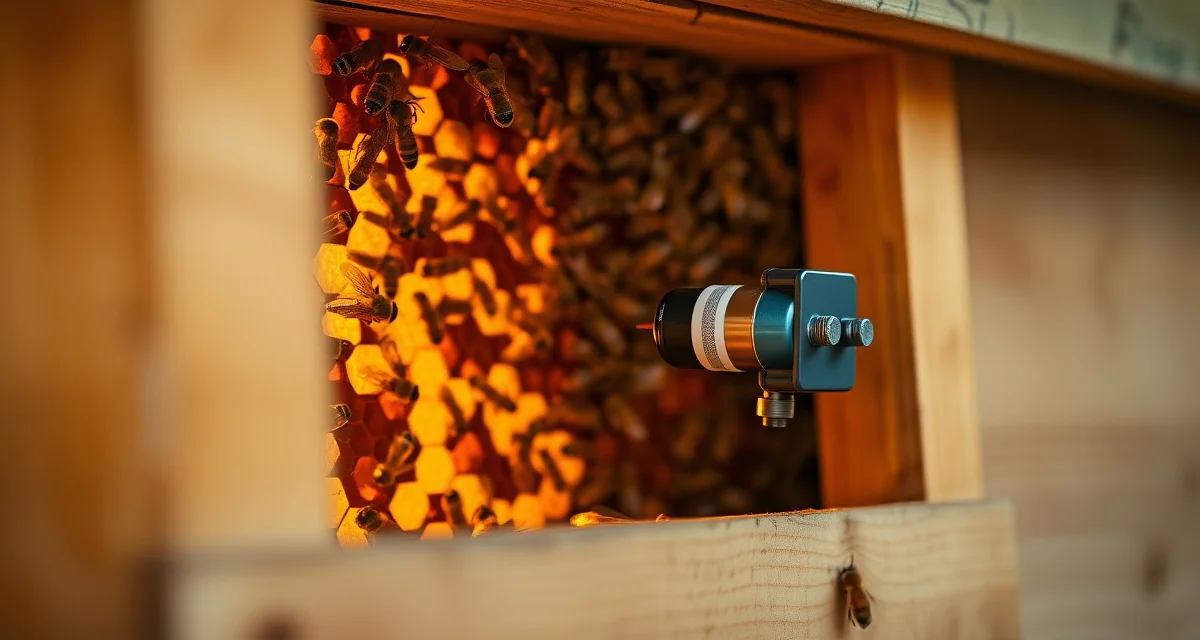
- Acoustic sampling devices are placed at strategic points within a yard (not one per hive, but positioned to capture aggregate yard-level acoustic data from nearby colonies)
- AI signal processing analyzes the acoustic data against trained models built from thousands of hours of labeled colony sound data
- Anomaly detection flags acoustic patterns consistent with queen loss, pre-swarm states, or population decline
- Alerts are delivered to the platform (and optionally by push notification to mobile) with the affected yard identified
- Crew dispatch is prioritized based on acoustic alerts rather than fixed-rotation scheduling
For a 20-yard operation, acoustic monitoring converts inspection scheduling from calendar-based to event-triggered. Crews go where the data says attention is needed.
The Commercial Value Case
Consider a 1,000-hive operation with 15 active yards. Without acoustic monitoring:
- Average visit frequency: once every 2–3 weeks per yard
- Time between queen-loss event and detection: up to 3 weeks
- At 3 weeks post-queen-loss: the colony has begun laying-worker spiral, no viable queen cells (if not started promptly), population in serious decline
- Recovery cost: $30–60 for a new queen, 6–8 weeks to rebuild to contract-worthy strength, or write the colony off
With acoustic monitoring:
- Queen loss detected within 48–72 hours
- Crew dispatched on next available day (within 1 week of event)
- Emergency queen cells or mated queen installed
- Colony maintains adequate population, recovers to full strength before next contract delivery
- Recovery cost: same $30–60 queen, but the colony is salvaged
For an operation losing 10–15% of hive value annually to undetected queen problems, reducing that detection window from 3 weeks to 3 days changes the economics significantly.
Integration With Colony Management
What makes PollenOps' acoustic monitoring useful versus a standalone sensor system is the integration. Acoustic alerts connect directly to:
Yard records: Alert appears in the yard record for the affected location, with timestamp and acoustic pattern type
Contract assignments: If the affected yard is under an active pollination contracts, the alert shows the contract status and delivery timeline
Crew scheduling: Alert generates a recommended visit task that can be assigned directly to a crew
Health documentation: Investigation results (what was found, what action was taken) document directly in the colony health record for that yard
This turns an acoustic signal into an actionable workflow: not just a notification that something might be wrong, but a path from alert to investigation to resolution, all tracked in one place.
What Acoustic Monitoring Doesn't Replace
Acoustic monitoring is an early-warning layer. It doesn't replace:
Physical inspection: When the acoustic system flags a yard, a crew still needs to visit and confirm. Acoustic anomalies have false-positive rates. A brief temperature event or localized disturbance can produce unusual sounds. Confirmation requires eyes on the hive.
Varroa monitoring: Acoustic signatures can suggest colony stress, but they can't count mites. Alcohol wash monitoring remains essential.
Seasonal management decisions: Split timing, super management, winter hive preparation. These require physical assessment.
Think of acoustic monitoring as the sensor layer that tells you which yard to prioritize, not as a replacement for the work that happens at the yard.
Compared to Hardware-Sensor Approaches
Nectar Technologies and similar platforms use physical sensor hardware installed in individual hive boxes. This approach provides precise individual-hive data (temperature, humidity, weight, and audio from that specific colony).
The tradeoffs at commercial scale:
- Hardware must be purchased, installed, maintained, and replaced when damaged
- Sensors on migratory hives face damage from transport and field conditions
- Per-hive sensor cost adds up rapidly at commercial scale
- Data from individual hives must be aggregated to yield yard-level insights
PollenOps' acoustic approach trades individual-hive precision for yard-level coverage without hardware management overhead. For commercial operations where the key question is "which yard needs attention?" rather than "what is the precise temperature in hive 847?", yard-level acoustic monitoring provides the decision-critical information at significantly lower operational cost.
FAQ
How accurate is acoustic colony health monitoring?
Commercial deployments of AI acoustic monitoring have demonstrated 80–90%+ accuracy for detecting queen loss events compared to physical inspection confirmation. False positive rates vary by deployment environment, as acoustic interference from wind, road noise, or nearby equipment can affect signal quality. The practical approach for commercial operations is to treat acoustic alerts as high-priority investigation triggers, not definitive diagnoses. An alert that generates a crew visit that confirms a healthy queenright colony has a low cost (the visit time). An alert that was ignored and the colony was queenless for 3 weeks has a much higher cost. The asymmetry favors responding to alerts.
Does acoustic monitoring work in outdoor yard environments?
Yes, with appropriate sensor placement and signal processing. Outdoor deployment requires weather-resistant hardware and acoustic processing algorithms that filter out environmental noise. Wind, rain, and traffic noise create interference that must be distinguished from colony acoustic signals. PollenOps' system is calibrated for outdoor yard deployment conditions common in commercial migratory beekeeping, not laboratory conditions. Performance is best in relatively quiet yard environments and degrades in high-noise locations (near roads, industrial facilities).
Can acoustic monitoring detect varroa mite infestation?
Acoustic monitoring can detect stress signatures consistent with high varroa loads. Colonies under mite pressure show distinct acoustic profiles in some research contexts. However, acoustic signals alone cannot provide mite count data equivalent to an alcohol wash. Think of acoustic indicators of stress as a prompt to conduct a varroa wash on that yard, not as a replacement for the wash. The combination of acoustic monitoring (early stress detection) and systematic mite washing (quantitative confirmation) provides better varroa management visibility than either approach alone.
What are the early warning signs of a queenless colony?
Early signs of queen loss include increasing worker agitation during inspection, scattered or absent brood in colonies that previously had solid laying patterns, and the presence of emergency queen cells (often built on the face of comb, not at the bottom) within 24-72 hours of queen loss. Within 1-2 weeks, population begins declining as no new workers emerge, and the colony may show a characteristic 'roaring' sound when the hive is approached. Acoustic monitoring can detect this sound signature within 24-48 hours of queen loss.
How do you prioritize inspection visits across a large number of yards?
Prioritization should be based on available data signals: acoustic alerts, recent treatment history, colonies known to have been in poor condition at last visit, and contract delivery proximity. Operations that inspect on a fixed rotation schedule (every 2-3 weeks per yard regardless of condition) are less efficient than those that allocate inspection time based on which yards most need attention. Management software that surfaces flagged yards based on health data or contract timelines supports data-driven scheduling.
What is the difference between colony strength and colony health?
Colony strength refers to population size, typically measured in frames of bees. Colony health refers to the biological condition of the colony: queen viability, disease and pest burden (especially varroa), nutritional status, and behavioral normality. A colony can be large but unhealthy (high population maintained through resistance or temporary forage despite high mite loads), or small but healthy (recently split, low mite load, young queen). Contracts specify strength; health affects whether the colony can maintain that strength through the contract period.
Try These Free Tools
Sources
- USDA Agricultural Research Service
- Bee Informed Partnership
- American Beekeeping Federation (ABF)
- Project Apis m.
- Pennsylvania State University Apiculture Program
Get Started with PollenOps
Early detection of colony problems is one of the highest-leverage actions a commercial beekeeper can take. PollenOps health monitoring tools connect acoustic alerts, inspection records, and treatment logs to your contract and crew management so every flagged issue has a clear response path.