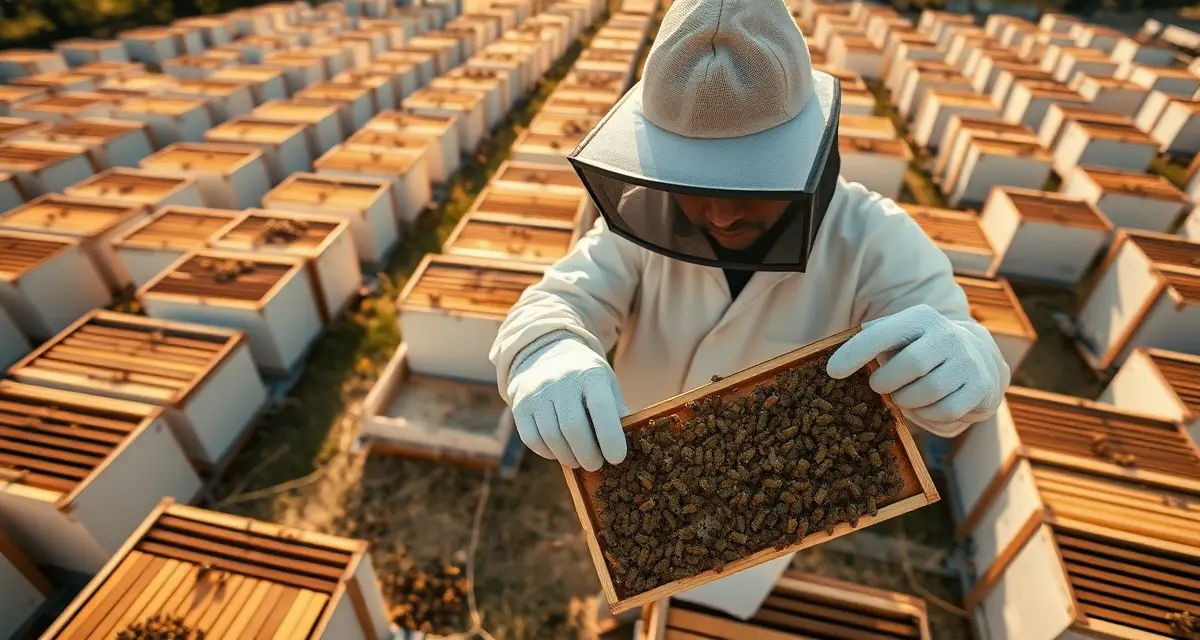
Varroa Management for Large Commercial Beekeeping Operations
At 1,000 hives, you can't run varroa management the way a hobbyist does. You don't have time to do individual alcohol washes on every colony before every treatment decision. You need protocols that work across hundreds of hives simultaneously, monitoring that gives you yard-level data, treatment schedules that fit your calendar, and documentation that satisfies grower requirements and state inspectors.
Here's how to build a varroa management system that works at commercial scale.
TL;DR
- Varroa and varroa-vectored viruses are the leading cause of commercial colony loss, with the Bee Informed Partnership reporting 30-40% annual winter losses nationally.
- At $200-300 per hive replacement cost, a 30% loss on 1,000 hives costs $60,000-90,000.
- Fall varroa treatment is the highest-stakes window: colonies entering winter with high mite loads have significantly elevated mortality.
- For almond-bound colonies, December treatment followed by a January mite wash monitoring confirming below 1 mite per 100 bees is increasingly standard.
- Rotation between treatment classes (amitraz, oxalic acid, formic acid) prevents resistance development that reduces efficacy over time.
Why Varroa Management Is Your Biggest Single Risk
More commercial hives are lost to varroa-related collapse than to any other single cause. The Bee Informed Partnership's annual surveys consistently show 30–40% winter losses in US commercial operations, with varroa and varroa-vectored viruses (DWV, sacbrood, acute bee paralysis virus) implicated in the majority.
At $200–300/hive replacement cost, a 30% winter loss on 1,000 hives costs $60,000–90,000. A 40% loss year can wipe out an entire season's pollination profit.
Managing varroa systematically, not reactively, is the difference between profitable operations and breakeven ones.
The Monitoring Problem at Scale
At 1,000 hives, you can't alcohol-wash every colony before every treatment cycle. You need a statistical sampling approach:
Sample size per yard: Wash 10% of colonies per yard, minimum 5 colonies, selecting colonies across the strength spectrum (not just the strongest, not just the weakest). This gives you a representative yard average with acceptable confidence.
Frequency:
- April–May: baseline pre-season check
- June: post-spring-build check
- August: critical pre-fall assessment, this is the one that matters most
- October: post-treatment verification
Threshold: Most commercial operators use a 2-mite-per-100-bees treatment threshold. At 3+ mites/100, treat immediately regardless of season. For colonies going to California almonds in February, target below 1 mite/100 at December assessment.
Documentation: Record wash results by yard, date, and assessor. This creates the historical data you need to identify chronically high-mite yards (often a local forage problem, high drift rates, or robbing bringing mites from collapsing colonies nearby).
Treatment Protocols by Season
Fall Treatment (September–November), Most Important
Fall is your highest-stakes varroa treatment window. The bees raised in October and November are the bees that will winter and then constitute your almond delivery population. Mite-infected winter bees have shortened lifespans and higher virus loads, they don't make it to February in the numbers you need.
Protocol:
- Pull honey supers (no approved varroa treatment can be applied with supers on for harvest)
- Assess mite loads across 10% of each yard
- Treat yards above threshold immediately, don't wait
- For colonies destined for California almonds: treat all colonies regardless of threshold count, targeting the broodless or reduced-brood window
Best treatments for fall:
Oxalic acid vaporization (OAV): Most effective during the broodless period (typically October–November in northern states). Kills phoretic mites (mites on bees) but not mites in capped cells. Apply multiple times (3–5 vaporizations at 5-day intervals) for maximum efficacy. Cost: $0.50–1.50/treatment per colony.
Apivar (amitraz strips): Effective across brood cycles. Leave in for 6–8 weeks. Cost: $3–5/treatment per colony. Resistance is a growing concern in some regions, rotate with other products.
MAQS (mite away quick strips, formic acid): Can be used with honey supers on in some protocols. Effective but temperature-sensitive, don't apply when temperatures exceed 85°F or fall below 50°F.
Winter Treatment (December–January)
For colonies in the south (Florida, Texas, California) with active brood in winter, OAV applied during reduced-brood periods is useful. Northern-overwintered colonies in broodless clusters: single OAV treatment is highly effective.
For California almond-bound hives: treat in December, confirm by January wash below 1 mite/100.
Spring Treatment (March–May)
Post-almond, assess colonies coming out of the rental period. Many will have elevated mite loads, the concentrated forage, potential pesticide stress, and transport stress create vulnerability. Treat before spring buildup fully kicks in to prevent summer mite explosion.
Summer Treatment (June–August)
Critical: don't ignore summer mite levels. Operations focused on summer honey production often delay fall treatment until after the honey run. If mites reach 3+ per 100 bees by July, the colony is compromised going into fall regardless of what you do later.
OAV in summer is challenging because colonies rarely have true broodless periods. Consider MAQS or Apivar in July–August for colonies with elevated loads.
Large-Scale Treatment Efficiency
OAV setup: Commercial-scale OAV requires an efficient vaporizer setup. Battery-powered vaporizers (like Varrox Edge or Pro Vap) treat one colony in 2–3 minutes. A crew of 2 can treat 100–150 colonies per day. For 1,000 hives, plan 7–10 crew-days per treatment cycle.
Strip treatments (Apivar, MAQS): Faster to apply than OAV, can treat 200–300 colonies/day with a 2-person crew. But require accurate timing for removal (Apivar strips must come out after 6–8 weeks).
Crew training: Everyone applying treatments needs to understand correct dosage, application method, and recording requirements. Incorrect OAV dosage is a common error, too little is ineffective, too much risks killing bees.
Record keeping: Document every treatment: product, date, dosage, applying crew member, and post-treatment mite wash result. This creates the compliance record for state inspection and grower contract verification.
Resistance Management
Amitraz (Apivar) and tau-fluvalinate (Apistan) resistance has been documented in varroa populations in the US. Resistance develops when colonies are repeatedly treated with the same product class.
Rotation protocol: Alternate treatment classes. Don't use Apivar for every treatment cycle in every yard. Integrate OAV, formic acid products (MAQS/formic pro), and oxalic acid into a rotation schedule.
Indicator: If a treatment that previously drove mite counts down stops working at the same dose, suspect resistance. Send samples to a state or university diagnostic lab for confirmation.
FAQ
How often should you treat for varroa in a commercial operation?
Commercial operations typically run 2–3 varroa treatment cycles per year: fall (September–November, the most important window), spring (March–May post-almond or early season), and sometimes a summer cycle for high-mite yards. The exact schedule depends on your circuit, what crops your hives are on, and when honey supers are on or off. The fall cycle is non-negotiable, colonies that go into winter with high mite loads have significantly higher mortality. For almond-bound colonies, a December treatment to confirm sub-threshold mite levels before California delivery is increasingly standard practice.
What is the best varroa treatment for large commercial operations?
No single treatment is universally best, effective commercial operations rotate between products to prevent resistance. Oxalic acid vaporization is cost-effective and highly efficacious during broodless periods, making it excellent for fall treatment of northern-overwintered colonies. Apivar (amitraz strips) works well across brood cycles for operations that need to treat during active brood rearing. MAQS (formic acid) can be applied with honey supers in some temperature conditions and provides good efficacy. The best protocol for large operations combines seasonal OAV with rotation through other product classes, never relying solely on one active ingredient across all treatment cycles.
How do you document varroa management for commercial contracts?
Documentation for commercial contract compliance should include: yard identifier, date of mite assessment, number of colonies sampled, individual and average mite counts, treatment product and dosage applied, date of treatment application, and crew member who applied treatment. Post-treatment verification wash results (ideally 3–4 weeks after treatment) demonstrate treatment effectiveness. For California almond contracts that require Varroa certification, your state apiary inspector will want to see that mite loads are below the state threshold, your internal records should support this certification. PollenOps includes structured varroa documentation tools that generate records meeting commercial contract and inspection requirements.
What mite count threshold triggers treatment in commercial operations?
Most commercial operators use a 2-mite-per-100-bees threshold for treatment decisions during the active season. At 3 or more mites per 100 bees, treat immediately regardless of season. For colonies destined for California almond contracts in February, the target is below 1 mite per 100 bees at December assessment, which is stricter than general treatment thresholds. The December target reflects the need for winter bees to survive at full viability through February.
Can organic-certified colonies be treated for varroa?
Organic honey certification has specific treatment restrictions. Oxalic acid and formic acid (MAQS, Formic Pro) are permitted for use in organic-certified operations. Apivar (amitraz) and Apistan (tau-fluvalinate) are synthetic miticides not compatible with organic certification. For operations pursuing organic honey premiums, building a varroa management protocol around approved products is required. Some organic pollination contracts also specify treatment restrictions; review contract language carefully.
What is the difference between commercial and hobby beekeeping?
Commercial beekeeping is distinguished by scale (typically 100+ hives, often 500-5,000+), revenue source (pollination contracts and bulk honey sales rather than local honey retail), and management approach (systematic protocols applied across yards rather than individual colony attention). Commercial operators manage bees as an agricultural enterprise, with the administrative, regulatory, and logistical complexity that entails. Most commercial operators derive the majority of their income from pollination services; honey production is a supplementary revenue stream.
Try These Free Tools
Sources
- USDA Agricultural Research Service
- Bee Informed Partnership
- American Beekeeping Federation (ABF)
- Project Apis m.
- Pennsylvania State University Apiculture Program
Get Started with PollenOps
Varroa management at commercial scale requires documentation that satisfies growers, state inspectors, and your own year-over-year analysis. PollenOps structures mite monitoring records, treatment logs, and yard-level history so the data you need is there when you need it.