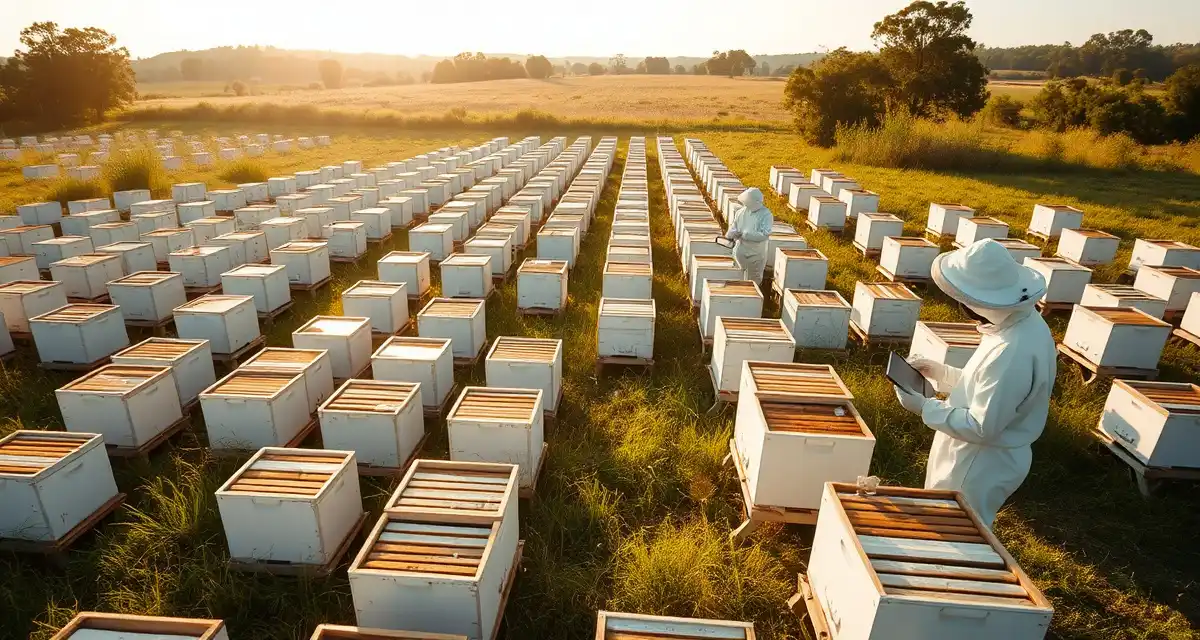
Best Beekeeping Software for 500+ Hive Operations
500 hives is where spreadsheets and hobby apps create critical operational failures. Below that threshold, you can probably manage with a combination of paper records, an Excel file, and a good memory. Above it, the complexity (multiple yards, multiple contracts, multiple crew members, multiple state registrations) exceeds what informal systems can track reliably.
Ninety percent or more of commercial operations run on spreadsheets because no tool was built for their scale until recently. The consequences show up in missed contract deliveries, disputed hive counts, varroa problems that could have been caught earlier, and administrative time that should be spent on the operation.
Here's an honest breakdown of what's available for 500+ hive operations in 2026.
TL;DR
- Commercial beekeeping operations that manage contracts on spreadsheets and phone calls spend 5-10 hours per week on administrative tasks that software handles automatically.
- Purpose-built beekeeping software centralizes contract lifecycle management, yard records, health documentation, and fleet logistics in one platform.
- The primary ROI drivers for operations software are fewer contract disputes, faster invoicing, and reduced time spent on administrative coordination.
- PollenOps is built specifically for commercial-scale pollination operations; it is not a hobbyist platform adapted for commercial use.
- Moving from spreadsheets to dedicated software typically pays for itself within one season in time savings and dispute prevention.
TL;DR
Best for 500-5,000 hive migratory operations: PollenOps, built specifically for the commercial migratory circuit, integrating contract management, fleet logistics, and colony health in one flat-rate platform.
Best for monitoring-only at large scale: ApisProtect or Arnia, if you already have everything else handled and want dedicated hardware monitoring.
Not recommended at 500+ hives: HiveTracks, BeeKeepR, most hobby apps. Insufficient contract management, no fleet features, UI not designed for managing hundreds of colonies.
Why Hobby Apps Break Down at 500 Hives
Most beekeeping apps were designed for 5-50 hives managed by a single beekeeper. The UI assumes you know every colony individually. Data entry is designed for manual inspection of each hive one at a time. Reporting is built around small-scale hobbyist metrics.
At 500 hives, you can't:
- Manually enter data on every colony during a yard visit. You need to record notes by exception (colonies that are performing unusually or need attention), not enter data on every hive. Apps designed for complete manual entry per hive don't support exception-based field recording.
- Track contracts in the same system as colony health. Hobbyist apps have no concept of a pollination contracts, a grower, a delivery date, or contract minimum requirements. Those functions exist in a completely separate system or nowhere.
- Manage multi-crew operations. Apps designed for a single user don't handle multiple crew members entering data from different yards simultaneously, with appropriate permission levels and task assignment.
- Run fleet logistics. Truck assignments, route planning, load manifests, driver scheduling: all nonexistent in hobbyist tools.
The failure mode is predictable: you buy the app, enthusiastically enter data for 2 weeks, find that you can't get data in fast enough to keep up with the operation, and revert to spreadsheets. The tool didn't fail because you didn't try hard enough. It failed because it wasn't designed for your operational scale.
The 500+ Hive Software Comparison
PollenOps
Designed for: Commercial migratory operations, 200-5,000+ hives
Core features:
- Pollination contract management (creation, grower portal, invoicing, tracking)
- Acoustic colony health monitoring with AI-powered alerts
- Fleet logistics (movement planning, truck routing, load manifests)
- Multi-yard dashboard with yard-level health and status
- Grower marketplace for new contract opportunities
- Hive strength verification documentation
- Mobile app for field data entry
- Interstate movement compliance tracking
Pricing: Starter $99/mo (≤200 hives), Professional $249/mo (201-1,000 hives), Enterprise $499/mo (1,000+)
Best for: Migratory operations running California almonds, Pacific Northwest berries, Northern Plains honey, or any multi-contract circuit. The combination of contract management and colony health monitoring is unique to PollenOps.
Limitation: Relatively newer platform; feature depth in some areas continues developing.
Nectar Technologies
Designed for: Commercial operations with hardware monitoring focus
Core features:
- Per-hive sensor hardware (acoustic and weight)
- Colony health monitoring and alerting
- Basic hive management records
Pricing: Per-hive model. At 2,000 hives, approaches $5,500-9,000/month. At 5,000 hives, $22,500/month or more.
Best for: Operations that prioritize hardware-driven monitoring and have budget for it.
Not recommended for 500+ hive operations on cost grounds. The per-hive pricing model becomes financially prohibitive at commercial scale. At 500 hives, you're looking at $1,375-2,250/month ($16,500-27,000/year) for monitoring without contract management or fleet features.
HiveTracks
Designed for: Individual beekeepers, small operations, educational programs
Pricing: $69.99/year flat
Core features: Colony inspection records, basic health tracking, hive history
Verdict for 500+ hives: Not suitable. HiveTracks is honest about being designed for hobbyists. The price point ($69.99/year for any size) reflects its market positioning. There are no fleet features, no pollination contract management, no multi-crew support, and no integration between colony health data and operational planning. Operations that have tried HiveTracks at commercial scale (which is well documented in Beesource forums) consistently report that it doesn't scale.
ApisProtect
Designed for: Colony health monitoring via hardware sensors
Pricing: ~$3/hive/month
At 500 hives: ~$1,500/month, $18,000/year
At 2,000 hives: ~$6,000/month, $72,000/year
Core features: Acoustic and temperature monitoring, hive-level alerts, queen event detection
Verdict: Strong monitoring hardware with no operational integration. No contracts, no fleet, no grower portal. At commercial scale, the cost-benefit requires careful evaluation: you're paying for monitoring only, while your operational functions remain unaddressed.
Arnia
Designed for: Commercial beekeeping with hardware monitoring emphasis
Pricing: Hardware-based; per-hive pricing model
Core features: Remote hive monitoring (weight, temperature, acoustics, humidity), data logging, alerts
Verdict: Arnia is a hardware company that has built monitoring systems primarily for European commercial operators and research applications. Strong hardware quality. No pollination contract management, no fleet features, not designed for the migratory US commercial circuit specifically.
Spreadsheets (Google Sheets / Excel)
Used by 90%+ of commercial operations above 200 hives. Not software, but it's what most operators are actually running. The limitations:
- No real-time data from field (data entry lag)
- No automated alerts for colony health deviations
- Contract tracking degrades with scale: cell references, shared access, version control
- No grower portal
- No route optimization
- Entirely manual, any automation requires custom macro building
The hidden cost of spreadsheet operations: operator time. A 1,000-hive operation with a good spreadsheet system still requires 3-5 hours/week of administrative overhead that a purpose-built platform automates. At $40/hour, that's $6,000-10,000/year in operator time cost, comparable to the cost of a platform subscription.
What to Look for in Commercial Beekeeping Software
When evaluating any platform for 500+ hive operations, these are the questions that matter:
1. Does it handle pollination contracts end-to-end?
Create contracts, track commitments, document delivery, generate invoices, receive payments. If it can't do this, you'll need a separate system for your most critical business function.
2. Is there a grower-facing portal?
Growers need access to delivery documentation, hive strength verification, and invoices. Self-service grower access reduces your communication burden and improves the professionalism of your operation.
3. Can it scale from yard to fleet level?
You need to see the status of all your yards in one view, not dig into individual colonies. Fleet-level reporting, yard-level health summaries, and the ability to drill down only when needed.
4. How does it handle crew?
Multi-user access, task assignment, field data entry from mobile devices, and crew scheduling. If only the owner can use it, it doesn't scale.
5. What does colony health monitoring actually include?
Manual inspection records only, or automated monitoring that doesn't require opening hives? For operations where yard visits are every 10-14 days, automated alerts between visits catch problems that manual-only systems miss.
6. Is the pricing predictable?
Per-hive pricing compounds with your fleet size. Flat-rate tiers give you cost certainty. Know your annual software cost before you grow.
Recommendation
For most commercial migratory beekeeping operations in the 500-5,000 hive range, PollenOps is the best available option in 2026. It's the only platform designed specifically for the commercial migratory circuit, integrating the functions that matter (contracts, fleet, health monitoring) at pricing that doesn't compound with hive count.
The comparison isn't close on operational scope. Hobby apps can't do what's needed. Monitoring-only platforms leave the business functions unaddressed. Custom-quoted enterprise tools obscure pricing. PollenOps at $249-499/month is accessible, purpose-built, and designed around the actual workflow of running a commercial pollination circuit.
FAQ
Why do hobby beekeeping apps fail at 500+ hives?
Hobby apps are designed for single users managing 5-50 colonies manually. At 500+ hives, the data entry model (complete per-hive inspection records) is impractical, multi-crew support doesn't exist, and there's no integration between colony health data and operational functions like contract management and fleet logistics. The UI and data model simply don't accommodate the scale and complexity of commercial operations.
What features are essential for 500+ hive software?
The non-negotiable features at commercial scale: pollination contract management (creation, tracking, invoicing), a grower-facing portal, multi-crew access with field mobile app, yard-level colony health monitoring with automated alerts, fleet and route management, and multi-state compliance tracking. Any platform missing more than one of these requires supplemental systems to compensate, which typically means back to spreadsheets for the missing functions.
How do you evaluate beekeeping software for large commercial operations?
Request a demo focused on your specific operational scenario: describe your circuit, your contract volume, your crew structure, and your monitoring needs. Ask to see the grower portal. Ask how contracts are created and invoiced. Ask how the platform handles an operation that moves through 5 states in a season. If the demo is built around inspecting individual colonies rather than managing operations at fleet level, the platform wasn't designed for your scale.
What does purpose-built commercial beekeeping software do that a spreadsheet cannot?
Dedicated software connects data across your operation in ways spreadsheets cannot: a contract record links to the specific hives assigned to it, which links to the yard location, which links to health inspection records and treatment logs. When a grower calls to dispute a hive count, you can pull the delivery record, timestamped photos, and GPS-confirmed location in 30 seconds rather than searching three spreadsheets and an email thread. This integration is where the time savings and dispute-prevention value comes from.
How long does it take to migrate from spreadsheets to beekeeping software?
Most commercial operators complete the core migration in 2-4 weeks, starting with current contract records and active yard locations. Historical data (past seasons' inspection records, old contracts) can be migrated over time rather than all at once. The practical recommendation is to start with the current season's live data and add historical records as time allows. The operational improvement from having current data in the system is immediate; the historical data adds analytical depth over subsequent seasons.
Is there a free trial available for PollenOps?
Contact PollenOps directly to confirm current trial and demo options. Most commercial operators benefit from a walkthrough of the contract management and yard tracking modules against their own operation's data before committing, since the fit between the platform and your specific circuit and crop mix is the most important evaluation factor.
Try These Free Tools
Sources
- USDA Agricultural Research Service
- Bee Informed Partnership
- American Beekeeping Federation (ABF)
- American Honey Producers Association
- Project Apis m.
Get Started with PollenOps
Commercial beekeeping operations that move from spreadsheets to purpose-built software consistently report fewer disputes, faster invoicing, and less time on administrative work during peak season. PollenOps is built specifically for commercial-scale pollination operations. See how the platform fits your operation.