Package Bees vs Nucleus Colonies: Economics for Commercial Beekeepers
At 1,000 hives, a 30% annual replacement rate means 300 new colonies needed each year. How you source those 300 replacements (packages or nucleus colonies) affects your cost structure, your winter survival rates, and how well your replacement colonies perform in the following pollination season. It's not a hobbyist question about which is easier. It's a business decision with real numbers.
Nucs show 20-30% better winter survivability than packages in most controlled comparisons, but they cost 2-3x more upfront. The math isn't always as simple as it looks. The right answer depends on your operation's timing, cash flow, and where you're using replacement colonies.
TL;DR
- Commercial beekeeping operations that manage contracts on spreadsheets and phone calls spend 5-10 hours per week on administrative tasks that software handles automatically.
- Purpose-built beekeeping software centralizes contract lifecycle management, yard records, health documentation, and fleet logistics in one platform.
- The primary ROI drivers for operations software are fewer contract disputes, faster invoicing, and reduced time spent on administrative coordination.
- PollenOps is built specifically for commercial-scale pollination operations; it is not a hobbyist platform adapted for commercial use.
- Moving from spreadsheets to dedicated software typically pays for itself within one season in time savings and dispute prevention.
The Core Difference
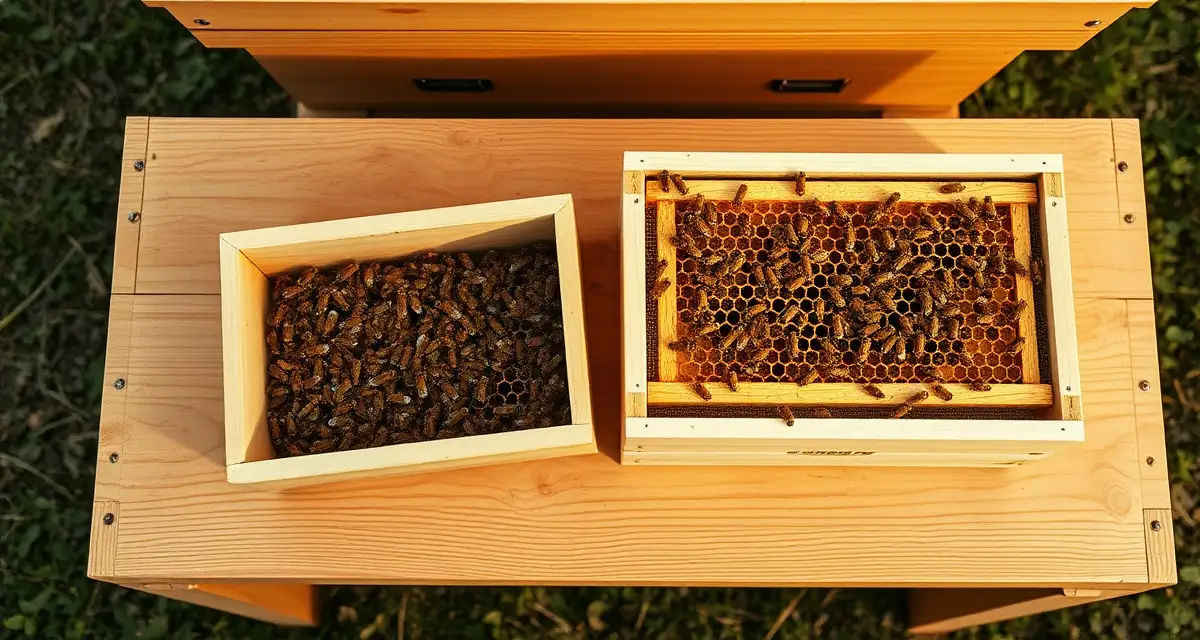
A package is 2-3 pounds of adult worker bees (roughly 7,000-10,000 bees) plus a mated queen in a cage. No drawn comb, no brood, no stores. It's bees and a queen in a screened box. Packages are shipped in late winter and early spring, typically March-April in the South and April-May further north.
A nucleus colony (nuc) is a small established colony: 4-5 frames of comb with drawn foundation, frames of eggs and brood in various stages, a laying queen, and enough bees to cover those frames. Nucs come with 3-5 frames of bees (real field bees plus nurse bees) and all the resources a colony needs to grow immediately without the establishment lag.
The difference in starting point matters enormously when you're trying to build to 6-frame pollination strength on a specific schedule.
Cost Comparison at Scale
Package pricing (2026): 3-lb packages typically run $130-165 each, depending on supplier, region, and order size. At 300 replacements, that's $39,000-49,500 for your package buy.
Nuc pricing (2026): 4-5 frame nucs from established commercial suppliers run $175-245 each, with significant regional variation. California nucs built off almond-season splits run on the lower end; premium nucs from queen-focused operations in the Southeast run higher. At 300 replacements, that's $52,500-73,500.
The upfront cost difference: $13,500-24,000 at 300 replacements. That's real money. But survivability changes the math.
If packages show 35-40% first-year mortality (a realistic figure for winter survival in northern climates) and nucs show 10-15%, your effective cost per surviving colony changes significantly. At 300 replacements:
- Packages at 37% mortality: ~190 surviving colonies. Effective cost per survivor: $205-260
- Nucs at 12% mortality: ~264 surviving colonies. Effective cost per survivor: $200-278
The survivability advantage of nucs largely offsets the higher upfront cost when you're buying at scale and calculating the actual cost per surviving producing unit. Where nucs pull ahead economically is in the second and third year: better-established colonies with drawn comb build faster, produce more honey, and carry higher pollination value.
Timing Constraints
Packages arrive in early spring. For operations targeting almond pollination the following February, a March package buy gives you 10-11 months to build colonies to 6-frame pollination strength. That's workable but tight. A package installed in March will build through summer, need varroa management in August, potentially need a fall requeen, and winter. What emerges in January needs to be at 6-frame strength.
Operations with aggressive management (good queens, systematic protein feeding, fall varroa treatment) consistently hit this target. Operations that are stretched thin across too many hives for their crew size don't.
Nucs installed in March-April start with a 4-6 week head start on packages. That advantage compounds: they expand faster in spring, build more honey, and enter winter in stronger condition. For a California almond contract that requires 6-frame delivery by February 5, a nuc started in April has more margin than a package started in March.
Availability is the practical constraint on nucs. Quality nucleus colonies from reputable commercial producers sell out 6-12 months in advance. If you decide in January that you want 300 nucs for March delivery, you're probably not getting them from the top-tier suppliers. Package suppliers can often fulfill larger last-minute orders because their model is designed for volume production.
When to Use Packages
Packages are the right choice when:
- You need volume fast and nuc supply isn't available
- Your replacement colonies are going into summer builds for September-December pollination (cucumbers, melons, clover seed) where the timing pressure is less than almonds
- You're replacing colonies in strong forage areas where rapid buildup compensates for the late start
- Cash flow constraints make the lower upfront cost determinative
For an operation that runs the Southeast spring circuit (early fruit pollination in March-April, then moving north for summer honey flows) packages installed in February can hit productive strength by late spring. The almond-or-bust calendar is what makes package timing tight; other circuits are more forgiving.
When Nucs Make More Sense
Nucs are worth the premium when:
- Replacement colonies need to be pollination-ready by the following February
- You're rebuilding after significant winter losses and need to recover quickly
- You're scaling the operation and need colonies that will be at full production within 60-90 days
- You're in a northern climate where packages have historically shown high first-year losses
For an operation that lost 20% of its fleet to a hard North Dakota winter and has almond contracts to fill by February 1, getting nucs in May instead of packages in April means the difference between colonies that make contract strength and colonies that don't.
Building Your Own Nucs from Splits
The most economical source of replacement nucleus colonies is your own operation. Splitting strong colonies in late spring (after almond season and before summer honey flows) produces nucs at a fraction of the commercial purchase price. A strong 10-12 frame colony can be split 2-3 ways with a purchased queen to create nucs that build through summer and are ready for almond season the following February.
At 1,000 hives, splitting 15-20% of your strongest colonies in May produces 150-200 replacement nucs. Add purchased queens (commercial production queens run $25-45 each) and your replacement cost per nuc from splits is around $50-80 versus $200+ purchased. At scale, this is the economics that separates profitable migratory operations from those that struggle with replacement costs.
The catch: splitting requires management time and suppresses honey production in split colonies during buildup. You're trading summer honey income for cheaper replacement colonies. Most operations that model this out find the trade favorable, but it depends on your honey flow timing and whether your crew has capacity for spring split management.
Colony Replacement Rate and Fleet Economics
The 30% annual replacement figure is an industry average that masks wide variation. Operations with strong varroa management, consistent requeening, and limited pesticide exposure show 15-20% annual replacement needs. Operations that stretch management, skip fall treatments, or take their colonies through back-to-back pollination contracts without recovery time run 40-50%.
At 1,000 hives, the difference between 20% and 40% annual replacement is 200 additional colonies per year. At $200 per nuc, that's $40,000 per year in additional replacement cost, on top of the labor, equipment, and trucking costs of managing that many additional replacements. Getting your replacement rate down is one of the highest-return management investments you can make.
Track replacement rates by year, by wintering location, by yard, and by colony source. You'll find patterns. Colonies from certain queen lines winter better. Yards in certain locations have worse spring populations. That data helps you make sourcing decisions and spot problems before they compound.
Practical Purchasing Considerations
Whether you're buying packages or nucs, order early. Large commercial package producers (including major operations in Georgia, California, and Hawaii) fill orders on a first-come basis. For March delivery, order in September-October. Quality nuc producers are often sold out by November for spring delivery.
Relationship matters in this supply chain. The same package producers who sell out their best stock in advance will often hold inventory for customers they've worked with for years. Show up on time, pay promptly, and don't call on short notice. That's what gets you prioritized in short-supply years.
Have a backup source. If your primary package supplier has a disease problem or a weather event that wipes out their production, you need a second call to make. Keep two or three supplier relationships active even if you only use one in most years.
FAQ
Are packages or nucs better for commercial operations?
Neither is universally better. It depends on your timing, cash flow, and circuit. Nucs offer 20-30% better survivability and faster buildup, making them the better choice for operations that need pollination-ready colonies by February. Packages offer lower upfront cost, greater availability, and sufficient performance for circuits with more flexible timing. Many large commercial operations use both: nucs for almond replacements, packages for summer or fall circuit rebuilds.
What is the cost difference between packages and nucs at scale?
In 2026, 3-lb packages run $130-165 each while quality 4-5 frame nucs run $175-245. At 300 replacements, that's a $13,500-24,000 upfront difference. When you factor in the 15-25% better survivability of nucs, the effective cost per surviving colony narrows considerably. The biggest economic advantage of nucs is in the second year: better-established colonies with drawn comb produce more honey and carry higher contract value faster.
How does colony replacement rate affect profitability at 1000 hives?
Annual replacement rate is one of the most powerful levers in the economics of a large commercial operation. At 1,000 hives, moving from a 35% replacement rate to 20% through better varroa management, consistent requeening, and optimized wintering saves roughly $30,000-60,000 per year in replacement colony costs alone, before accounting for the labor and logistics of managing replacement colonies. Tracking your replacement rate by year and by source is how you identify what's working and what's costing you.
What does purpose-built commercial beekeeping software do that a spreadsheet cannot?
Dedicated software connects data across your operation in ways spreadsheets cannot: a contract record links to the specific hives assigned to it, which links to the yard location, which links to health inspection records and treatment logs. When a grower calls to dispute a hive count, you can pull the delivery record, timestamped photos, and GPS-confirmed location in 30 seconds rather than searching three spreadsheets and an email thread. This integration is where the time savings and dispute-prevention value comes from.
How long does it take to migrate from spreadsheets to beekeeping software?
Most commercial operators complete the core migration in 2-4 weeks, starting with current contract records and active yard locations. Historical data (past seasons' inspection records, old contracts) can be migrated over time rather than all at once. The practical recommendation is to start with the current season's live data and add historical records as time allows. The operational improvement from having current data in the system is immediate; the historical data adds analytical depth over subsequent seasons.
Is there a free trial available for PollenOps?
Contact PollenOps directly to confirm current trial and demo options. Most commercial operators benefit from a walkthrough of the contract management and yard tracking modules against their own operation's data before committing, since the fit between the platform and your specific circuit and crop mix is the most important evaluation factor.
Try These Free Tools
Sources
- USDA Agricultural Research Service
- Bee Informed Partnership
- American Beekeeping Federation (ABF)
- American Honey Producers Association
- Project Apis m.
Get Started with PollenOps
Commercial beekeeping operations that move from spreadsheets to purpose-built software consistently report fewer disputes, faster invoicing, and less time on administrative work during peak season. PollenOps is built specifically for commercial-scale pollination operations. See how the platform fits your operation.