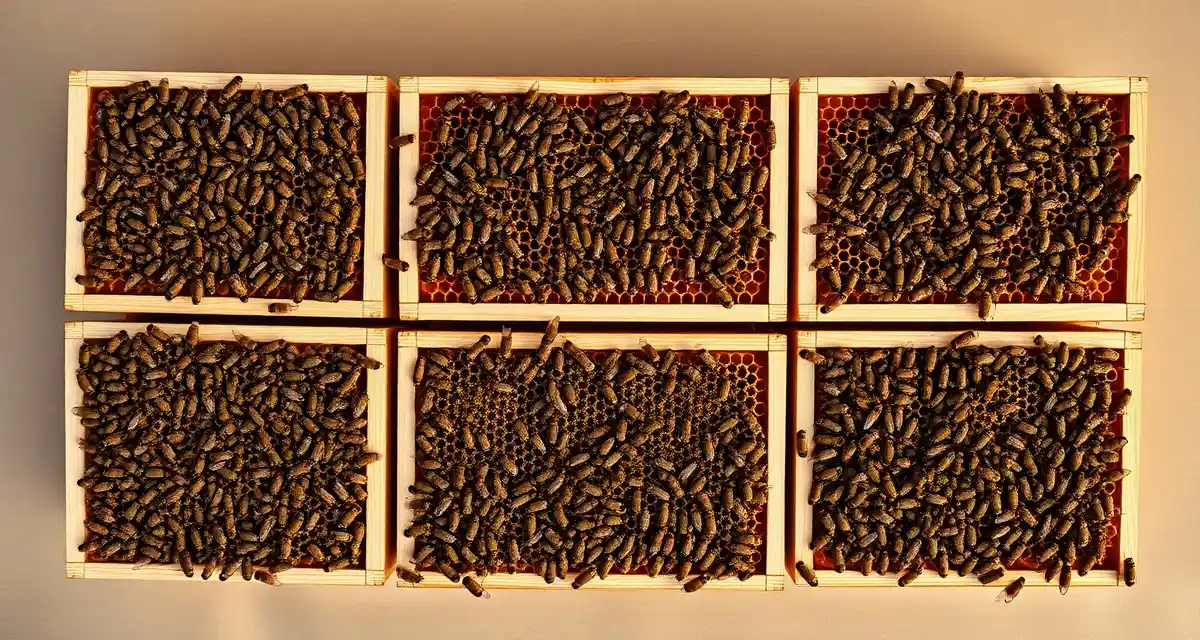
Colony Strength Requirements by Crop
Every pollination crop has different strength requirements, and growers are getting more precise about what they expect. Here's a practical reference for the frame count standards you'll encounter across commercial pollination crops.
TL;DR
- The California Almond Board's research supports 6 frames of bees as the minimum effective colony strength for almond pollination.
- Many growers now specify 8 frames for premium contracts, with rates at $200-215/hive versus $185-195 for 6-frame minimums.
- Hive strength assessment should be documented by yard, date, and assessor to create a defensible record for contract compliance.
- A colony assessed at the required strength in January can fall below minimum by February delivery if varroa loads are high or weather stress is severe.
- Third-party inspection at delivery is the cleanest resolution for strength disputes and protects operators as well as growers.
Quick Reference: Strength Standards by Crop
| Crop | Frames of Bees | Notes |
|---|---|---|
| Almonds (standard) | 6 frames min | California Almond Board recommendation |
| Almonds (premium) | 8 frames min | Corporate growers, premium rate |
| Blueberry (highbush) | 4–6 frames | Michigan, PNW, NJ |
| Blueberry (lowbush) | 3–4 frames | Maine (earlier in season) |
| Cherry (sweet) | 4–6 frames | Washington, Oregon |
| Cherry (tart) | 4–5 frames | Michigan |
| Apple | 4–6 frames | All regions |
| Cranberry | 4–5 frames | Wisconsin, Massachusetts |
| Avocado | 4–6 frames | California, Florida |
| Watermelon | 4–5 frames | All regions |
| Cucumber | 3–5 frames | All regions |
| Clover seed | 5–6 frames | Oregon, Northwest |
| Sunflower | 4–5 frames | Plains states |
| Canola | 3–5 frames | Northern states |
Why Almonds Demand the Strongest Colonies
Almonds require the highest strength standards for several reasons. The bloom window is narrow (3–4 weeks) and cross-pollination between Nonpareil and pollinizer varieties requires bees actively moving across rows. A stronger colony deploys more foragers per day, increasing the probability of effective cross-pollination. Research from UC Davis and the Almond Board consistently shows correlation between bee density per acre and almond set rates, and between colony strength and effective forager numbers.
The 6-frame standard was established through field research on set rates versus colony size. The shift toward 8-frame premium standards reflects larger growers wanting the top of that curve.
Why Blueberry Strength Matters More Than the Number Suggests
Blueberry in Maine runs in late May and early June, early in the season when colonies that wintered well may still be building population. A colony at 3–4 frames in Maine in early June is doing adequate work if those bees are healthy and foraging actively.
The same colony in Michigan highbush, which blooms slightly later (mid-May through June), needs 4–6 frames to service the higher-density plantings effectively.
Buzz pollination capability matters here more than for almond. Stronger colonies with more active foragers produce more effective buzz-pollination events per acre per day.
Cherry: Weather Performance Matters
Cherry bloom in the Pacific Northwest is subject to significant weather variability. A colony at 4 frames may be adequate in ideal weather but underperform during the rain and cold periods that are common in April and May in Washington.
Strong colonies (5–6 frames) maintain forager activity more effectively during short weather breaks in an otherwise cool, rainy bloom period. Growers who've had weak set years in bad weather years tend to specify stronger minimums.
Practical Implications
Build to exceed minimums: Delivering exactly at the contracted minimum leaves no margin. Colonies that lose a few frames to transport stress, cold nights, or minor disease issues can fall below contract standard. Target 1–2 frames above the contract minimum.
Document at the source yard, not at delivery: Assess strength at your home or staging yard before loading, not at the grower's field. If a colony is at 5.5 frames at your yard and loses some bees during a 1,000-mile haul, you want a record showing pre-transport strength.
Temperature effects on assessment: Colony frame coverage assessments done below 55°F undercount because bees cluster more tightly in cold. Assess in warm conditions or account for temperature effects in your count.
FAQ
What frame count do almond growers require for pollination?
California almond growers typically require a minimum of 6 frames of covered bees per colony (California Almond Board standard). Many commercial operations (particularly large corporate growers in Kern, Fresno, and Tulare counties) now specify 8 frames minimum for premium contracts, which pay $200–215/hive versus $185–195/hive for 6-frame minimums. Some growers require third-party verification of colony strength at delivery. Always confirm the specific frame count requirement in your signed contract. "Strong colonies" without a number is not a standard.
How does hive strength differ between blueberry and almond contracts?
Almond contracts specify higher frame counts (6–8 frames) than most blueberry contracts (3–6 frames depending on region and variety). This difference reflects both the economic intensity of almond production and the longer rental period. A 3–5 week almond rental with a 2-hive-per-acre density requirement demands peak-performance colonies. Maine lowbush blueberry, where the rental period is shorter and earlier in the season, uses lower strength minimums (3–4 frames) that reflect actual spring colony populations. Michigan and Pacific Northwest highbush blueberry contracts typically specify 4–6 frames, closer to tree fruit standards.
Does colony strength affect pollination effectiveness?
Yes, significantly. Research across multiple crops consistently shows correlation between colony strength (forager population) and pollination effectiveness. For almonds, UC Davis research demonstrates set rate improvements as bee density per acre increases, and per-acre bee density is a function of both hives per acre and forager population per hive. Strong colonies deploy more foragers per day, cover more flower area per forager flight, and maintain foraging activity better during weather disruptions. A 4-frame colony generates substantially fewer effective forager trips per day than an 8-frame colony. Growers who've measured yield response to pollination quality generally find strong colonies at moderate density outperform weak colonies at high density.
How is hive strength measured for commercial contract compliance?
Hive strength is typically measured by counting frames of bees: the number of frames in the brood box that are covered (both faces) by worker bees. A frame covered on both faces counts as one frame of bees. Some assessors use a modified approach counting only the top face of each frame. The contract should specify the measurement method, since a hive assessed at 6 frames by one method might be 5 frames by another. Third-party inspection using a consistent, documented method is the cleanest standard for compliance.
What causes hives to fall below strength requirements between assessment and delivery?
Several factors can reduce colony strength between pre-season assessment and delivery: high varroa loads with insufficient treatment response, poor winter weather in northern states during transport south, queen failure or queen loss in the weeks before delivery, and nutritional stress from limited forage. Commercial operators typically re-assess colonies 1-2 weeks before departure to confirm strength has been maintained, replacing any colonies that have declined with stronger hives from their reserve inventory.
Can strength requirements be met with a recently split colony?
No. A recently split colony (within 4-6 weeks) will not have a full brood cycle's worth of adult workers emerging to maintain population. A split colony may appear to have adequate frames at the time of split but will decline in population over the following weeks as older workers die without emerging brood to replace them. Colonies going to almond pollination should have had their most recent split at least 8-10 weeks before delivery to allow full population recovery.
Try These Free Tools
Sources
- USDA Agricultural Research Service
- Bee Informed Partnership
- American Beekeeping Federation (ABF)
- Almond Board of California
- Project Apis m.
Get Started with PollenOps
Hive strength documentation is the foundation of contract compliance and dispute prevention. PollenOps structures strength assessment records, delivery confirmations, and inspection data so you have the evidence you need when questions arise about contract performance.