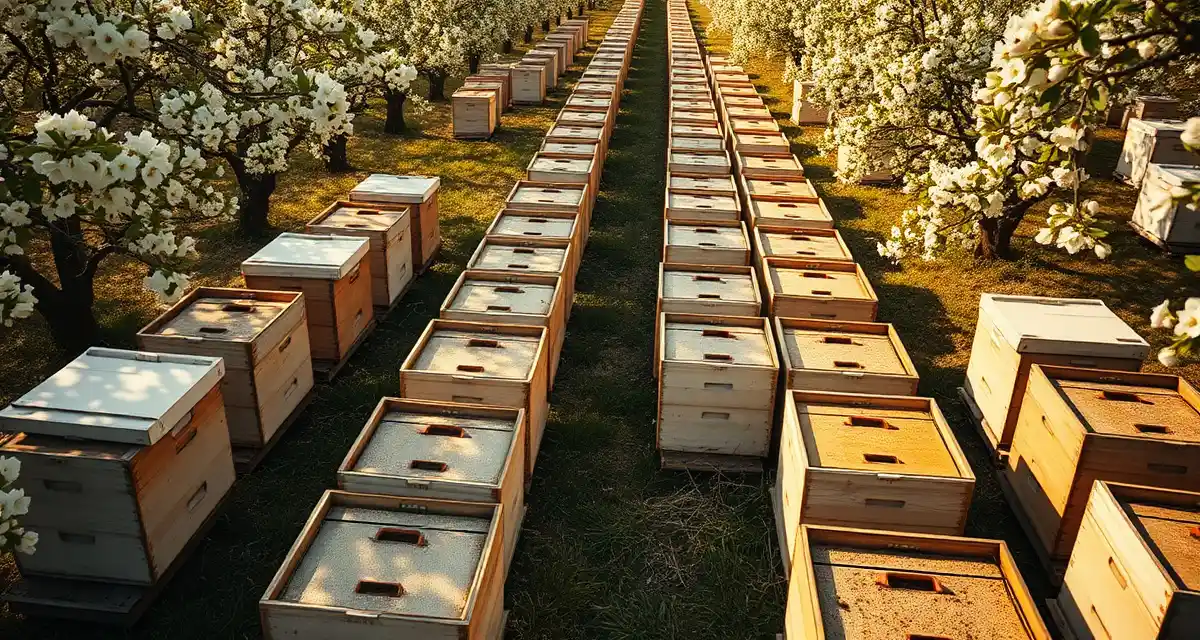
Hive Count Requirements by Crop: The Complete Reference
Almonds require 2 to 3 hives per acre, blueberries 4 to 6 per acre, and watermelons 0.5 to 1 per acre for commercial production. The spread in density requirements across crops reflects fundamentally different pollination biology: highbush blueberry needs multiple bee visits per flower to achieve full fruit set, almonds require cross-pollination between varieties that bloom simultaneously but in dense plantings, and watermelon needs far fewer visits per flower across a much larger field area.
Knowing the correct density for each crop before you write a contract means you don't under-promise hives a grower actually needs or over-promise hives at a density that isn't economically justified. These figures represent commercial production standards; individual growers may specify above or below the range depending on their orchard history, native pollinator presence, and yield targets.
TL;DR
- The California Almond Board's research supports 6 frames of bees as the minimum effective colony strength for almond pollination.
- Many growers now specify 8 frames for premium contracts, with rates at $200-215/hive versus $185-195 for 6-frame minimums.
- Hive strength assessment should be documented by yard, date, and assessor to create a defensible record for contract compliance.
- A colony assessed at the required strength in January can fall below minimum by February delivery if varroa loads are high or weather stress is severe.
- Third-party inspection at delivery is the cleanest resolution for strength disputes and protects operators as well as growers.
Tree Fruits
Almonds: 2 to 3 hives per acre. The California commercial standard is 2 hives per acre minimum; many premium operations specify 2.5 to 3 hives per acre for maximum fruit set. At 2 hives per acre, a 100-acre almond block requires 200 hives. Cross-pollination varieties must be present and timed to bloom simultaneously.
Sweet cherry: 1 to 2 hives per acre. Standard Bing operations at 1 hive per acre; Rainier cherry frequently at 2 hives per acre due to the crop's higher value and stricter fruit set requirements.
Tart cherry: 1 to 1.5 hives per acre. Tart cherry (Montmorency) is self-fertile but benefits from bee activity for complete fruit set. The Great Lakes tart cherry market typically specifies 1 hive per acre.
Apple: 1 to 2 hives per acre. Standard commercial at 1 to 1.5 hives per acre; premium Honeycrisp at 2 hives per acre. Requires cross-pollination between varieties.
Pear: 1 to 1.5 hives per acre. Most commercial pear varieties require cross-pollination. Oregon and Washington pear orchards typically specify 1 hive per acre.
Peach and nectarine: 0.5 to 1 hive per acre. Most peach varieties are self-fertile; pollination contracts are less common than for cross-pollinating crops but still present in the market.
Avocado: 1 to 2 hives per acre. Avocado's A/B flower synchrony makes timing more critical than density; 1 to 1.5 hives per acre for coastal California standard.
Plum and prune: 1 to 1.5 hives per acre. Cross-pollination required for most commercial varieties.
Blueberry
Highbush blueberry: 4 to 6 hives per acre. Michigan and New England commercial standard is 4 hives per acre minimum for established plantings with native pollinator presence; 5 to 6 hives per acre for new plantings or maximum yield targets.
Rabbiteye blueberry: 2 to 4 hives per acre. The Georgia and Southeast commercial standard is somewhat lower density than highbush due to the variety's different pollination biology and typically lower planting density.
Southern highbush blueberry: 3 to 5 hives per acre. Higher value crop with stricter fruit set requirements than rabbiteye.
Cucurbits
Watermelon: 0.5 to 1 hive per acre. At 1 hive per acre, a 100-acre watermelon field requires 100 hives. Seedless watermelon requires both seedless plants and pollinator (seeded) plants with bees to transfer pollen.
Cantaloupe and honeydew: 0.5 to 1.5 hives per acre. Desert Southwest commercial operations often at 1 to 1.5 hives per acre for the higher-density planting systems used in California and Arizona.
Cucumber (fresh market): 1 to 2 hives per acre. Gynoecious cucumber varieties require more active pollination support than monoecious varieties; fresh market cucumber growers in the Midwest and Southeast commonly specify 1.5 to 2 hives per acre.
Cucumber (pickle): 0.5 to 1 hive per acre. Pickle cucumber operations run at lower bee density than fresh market due to lower per-acre value.
Summer squash and zucchini: 0.5 to 1 hive per acre. High bloom density in squash fields means lower hive density is sufficient.
Pumpkin: 1 to 2 hives per acre. Commercial pumpkin operations in Indiana, Illinois, and Ohio typically specify 1 to 1.5 hives per acre.
Other Crops
Cranberry: 2 to 4 hives per acre. Massachusetts and New Jersey cranberry bogs at 2 to 3 hives per acre standard; Oregon and Washington cranberry at similar density.
Red clover seed: 4 to 8 hives per acre. Clover seed production is among the most hive-intensive crops in the country per acre due to the bloom structure and seed set requirements.
White clover seed: 3 to 6 hives per acre. Slightly lower density than red clover but still among the higher density crops.
Canola (hybrid seed): 2 to 4 hives per acre. Open-pollinated canola has lower requirements; hybrid seed canola in the Northern Plains requires active pollination.
Sunflower seed: 1 to 2 hives per acre. Hybrid sunflower seed production in North Dakota and South Dakota.
For the calculation method that converts acreage and density into contract terms, see per-hive rate calculation. For the full hive count reference integrated into contract writing, see how many hives per acre pollination.
Frequently Asked Questions
How many hives per acre do almonds require?
California commercial almond production requires a minimum of 2 hives per acre, with many growers specifying 2.5 to 3 hives per acre for maximum pollination effectiveness. The 2 hives per acre standard is set by the Almond Board of California and reflects the cross-pollination requirements of the main commercial varieties (Nonpareil, Carmel, Butte, Padre) and the dense planting configurations of modern commercial almond orchards. At 2 hives per acre, a 100-acre almond block requires 200 hives generating $36,000 to $47,000 at current California rates. At 3 hives per acre, the same block requires 300 hives. Confirm the density requirement in each contract; individual large-scale growers sometimes specify above or below the industry standard based on their orchard's history.
What crops need the most hives per acre for commercial pollination?
Red clover seed production tops the density list at 4 to 8 hives per acre, followed by highbush blueberry at 4 to 6 hives per acre. These two crops have the most demanding per-acre pollination requirements in US commercial agriculture. Michigan highbush blueberry at 5 hives per acre on a 50-acre operation requires 250 hives, a substantial deployment for a single grower contract. Red clover seed in Oregon and Idaho at 6 hives per acre is similarly intensive. In practice, high-density crops like blueberry and clover seed generate more contract revenue per acre than lower-density tree fruit crops, which is part of the reason specialized operators focus on these markets despite their higher hive count requirements.
How do I calculate total hives needed for a mixed-crop pollination contract?
Calculate each crop block separately using its crop-specific density requirement, then sum the totals. For a mixed farm with 40 acres of almonds (at 2 hives per acre = 80 hives) and 10 acres of watermelon (at 0.75 hives per acre = 7.5, rounded to 8 hives), the total contract is 88 hives. If the two crops bloom in overlapping windows, you need 88 hives simultaneously deployed at the site. If they bloom sequentially, you can serve the earlier crop with hives that then transition to the later crop, reducing your simultaneous deployment requirement. Clarify bloom overlap with the grower when writing mixed-crop contracts, and specify in the contract whether hive counts apply simultaneously or sequentially based on bloom timing.
How is hive strength measured for commercial contract compliance?
Hive strength is typically measured by counting frames of bees: the number of frames in the brood box that are covered (both faces) by worker bees. A frame covered on both faces counts as one frame of bees. Some assessors use a modified approach counting only the top face of each frame. The contract should specify the measurement method, since a hive assessed at 6 frames by one method might be 5 frames by another. Third-party inspection using a consistent, documented method is the cleanest standard for compliance.
What causes hives to fall below strength requirements between assessment and delivery?
Several factors can reduce colony strength between pre-season assessment and delivery: high varroa loads with insufficient treatment response, poor winter weather in northern states during transport south, queen failure or queen loss in the weeks before delivery, and nutritional stress from limited forage. Commercial operators typically re-assess colonies 1-2 weeks before departure to confirm strength has been maintained, replacing any colonies that have declined with stronger hives from their reserve inventory.
Can strength requirements be met with a recently split colony?
No. A recently split colony (within 4-6 weeks) will not have a full brood cycle's worth of adult workers emerging to maintain population. A split colony may appear to have adequate frames at the time of split but will decline in population over the following weeks as older workers die without emerging brood to replace them. Colonies going to almond pollination should have had their most recent split at least 8-10 weeks before delivery to allow full population recovery.
Try These Free Tools
Sources
- USDA Agricultural Research Service
- Bee Informed Partnership
- American Beekeeping Federation (ABF)
- Almond Board of California
- Project Apis m.
Get Started with PollenOps
Hive strength documentation is the foundation of contract compliance and dispute prevention. PollenOps structures strength assessment records, delivery confirmations, and inspection data so you have the evidence you need when questions arise about contract performance.