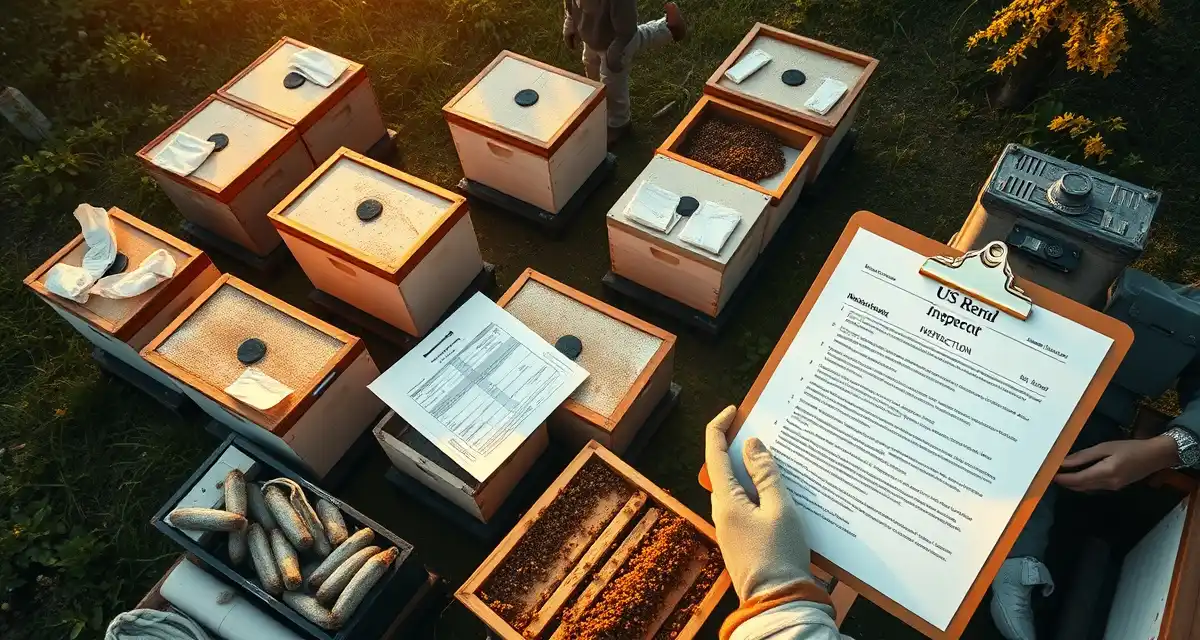
USDA APHIS Regulations for Commercial Beekeeping Operations
APHIS requires reporting of American Foulbrood and other regulated bee diseases, in ways that affect interstate movement permits and federal program eligibility, not just to state apiarists. Federal import restrictions significantly affect queen and package bee supply chains, with implications for how operations source replacement colonies.
Most commercial beekeepers understand that state regulations govern apiary registration and interstate entry permits. The federal layer (USDA APHIS's authority over bee imports, disease reporting, and program compliance) is less familiar but equally real for large commercial operations.
TL;DR
- Most states require annual apiary registration with a state agricultural agency before placing colonies for commercial purposes.
- Out-of-state operators entering for pollination contracts must register before hives land in most jurisdictions.
- California, Florida, and Texas have the most detailed entry requirements for commercial honey bees, including specific pest and disease certifications.
- State apiary inspectors focus on disease detection (AFB, EFB), pest management, and compliance with registration requirements.
- Permit and certificate requirements change periodically; verifying current requirements 30-60 days before planned entry prevents compliance failures.
APHIS Authority Over Commercial Beekeeping
USDA's Animal and Plant Health Inspection Service (APHIS) has several distinct regulatory authorities that touch commercial beekeeping:
Import authority: Under the Federal Honeybee Act (7 U.S.C. 281 et seq.), APHIS regulates the import of honey bees, queens, and bee semen from other countries. Importing live bees, queens, or used equipment from most countries requires an APHIS permit. Some countries are prohibited source countries entirely.
Disease surveillance: APHIS funds and coordinates the National Honey Bee Disease Survey, an annual systematic sampling of commercial apiaries for regulated pests and diseases. Participation is voluntary but provides APHIS with disease prevalence data that informs policy.
Reportable diseases: American Foulbrood is the primary federally reportable bee disease. Confirmed AFB in a commercial operation should be reported to both the state apiarist (required in most states) and APHIS's state veterinarian office. While federal enforcement of individual AFB reporting is limited, operations that participate in USDA programs (EQIP, ELAP, NAP) may have reporting obligations as program conditions.
Emergency authority: APHIS has emergency authority to act on exotic pest introductions. If an exotic pest (Small Hive Beetle outside its current range, Tropilaelaps mites, Aethina tumida from a new region) establishes, APHIS can impose interstate movement restrictions and treatment requirements.
Importing Queens and Package Bees from Abroad
The federal queen and package bee import market is small but affects supply for specific genetics:
From within the US: Moving queens or package bees domestically between states is regulated by receiving states, not APHIS. California, for example, requires health certificates and entry permits for any commercial colony movement. This is state authority, not federal.
From Hawaii: Hawaii has significant queen production for the mainland market. Queens from Hawaii moving to the continental US face standard state entry requirements at the destination state but not federal APHIS import permits (Hawaii is a US state).
From New Zealand and Australia: APHIS prohibits imports from New Zealand and Australia due to disease risks (particularly Varroa jaconi and Braula coeca from Australian stock). Commercial queen imports from these countries are not currently possible through normal channels.
From Canada: Commercial queen imports from Canada are possible with an APHIS permit. Canadian queens, particularly from British Columbia Carniolan producers, are a significant supply source for West Coast operations.
Semen importation: Instrumentally inseminated queens using imported drone semen are a genetic import pathway that some commercial queen breeders use. APHIS has a specific permitting process for bee semen importation.
APHIS and Varroa Management
APHIS has funded extensive Varroa research and management tool development, but does not directly regulate varroa treatment protocols. Treatment product registration is handled by EPA (for federally-registered pesticides) and USDA (for organic-approved treatments). State regulations may restrict specific treatments or require prescription (amitraz/Apivar treatment requires a veterinary prescription in some contexts).
What APHIS does regulate: the registration of new varroa treatment products. When a new treatment seeks EPA registration with a FIFRA section 18 emergency exemption or full registration, APHIS technical comments inform the EPA review. Commercial operators tracking new treatment approvals (oxalic acid vaporization got its full label through this process in 2015) should monitor APHIS and EPA regulatory notices.
APHIS and the Veterinary Feed Directive
The FDA Veterinary Feed Directive (VFD), implemented in 2017, affects commercial beekeeping more than many operators realize:
Antibiotics for bee disease: Oxytetracycline (OTC), formerly available over the counter for preventing American Foulbrood and European Foulbrood, now requires a veterinary prescription (VFD prescription) for use in honey bees. Commercial operators who use antibiotic treatments must work with an accredited veterinarian who has established a veterinarian-client-patient relationship (VCPR) and provides the prescription.
Practical implication: If you're still purchasing and using oxytetracycline for EFB prevention without a vet prescription, you're operating outside FDA/VFD requirements. Establish a VCPR with an accredited vet. The same vet who does your CVIs is often the same vet who provides VFD prescriptions.
APHIS Programs That Benefit Commercial Operations
Beyond regulation, APHIS programs provide direct value:
National Honey Bee Disease Survey: Participating operations contribute samples and receive disease monitoring data for their geographic area. Useful for understanding regional disease pressure.
Varroa Sentinel Monitoring Network: APHIS coordinates sentinel apiary monitoring for exotic pest surveillance. Participating provides early warning if exotic pests appear in your region.
APHIS Technical Assistance: For emerging disease or pest situations (colony mass die-offs, unusual symptoms, suspected exotic pest introductions), APHIS provides technical assistance and can fund diagnostic laboratory analysis.
FAQ
What APHIS regulations apply to commercial beekeeping?
The primary APHIS regulations affecting commercial beekeeping are: import restrictions under the Federal Honeybee Act (limiting which countries you can source queens and packages from), the Veterinary Feed Directive requirement for antibiotic prescriptions, the National Honey Bee Disease Survey participation (voluntary), and emergency authority for exotic pest response. APHIS has limited authority over domestic interstate movement. That's governed by state regulations.
Are there federal reporting requirements for bee diseases?
American Foulbrood is reportable under many state laws, and confirmed AFB should be reported to your state apiarist. Federal reporting to APHIS is not universally mandatory for individual beekeepers, but USDA program participants (EQIP, ELAP, NAP) may have disease documentation requirements as program conditions. Exotic or unusual disease presentations (symptoms not matching known US bee diseases) should be reported to your state apiarist and APHIS to initiate diagnostic investigation.
How do APHIS regulations affect buying queens and packages?
Domestic queen and package purchases (from US producers) are governed by state entry requirements at the destination, not APHIS. International imports are where APHIS regulations significantly constrain commercial choices: New Zealand and Australian sources are prohibited; Canadian imports require APHIS permits; most other country sources are prohibited or heavily restricted. The effective result is that US commercial operations source almost exclusively from domestic suppliers or Hawaii. Queen supply limitations have been a commercial constraint, particularly for specialty genetics, since Australian imports were restricted.
What is the process for registering an out-of-state apiary in a new state?
Most states require out-of-state operators to register with the state department of agriculture apiary program before placing colonies. The process typically involves submitting a registration application (online or paper), paying a fee (usually $10-50 per location), and providing contact information for the operation. Some states also require the registration to be renewed annually. Contact the destination state's department of agriculture apiary program at least 60 days before your planned arrival to confirm current requirements.
What documentation do state apiary inspectors typically review?
State apiary inspectors review health certificates for out-of-state colonies, registration documentation, and colony inspection records during apiary visits. Inspectors check for signs of American foulbrood, European foulbrood, and other regulated pests and diseases. Operations with organized digital records that include treatment history and mite counts typically have faster, less complicated inspections than operations without documentation. Some state inspectors also verify that varroa mite loads are below state entry thresholds.
What triggers a state apiary inspection?
State apiary inspections can be triggered by routine inspection schedules (most states inspect a percentage of registered apiaries annually), neighbor or landowner complaints, disease reports from nearby operations, or inspection requirements tied to state entry permits. California, in particular, has the right to inspect incoming loads at port of entry for commercial beekeeping operations. Maintaining current registration and organized records makes required inspections faster and less disruptive.
Try These Free Tools
Sources
- USDA Agricultural Research Service
- Bee Informed Partnership
- American Beekeeping Federation (ABF)
- USDA Animal and Plant Health Inspection Service (APHIS)
- National Association of State Departments of Agriculture
Get Started with PollenOps
Navigating state apiary registration and permit requirements across a multi-state circuit adds administrative complexity to an already demanding operation. PollenOps tracks permit status and documentation requirements alongside your contract and yard records so compliance doesn't fall behind operational demands.