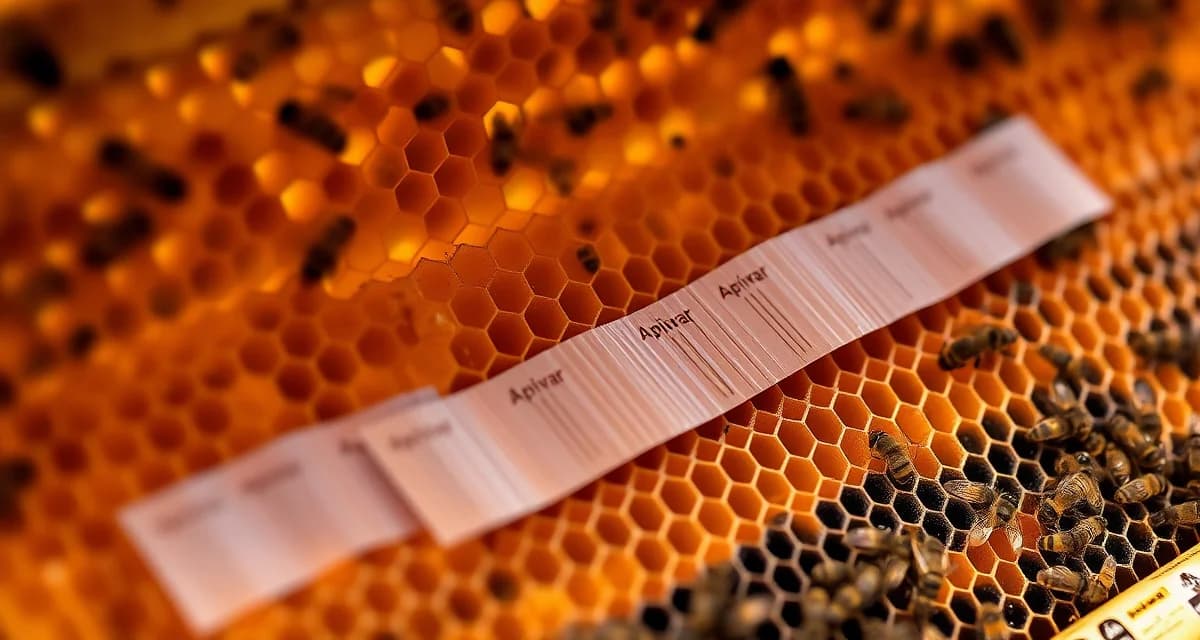
Apivar Amitraz Treatment for Commercial Beekeeping Operations
Apivar strips must be removed 42 days or more before honey supers are added. For commercial operations, this is the most critical timing rule you need to build your treatment calendar around. Get the timing wrong and you're either contaminating honey with amitraz residue or pulling strips too early and getting incomplete mite knockdown.
Apivar at $3 to $5 per strip, two strips per hive, across a 1,000-hive operation runs $6,000 to $10,000 per treatment round. That's the commercial reality of amitraz treatment. It's effective, the cost is real, and treatment timing directly affects your contract compliance and honey revenue.
TL;DR
- Commercial beekeeping operations face two primary management challenges: operational logistics (hive health, transport, placement) and administrative coordination (contracts, payments, documentation).
- Most disputes and revenue losses in commercial beekeeping are preventable with better documentation and clearer contract terms.
- The operations that run most profitably are those with disciplined systems for tracking hive health, contract status, and fleet logistics in one place.
- PollenOps is built specifically for the operational complexity of commercial-scale pollination services, not adapted from a hobbyist tool.
- The most important management decisions (treatment timing, contract renewal, hive allocation) require accurate current data to make well.
How Apivar Works
Apivar plastic strips are impregnated with amitraz, an acaricide that disrupts octopamine receptors in varroa mites. Bees walking over the strips pick up amitraz on their bodies and distribute it through the colony, contacting and killing phoretic mites.
The strips must remain in the colony for 42 to 56 days to achieve full efficacy. Pulling strips early because you want to get supers on leads to incomplete treatment and accelerated resistance development. Follow the label.
Apivar does not penetrate capped brood. Mites in capped cells are protected until they emerge with the bee. The 42+ day treatment window is designed to allow brood cycles to complete and expose successive mite generations to the strips.
Treatment Windows for Migratory Operations
For a California almond circuit with February delivery, your Apivar treatment window options are:
Summer treatment (August): Apply strips after pulling honey supers in late July or August. Remove strips after 42 to 56 days in September. Follow with a mite wash monitoring to confirm knockdown. This leaves a gap between September strip removal and February almond delivery. Monitor mites monthly and treat with oxalic acid in December if counts rebound.
Fall treatment (September to October): Apply strips in September. Remove in October to November. Gives good knockdown of fall varroa levels when winter bee populations are being raised. Works well if your operation pulls supers before September.
Post-almond treatment (March to April): After returning from almond season, apply Apivar before significant spring buildup. This restores colony health before summer honey production. Make sure to remove strips at least 42 days before supers go on.
Track all treatment applications tied to your varroa management program for large operations to maintain a full treatment history per colony.
Resistance Management
Amitraz resistance in varroa has been documented in several countries and is an emerging concern in US operations that have used Apivar continuously for many years. Best practice is to rotate treatment classes, using oxalic acid and formic acid treatments in rotation with amitraz rather than relying on Apivar for every treatment round.
If your post-treatment mite wash shows less than 70% knockdown from a properly applied Apivar treatment, resistance testing or switching treatment class should be considered.
Application Protocol at Scale
For 1,000 hives, Apivar application is straightforward but time-consuming:
- Two strips per brood box, placed in the brood nest between the frames where bees are most concentrated
- Use proper PPE: disposable gloves, do not handle strips bare-handed
- Insert strips vertically between frames 3 and 4, and 6 and 7 in a 10-frame box
- Record colony ID, yard, date applied, and strip lot number
- Set strip removal date in your management calendar at 42 to 56 days from application
Strip removal must be documented with the same rigor as application. Lost strips left in a colony during honey production is a contamination event.
Compliance with Pollination Contracts
Some growers, particularly organic almond producers, prohibit Apivar use. Know your contract terms before applying synthetic treatments. If you treat with Apivar, you must document the treatment date and strip removal date and confirm the removal precedes any honey super installation or organic certification window.
For contract-specific treatment restrictions and documentation requirements, hive health monitoring for commercial operations covers how to link treatment records to contract compliance tracking.
Frequently Asked Questions
When should Apivar be applied relative to pollination delivery?
For almond delivery in early February, Apivar strips must be removed at least 42 days before honey supers are installed. Most operators run a summer or fall Apivar treatment round with strip removal completed by October or November, followed by oxalic acid vaporization in December or January for a final mite knockdown before delivery. Applying Apivar in November and pulling strips in January still meets the 42-day rule, but the timing is tight and any delays in strip removal create compliance risk. Document all application and removal dates per colony.
Can Apivar be used during active pollination contracts?
Apivar is not recommended during active pollination because strips take 42 to 56 days to complete treatment. Installing strips while colonies are in an orchard means you'll still have strips present when you move hives out, creating logistical problems for supers and next-placement compliance. Some grower contracts explicitly prohibit synthetic acaricide use during the pollination period. Review your contract terms before applying any treatment to hives under contract. If mite loads spike during an active contract, oxalic acid extended-release strips are the more appropriate intervention.
How do you track Apivar application across 1000 hives?
Every Apivar application needs a record including: colony ID or yard-level batch record, date applied, strip lot number, applicator name, and scheduled removal date. Set automatic calendar reminders for strip removal 42 to 56 days from application. Post-removal mite washes should be scheduled 30 days after strips come out to verify knockdown. At 1,000 hives, paper records are inadequate. A digital system that timestamps treatment events and generates removal reminders by yard prevents the strip abandonment and timing errors that create contamination risk and regulatory exposure.
What is the difference between commercial and hobby beekeeping?
Commercial beekeeping is distinguished by scale (typically 100+ hives, often 500-5,000+), revenue source (pollination contracts and bulk honey sales rather than local honey retail), and management approach (systematic protocols applied across yards rather than individual colony attention). Commercial operators manage bees as an agricultural enterprise, with the administrative, regulatory, and logistical complexity that entails. Most commercial operators derive the majority of their income from pollination services; honey production is a supplementary revenue stream.
How many hives are needed to make commercial beekeeping a full-time income?
Most beekeeping economists put the full-time commercial threshold at 500-800 hives, assuming efficient operations management and a combination of pollination and honey revenue. At 500 hives and $200/hive for almond pollination, almond season alone generates $100,000 in gross revenue before expenses. Net margins depend on operational efficiency, but well-run operations can achieve 30-50% net margins on pollination revenue. Additional crops and honey production improve per-hive economics but require additional management capacity.
What is the annual revenue potential for a 1,000-hive commercial operation?
A 1,000-hive operation running an almond season ($200/hive) plus blueberry or apple contracts ($80-100/hive) plus summer honey production ($25-40/hive after extraction costs) can generate $300,000-360,000 in annual gross revenue. Net margins after transport, crew, equipment, and hive replacement costs typically run 25-40% for well-managed operations, putting net income at $75,000-145,000 annually. The specific number depends heavily on circuit efficiency, loss rates, and contract quality.
Try These Free Tools
Sources
- USDA Agricultural Research Service
- Bee Informed Partnership
- American Beekeeping Federation (ABF)
- American Honey Producers Association
- Project Apis m.
Get Started with PollenOps
Managing a commercial beekeeping operation involves more data, more deadlines, and more moving parts than any general-purpose tool was designed to handle. PollenOps brings contracts, yard records, health documentation, and fleet logistics together in one platform built for the realities of commercial-scale beekeeping.