Oxalic Acid Varroa Treatment at Commercial Scale: Protocols and Timing
Oxalic acid vaporization can treat 4 to 6 hives per hour with one applicator, compared to 1 to 2 hives per hour for dribble method. At 1,000 hives, that difference is 200 to 400 hours of treatment labor per round. If you're still doing dribble-only on a large operation, the math on switching to vaporization is straightforward.
Oxalic acid is effective at killing phoretic mites (mites on adult bees), but it does not penetrate capped brood. This fundamental limitation shapes everything about timing and method selection. Extended-release oxalic acid strips, now EPA-registered in the US, address the brood limitation by maintaining efficacy over 8 to 12 weeks as wax slowly dissolves the strips.
TL;DR
- Commercial beekeeping operations face two primary management challenges: operational logistics (hive health, transport, placement) and administrative coordination (contracts, payments, documentation).
- Most disputes and revenue losses in commercial beekeeping are preventable with better documentation and clearer contract terms.
- The operations that run most profitably are those with disciplined systems for tracking hive health, contract status, and fleet logistics in one place.
- PollenOps is built specifically for the operational complexity of commercial-scale pollination services, not adapted from a hobbyist tool.
- The most important management decisions (treatment timing, contract renewal, hive allocation) require accurate current data to make well.
Method Comparison at Scale
Dribble Method
Oxalic acid dribble (2% solution, 5ml per seam of bees) is most effective when there is no capped brood in the colony. In practical terms, this means winter treatment during natural broodless period or before overwintering package installation.
Dribble rate at scale: 1 to 2 hives per applicator per hour, depending on colony density and equipment setup. One crew member treating 400 hives needs 200 to 400 hours of labor. Not practical as a mid-season tool.
The advantage: low equipment cost, no electricity or propane, effective in cold weather.
Vaporization
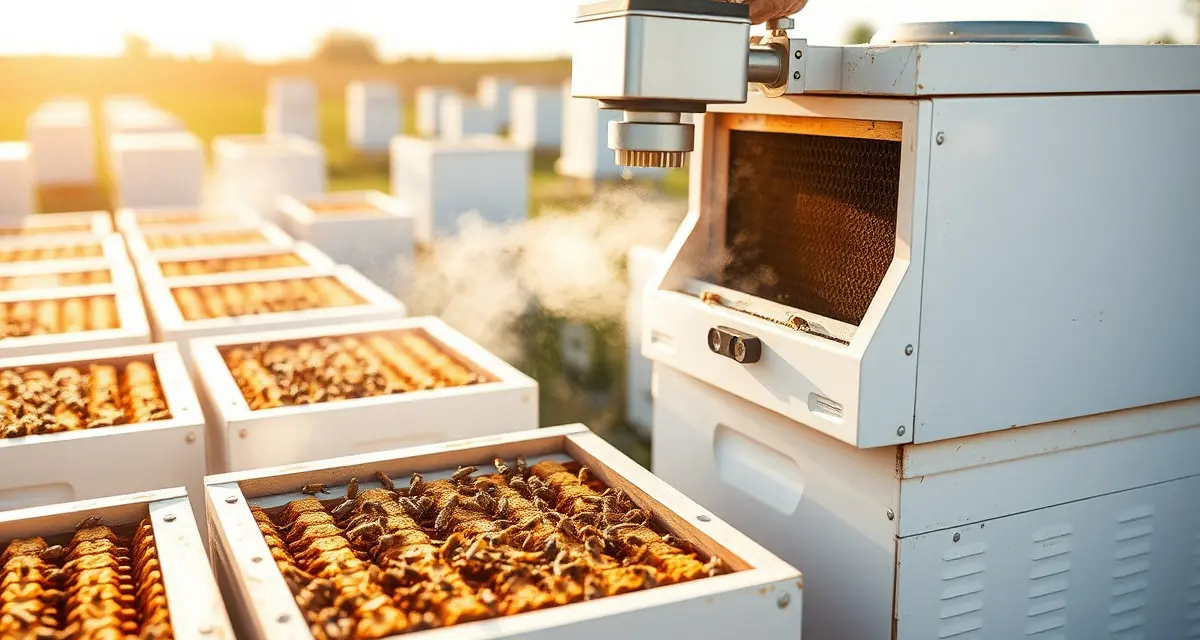
Oxalic acid vaporizer (Varrojet, ProVap, Sublimox, or similar) deposits oxalic acid crystals throughout the hive cavity. The applicator is inserted into the bottom entrance, the wand heats and vaporizes the measured dose, and the applicator is moved to the next hive.
Treatment rate: 4 to 6 hives per applicator per hour with practice. For 1,000 hives, that's roughly 200 hours per treatment round, which can be accomplished with 2 to 3 applicators running simultaneously.
Vaporization requires PPE: full face shield with N95 or P100 respirator, not just a dust mask. Oxalic acid vapor is corrosive to respiratory tissue. Exposure incidents must be documented.
For multi-round treatment schedules and treatment timing integration with your contract calendar, varroa management for large operations covers the full program.
Extended-Release Strips
EPA-registered extended-release oxalic acid strips (Api-Bioxal extended release format) are approved for use in colonies with brood. The strips are placed between frames in the brood nest, releasing oxalic acid slowly over 8 to 12 weeks as bees chew on the wax carrier.
This is the only EPA-registered oxalic acid method that works in active brood colonies. It costs more per treatment than bulk oxalic acid, but the labor savings and brood-presence compatibility make it practical for summer and fall treatments.
Strips at $3 to $5 per strip, two strips per hive for a full treatment: $6 to $10 per hive for an extended-release treatment round on 1,000 hives runs $6,000 to $10,000. Budget accordingly.
Timing Relative to Pollination Contracts
Oxalic acid has no honey withdrawal period under any method, and no residue limits in honey. This makes it compatible with honey production colonies.
For almond pollination, the key question is whether you're treating close enough to delivery to be meaningful. Vaporization during the broodless period in December and January reduces phoretic mite load before delivery. Extended-release strips applied in September to October provide ongoing suppression through the winter buildup period.
Do not apply vaporization treatments when colonies are in active pollination yards without grower approval. While oxalic acid has no honey contamination risk, the treatment procedure disturbs colonies and can affect foraging behavior for 24 to 48 hours.
Track all treatment applications against your mite wash varroa monitoring data to verify efficacy. If mite counts don't drop 70 to 90% within 30 days of treatment, investigate technique, queen status, and treatment completeness.
Regulatory Compliance
Oxalic acid dihydrate is EPA-registered under the product name Api-Bioxal. Only the registered product may be used legally; mixing your own oxalic acid solution from bulk chemical does not comply with the registration.
Maintain treatment records including: product name and lot number, application method, date and time, colony count treated, and applicator name. These records may be required for organic certification compliance or by certain grower contracts.
Frequently Asked Questions
Which oxalic acid method is most efficient for 1000-hive operations?
Vaporization is the most labor-efficient method, treating 4 to 6 hives per applicator per hour versus 1 to 2 for dribble. For a 1,000-hive operation, running 2 to 3 vaporizers simultaneously allows a full treatment round in a single working week. The limitation is that vaporization, like dribble, is most effective without capped brood. Extended-release strips address the brood limitation for mid-season treatments. Many large operations use vaporization during the winter broodless period and extended-release strips during summer and fall to maintain year-round suppression without relying on Apivar or other synthetic treatments.
Can oxalic acid be used during active almond pollination?
Oxalic acid has no honey withdrawal period and no residue concern, so it's not restricted from use during pollination from a honey safety standpoint. However, the treatment procedure disturbs colonies and the logistics of treating in an orchard setting are challenging. Most operators complete their pre-almond oxalic acid treatment during December or January before delivery, using the natural broodless or near-broodless period to maximize efficacy. If mite counts spike during almond season, an extended-release strip treatment is the most practical option that avoids the disruption of repeat vaporization visits.
What is the minimum broodless period required for effective OA dribble treatment?
A fully broodless colony allows oxalic acid dribble to achieve 90%+ mite kill in a single treatment, since all mites are phoretic (on adult bees) and exposed to the oxalic acid solution. As little as 10 to 15% capped brood significantly reduces efficacy, since mites inside capped cells are protected. In practical terms, a queen-right colony in the Deep South may never achieve full broodlessness, while colonies in northern states may have a natural broodless window of 4 to 8 weeks in December and January. Inspect for the absence of capped brood before dribble treatment, or use extended-release strips if brood is present.
What is the difference between commercial and hobby beekeeping?
Commercial beekeeping is distinguished by scale (typically 100+ hives, often 500-5,000+), revenue source (pollination contracts and bulk honey sales rather than local honey retail), and management approach (systematic protocols applied across yards rather than individual colony attention). Commercial operators manage bees as an agricultural enterprise, with the administrative, regulatory, and logistical complexity that entails. Most commercial operators derive the majority of their income from pollination services; honey production is a supplementary revenue stream.
How many hives are needed to make commercial beekeeping a full-time income?
Most beekeeping economists put the full-time commercial threshold at 500-800 hives, assuming efficient operations management and a combination of pollination and honey revenue. At 500 hives and $200/hive for almond pollination, almond season alone generates $100,000 in gross revenue before expenses. Net margins depend on operational efficiency, but well-run operations can achieve 30-50% net margins on pollination revenue. Additional crops and honey production improve per-hive economics but require additional management capacity.
What is the annual revenue potential for a 1,000-hive commercial operation?
A 1,000-hive operation running an almond season ($200/hive) plus blueberry or apple contracts ($80-100/hive) plus summer honey production ($25-40/hive after extraction costs) can generate $300,000-360,000 in annual gross revenue. Net margins after transport, crew, equipment, and hive replacement costs typically run 25-40% for well-managed operations, putting net income at $75,000-145,000 annually. The specific number depends heavily on circuit efficiency, loss rates, and contract quality.
Try These Free Tools
Sources
- USDA Agricultural Research Service
- Bee Informed Partnership
- American Beekeeping Federation (ABF)
- American Honey Producers Association
- Project Apis m.
Get Started with PollenOps
Managing a commercial beekeeping operation involves more data, more deadlines, and more moving parts than any general-purpose tool was designed to handle. PollenOps brings contracts, yard records, health documentation, and fleet logistics together in one platform built for the realities of commercial-scale beekeeping.