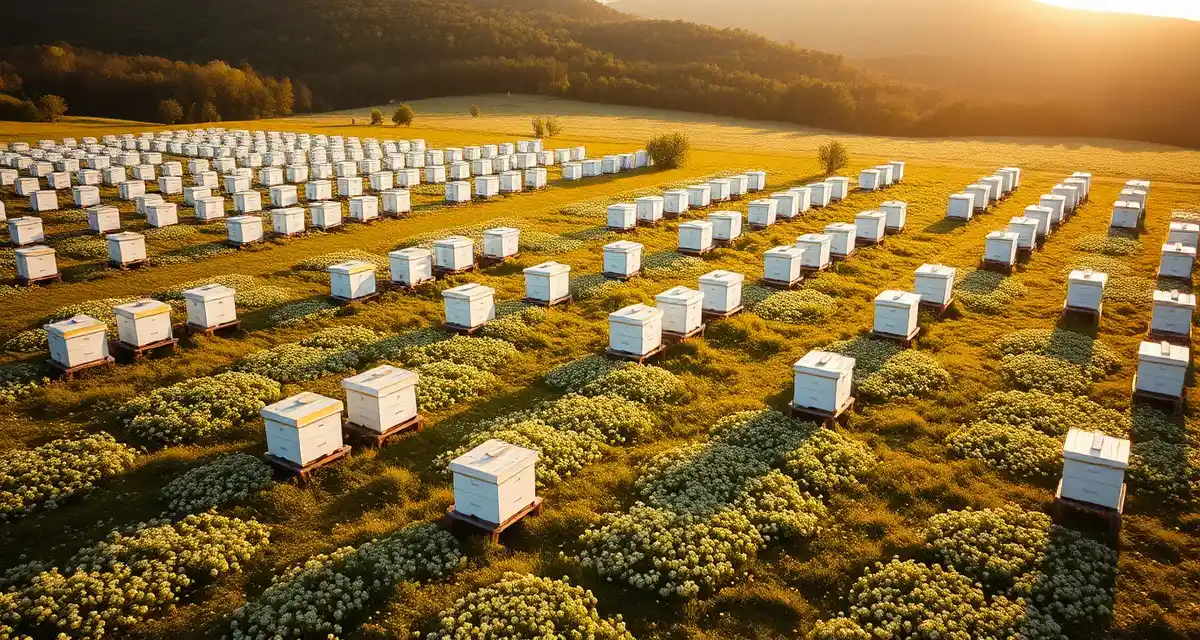
Commercial Beekeeping in Missouri: Fruit Crops and Honey
Missouri requires apiary registration and inspection for commercial beekeeping operations. Missouri's clover and wildflower forage plus fruit crops support diverse commercial income. The state's position between the Midwest grain belt and the Ozark highlands gives it more honey production diversity than most central states.
TL;DR
- Missouri's primary commercial beekeeping role is shaped by its crop mix, climate, and position on the national pollination circuit.
- Pollination rates in Missouri range $70-90/hive depending on crop and colony strength requirements.
- Out-of-state operators entering Missouri for pollination contracts must register with the state agricultural authority and obtain a Certificate of Health.
- Missouri functions as either a primary pollination destination, a seasonal honey production location, or a transitional stop depending on the circuit.
- Tracking permit status, registration documents, and yard records for Missouri operations requires organized record-keeping before the season opens.
Missouri Honey Production
Tulip poplar and mixed hardwood: The Missouri Ozarks (southern and central Missouri, including Shannon, Oregon, Reynolds, Carter, and Ripley counties) have extensive hardwood forests with tulip poplar, black locust, and diverse wildflowers. The Ozarks produce some of Missouri's best honey: distinctive mixed hardwood honey with complex character.
Sweet clover: Missouri's northern tier and agricultural areas have sweet clover roadside flows, similar to adjacent Iowa and Kansas. Flow timing: June-August.
Black locust: Black locust grows extensively in the Missouri Ozarks and river bluffs, producing an exceptional May honey flow. The light-colored, mild black locust honey is sold as "Missouri wildflower" or specifically labeled for the specialty market.
Persimmon: Missouri has significant persimmon populations, particularly in the Ozarks. Persimmon bloom in May provides a distinctive if modest nectar source.
Missouri Pollination Opportunities
Apple and soft fruit: Missouri's commercial apple production in the northeastern counties (Ste. Genevieve, St. Francois, Washington) and some Ozark orchards. Contract rates: $70-90/hive.
Soybean-adjacent crops: Missouri's extensive soybean and corn agriculture doesn't require pollination, but sunflower and specialty crop production in the state does create limited demand.
Cucurbits and vegetables: Commercial pumpkin and watermelon production creates modest demand in warmer seasons.
Missouri Regulations
Administering agency: Missouri Department of Agriculture, Plant Industries Division
Registration: Annual registration required for all Missouri beekeepers. Out-of-state operators must register.
CVI requirement: Missouri requires health certificates for colonies entering from out of state.
State inspection: Missouri has an active apiary inspection program.
Missouri's Circuit Position
Missouri serves as a transition zone for operations moving between the Southeast (Georgia, Tennessee) and the Northern Plains (Dakotas). The Ozarks offer a spring honey production stop with distinctive character that northern Plains honey can't match. Operations that position some colonies in the Missouri Ozarks for the May-June black locust and tulip poplar flow capture a premium varietal opportunity before the main summer northern run.
FAQ
What pollination opportunities exist in Missouri?
Missouri's commercial pollination market is limited compared to the Pacific Northwest or Northeast, primarily apple orchards in the northeastern counties and Ozark highlands ($70-90/hive), limited cucurbit and specialty vegetable demand, and some soft fruit in the St. Louis exurban area. Missouri is primarily a honey production state for commercial migratory operations rather than a contract pollination hub.
What honey production opportunities does Missouri offer?
Missouri's best honey comes from the Ozarks region: black locust honey in May (water-white, mild, premium varietal), tulip poplar in May-June (dark amber, distinctive), and mixed Ozark hardwood wildflower through summer. Northern and central Missouri sweet clover and wildflower flows are similar to adjacent Plains states. Ozark honey has regional premium market potential in the St. Louis and Kansas City specialty food scenes and in direct-to-consumer channels.
What are Missouri's apiary registration requirements?
Missouri requires annual registration with the Missouri Department of Agriculture Plant Industries Division. Out-of-state commercial operators must register before placing colonies. Health certificates are required for colonies entering from out of state. Missouri has an active inspection program. Contact the Missouri Department of Agriculture before your first Missouri season to confirm current registration requirements.
What is the process for registering an out-of-state apiary in a new state?
Most states require out-of-state operators to register with the state department of agriculture apiary program before placing colonies. The process typically involves submitting a registration application (online or paper), paying a fee (usually $10-50 per location), and providing contact information for the operation. Some states also require the registration to be renewed annually. Contact the destination state's department of agriculture apiary program at least 60 days before your planned arrival to confirm current requirements.
What documentation do state apiary inspectors typically review?
State apiary inspectors review health certificates for out-of-state colonies, registration documentation, and colony inspection records during apiary visits. Inspectors check for signs of American foulbrood, European foulbrood, and other regulated pests and diseases. Operations with organized digital records that include treatment history and mite counts typically have faster, less complicated inspections than operations without documentation. Some state inspectors also verify that varroa mite loads are below state entry thresholds.
What triggers a state apiary inspection?
State apiary inspections can be triggered by routine inspection schedules (most states inspect a percentage of registered apiaries annually), neighbor or landowner complaints, disease reports from nearby operations, or inspection requirements tied to state entry permits. California, in particular, has the right to inspect incoming loads at port of entry for commercial beekeeping operations. Maintaining current registration and organized records makes required inspections faster and less disruptive.
Try These Free Tools
Sources
- USDA Agricultural Research Service
- Bee Informed Partnership
- American Beekeeping Federation (ABF)
- Missouri Department of Agriculture
- Project Apis m.
Get Started with PollenOps
Commercial operations working in Missouri face the same registration, permit, and documentation requirements as any state on the national circuit -- plus Missouri's specific regulatory requirements. PollenOps tracks your Missouri yard records, contract assignments, and permit documentation alongside your full operation, so entering a new state doesn't add a separate administrative burden. See how the platform fits operations working across multiple states.