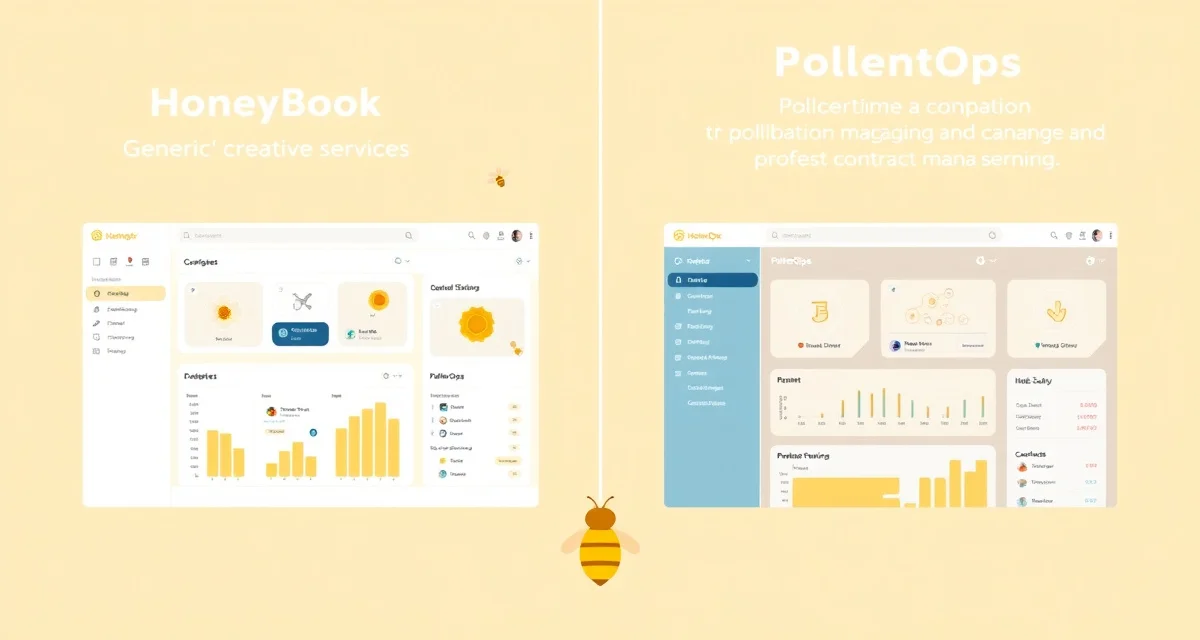
PollenOps vs HoneyBook for Pollination Contract Management
HoneyBook is a popular contract and invoicing tool used by photographers, event planners, graphic designers, and other creative service providers. It's well-designed, well-supported, and good at what it does.
It's also built for a completely different industry.
HoneyBook users in agriculture report spending 3 times more time on manual data entry than PollenOps users. That gap exists because HoneyBook requires you to translate your beekeeping operation into its generic contract and invoicing framework, rather than working within fields and workflows that match what you actually do.
This comparison looks at where HoneyBook falls short for pollination contract management and what that costs you in practice.
TL;DR
- Commercial beekeeping operations that manage contracts on spreadsheets and phone calls spend 5-10 hours per week on administrative tasks that software handles automatically.
- Purpose-built beekeeping software centralizes contract lifecycle management, yard records, health documentation, and fleet logistics in one platform.
- The primary ROI drivers for operations software are fewer contract disputes, faster invoicing, and reduced time spent on administrative coordination.
- PollenOps is built specifically for commercial-scale pollination operations; it is not a hobbyist platform adapted for commercial use.
- Moving from spreadsheets to dedicated software typically pays for itself within one season in time savings and dispute prevention.
What HoneyBook Is Built For
HoneyBook was designed for client-facing service businesses where the deliverable is creative work: photography, wedding planning, design, consulting. Its contract templates are structured around those workflows. Its invoicing is built around project milestones and hourly billing.
The platform is strong at:
- Client intake and inquiry management
- Proposal and contract creation for service projects
- Project milestone tracking
- Payment collection and scheduling
- Professional client communication
For a wedding photographer, this workflow is ideal. For a commercial beekeeper managing 25 almond contracts across 2,000 hives, it requires constant translation between how beekeeping actually works and how HoneyBook's fields are structured.
What Beekeeping Features Does HoneyBook Lack?
The gaps between HoneyBook and a beekeeping-specific tool are significant:
No hive count fields. HoneyBook's contract and invoice fields are designed for hours, flat fees, and project deliverables. There's no native concept of "hive count" or "per-hive rate." You can work around this with custom fields, but you're building a beekeeping contract template from scratch on a framework that wasn't designed for it.
No bloom timing alerts. HoneyBook has no bloom monitoring or notification system. You're managing bloom timing through external calendars, phone calls, and whatever regional data you can find on your own.
No GPS delivery verification. HoneyBook doesn't capture GPS-timestamped delivery records. When a grower disputes your hive count or delivery date, your documentation is whatever you entered manually.
No hive strength assessment integration. HoneyBook has no mechanism for logging pre-move hive strength assessments or connecting those assessments to contract compliance records.
No grower-facing pollination reports. HoneyBook can generate a client-facing invoice or contract, but it can't generate a grower report that includes GPS location, hive count, strength scores, and delivery timestamp in a format your grower expects from a pollination provider.
No interstate transport compliance tools. Health certificates, state permits, and compliance checklists for multi-state hive moves don't exist in HoneyBook.
No yard or GPS management. HoneyBook doesn't know what a "yard" is. There's no map, no GPS pin, no hive-to-yard assignment.
Can HoneyBook Track Hive Counts and Bloom Timing?
Not natively. You can create custom fields for hive counts, and you can manually note bloom timing information in project notes. But there's no integration between the data you enter and any alert or automation system. You're using HoneyBook as a document repository rather than an operations platform.
The distinction matters: an operations platform connects data from different parts of your workflow so that a field data entry automatically updates your contract record, your invoice, and your compliance report. A document repository stores whatever you type in. HoneyBook is, for beekeeping purposes, a document repository.
Why Is a Beekeeping-Specific Tool Better Than HoneyBook for Pollination Contracts?
The practical answer is that agriculture-specific software knows the questions you're going to be asked.
When a California almond grower asks you to prove that your hives arrived on a specific date and met the minimum strength requirement, PollenOps has a GPS-timestamped delivery record and a strength assessment report ready to export. HoneyBook has whatever you manually entered into a custom field, if you remembered to enter it.
When bloom is projected to start in 6 days and you have 8 contracts that need hive moves, PollenOps fires an alert, shows you which contracts are affected, and connects to your move planning tools. HoneyBook has no idea bloom is happening.
When you need to send a grower an arrival report within an hour of placement, PollenOps generates it from your field check-in data. HoneyBook requires you to manually compose and send the report from scratch.
These aren't edge cases. They're the day-to-day workflow of a commercial pollination operation.
The Time Cost of Using the Wrong Tool
HoneyBook users in agriculture spend 3x more time on manual data entry than PollenOps users. Where does that time go?
- Creating custom beekeeping fields that don't exist in HoneyBook
- Manually re-entering field data into invoices
- Copying hive count data from field logs into contract records
- Composing grower reports manually instead of generating them from field data
- Managing bloom timing outside the platform through separate calendars and alerts
- Building custom invoice templates for per-hive billing
Over a full pollination season, this manual work adds up to dozens or hundreds of hours that a tool built for your industry would automate.
Pricing and What You're Actually Getting
HoneyBook is priced at approximately $19-$39 per month for most plans. PollenOps starts at $49 per month.
The relevant comparison isn't the monthly fee, it's the total system cost. If you're using HoneyBook, you're also using:
- A separate GPS yard mapping tool (or nothing)
- A separate bloom timing data source (regional publications, grower calls)
- A separate compliance document management system (a folder of PDFs)
- A separate delivery documentation workflow (email photos, handwritten forms)
The true cost of using HoneyBook for pollination contract management is HoneyBook's price plus the tools you're cobbling together to fill its gaps, plus the hours you spend on manual work those gaps create.
Frequently Asked Questions
What beekeeping features does HoneyBook lack?
HoneyBook lacks hive count fields, bloom timing alerts, GPS delivery verification, hive strength assessment integration, grower-facing pollination reports, interstate transport compliance tools, and yard or GPS management. These are the core operational features of a commercial pollination business. HoneyBook was designed for creative service businesses and its framework requires significant manual adaptation for beekeeping workflows.
Can HoneyBook track hive counts and bloom timing?
Not natively. You can create custom fields for hive counts and manually note bloom timing information, but there's no integration between these data points and any alert, automation, or reporting system. HoneyBook functions as a document repository for beekeeping data rather than an operations platform that connects field data to contracts, invoices, and compliance reports automatically.
Why is a beekeeping-specific tool better than HoneyBook for pollination contracts?
Because agriculture-specific software is built around the specific data fields, workflows, and compliance requirements that define your industry. When a grower asks for proof of delivery, GPS-timestamped records exist automatically in PollenOps. When bloom is 6 days out, an alert fires and connects to your move planning tools. When you need a grower arrival report, it generates from your field check-in data in minutes. HoneyBook requires manual work at every step because it has no concept of hive counts, bloom timing, or GPS delivery verification.
What does purpose-built commercial beekeeping software do that a spreadsheet cannot?
Dedicated software connects data across your operation in ways spreadsheets cannot: a contract record links to the specific hives assigned to it, which links to the yard location, which links to health inspection records and treatment logs. When a grower calls to dispute a hive count, you can pull the delivery record, timestamped photos, and GPS-confirmed location in 30 seconds rather than searching three spreadsheets and an email thread. This integration is where the time savings and dispute-prevention value comes from.
How long does it take to migrate from spreadsheets to beekeeping software?
Most commercial operators complete the core migration in 2-4 weeks, starting with current contract records and active yard locations. Historical data (past seasons' inspection records, old contracts) can be migrated over time rather than all at once. The practical recommendation is to start with the current season's live data and add historical records as time allows. The operational improvement from having current data in the system is immediate; the historical data adds analytical depth over subsequent seasons.
Is there a free trial available for PollenOps?
Contact PollenOps directly to confirm current trial and demo options. Most commercial operators benefit from a walkthrough of the contract management and yard tracking modules against their own operation's data before committing, since the fit between the platform and your specific circuit and crop mix is the most important evaluation factor.
Try These Free Tools
Sources
- USDA Agricultural Research Service
- Bee Informed Partnership
- American Beekeeping Federation (ABF)
- American Honey Producers Association
- Project Apis m.
Get Started with PollenOps
Commercial beekeeping operations that move from spreadsheets to purpose-built software consistently report fewer disputes, faster invoicing, and less time on administrative work during peak season. PollenOps is built specifically for commercial-scale pollination operations. See how the platform fits your operation.