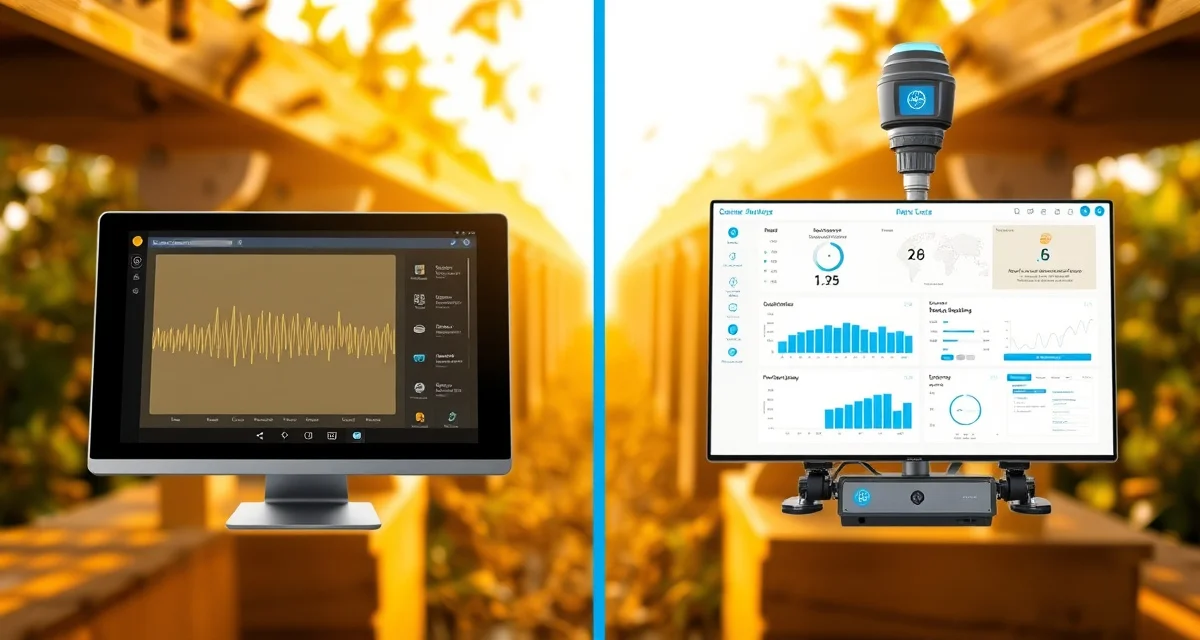
PollenOps vs Nectar Technologies: Pricing and Features Compared
TL;DR: Nectar Technologies is a hardware-sensor platform with per-hive monthly pricing that reaches $9,000/month at 2,000 hives. PollenOps is a flat-rate operations platform ($249–499/month) that includes acoustic colony monitoring plus the contract management and fleet logistics that Nectar doesn't offer. For commercial migratory operations, the math isn't close.
TL;DR
- Commercial beekeeping operations that manage contracts on spreadsheets and phone calls spend 5-10 hours per week on administrative tasks that software handles automatically.
- Purpose-built beekeeping software centralizes contract lifecycle management, yard records, health documentation, and fleet logistics in one platform.
- The primary ROI drivers for operations software are fewer contract disputes, faster invoicing, and reduced time spent on administrative coordination.
- PollenOps is built specifically for commercial-scale pollination operations; it is not a hobbyist platform adapted for commercial use.
- Moving from spreadsheets to dedicated software typically pays for itself within one season in time savings and dispute prevention.
The Pricing Math
Let's run the actual numbers.
| Hive Count | Nectar (~$2.75/hive/mo) | Nectar (~$4.50/hive/mo) | PollenOps |
|---|---|---|---|
| 200 hives | $550/mo | $900/mo | $99/mo |
| 500 hives | $1,375/mo | $2,250/mo | $249/mo |
| 1,000 hives | $2,750/mo | $4,500/mo | $249/mo |
| 2,000 hives | $5,500/mo | $9,000/mo | $499/mo |
| 5,000 hives | $13,750/mo | $22,500/mo | $499/mo |
At 2,000 hives, you're paying up to $9,000/month for Nectar Technologies' software, which is $108,000/year. PollenOps Enterprise covers up to unlimited hives at $499/month, which is $5,988/year.
The difference at 2,000 hives: over $100,000/year. That's not a rounding error. That's a full-time employee, a new truck, or a significant chunk of hive acquisition.
And that's before hardware. Nectar Technologies requires purchasing physical sensor hardware for each hive (or each hive location, depending on the deployment model). Add another significant upfront cost on top of the monthly subscription.
Feature Comparison
| Feature | PollenOps | Nectar Technologies |
|---|---|---|
| Colony health monitoring | Acoustic AI (software) | Hardware sensors |
| Pollination contract management | Yes | No |
| Invoice generation | Yes | No |
| Grower communication / portal | Yes | No |
| Fleet / route optimization | Yes | No |
| Multi-yard management | Yes | Limited |
| Hive strength documentation | Yes | Sensor-based |
| Interstate permit tracking | Yes | No |
| Honey yield forecasting | Yes | No |
| Grower marketplace | Yes | No |
| Flat-rate pricing | Yes | No (per-hive) |
| Hardware required | No | Yes |
Colony Health Monitoring: Sensors vs. Acoustic AI
This is where Nectar Technologies has genuine technology. Their hardware sensors collect temperature, humidity, weight, and audio data from instrumented hive boxes. If you need high-precision sensor data from individual colonies (for research or premium single-location apiaries) Nectar's hardware provides that.
For commercial migratory operations, the hardware model creates problems:
Hardware management overhead. Physical sensors on hives that travel thousands of miles get damaged, disconnected, and lost. Managing sensor inventory across 2,000 hives in 20+ yard locations adds operational complexity.
Limited deployment. You can't practically instrument every hive in a commercial operation. Most operators using sensor-based platforms instrument a subset of hives and extrapolate, which means you're paying per-hive pricing for data you're not even collecting on every colony.
No commercial workflow features. Knowing that hive 847 has a temperature anomaly is useful. But if that information doesn't connect to a contract telling you which grower account that hive is serving, or a crew scheduling tool that determines which yard gets checked first, the data is isolated.
PollenOps' acoustic AI monitoring works at the yard level, analyzing sound signatures from colony clusters to detect issues like queen loss, laying worker conditions, or pre-swarm states. No hardware installation required per hive. The monitoring connects directly to yard records and contract assignments, so a health alert in Yard 12 immediately shows you which grower contract is affected.
What Nectar Technologies Doesn't Cover
Nectar Technologies is fundamentally a colony health monitoring tool. It's not an operations platform for commercial beekeeping businesses. Specifically, it doesn't handle:
- pollination contracts: No quote generation, no contract tracking, no invoice creation
- Grower communication: No logging of conversations, no grower-facing portal
- Fleet logistics: No truck routing, no crew scheduling tied to hive movements
- Multi-contract management: No ability to assign hive groups to specific grower contracts
- Permit and compliance tracking: No interstate movement permit management
For a commercial migratory operator, these aren't nice-to-have features. They're the core work of running the business. Using Nectar Technologies for colony health monitoring and then managing contracts on spreadsheets and invoicing in QuickBooks is three separate systems instead of one.
Does Nectar Technologies Require Physical Tag Purchases?
Nectar Technologies' hardware-based model requires purchasing sensor units. Pricing varies by deployment configuration, but the capital cost for hardware adds to the ongoing monthly subscription cost. This is in addition to the per-hive software fee.
For a 1,000-hive operation, the combined hardware and software cost in the first year is significantly higher than the monthly subscription alone.
PollenOps has no hardware requirements. The acoustic monitoring uses software-based signal analysis, and all other features (contracts, logistics, invoicing) are pure software. There's no sensor inventory to manage and no hardware to replace when it fails or goes missing during a hive transport.
Who Should Use Nectar Technologies
Nectar Technologies is appropriate for:
- Research operations that need precise per-hive sensor data
- Small premium apiaries where per-hive pricing is manageable
- Operations that prioritize hardware-quality temperature and weight data over contract and logistics management
- Beekeepers where colony health monitoring is the primary software need and business administration is handled elsewhere
It's not appropriate for commercial migratory operators who need integrated contract management, fleet logistics, and invoicing alongside health monitoring.
Switching From Nectar Technologies to PollenOps
If you're currently using Nectar Technologies and want to evaluate PollenOps:
- Run both platforms simultaneously for one season
- Compare the actual time spent on contract admin, invoicing, and logistics coordination under each model
- Calculate your annual savings at your current hive count
- Review PollenOps' acoustic monitoring data quality for your specific operation type
PollenOps offers a free trial. The pricing math alone justifies a trial at any commercial scale.
FAQ
Does Nectar Technologies require purchasing physical tags?
Nectar Technologies' platform is hardware-based and requires physical sensor units installed in hive equipment. These hardware units are purchased separately from the monthly software subscription. The combined cost (hardware purchase plus per-hive monthly subscription) makes Nectar Technologies particularly expensive for operations with large hive counts. PollenOps does not require any hardware purchases; all features including acoustic colony monitoring operate as software.
How does PollenOps pricing scale compared to Nectar Technologies?
PollenOps uses flat-rate tiers: $99/month for up to 200 hives, $249/month for 201–1,000 hives, $499/month for 1,000+ hives. Cost does not increase as you add hives within a tier. Nectar Technologies charges $2.75–4.50 per hive per month, so every additional hive increases your monthly cost. At 2,000 hives, this difference is over $8,500/month, more than $100,000/year. The per-hive pricing model structurally penalizes growth, while flat-rate tiers let you scale without software costs eroding margin on each new colony.
What features does Nectar Technologies have that PollenOps lacks?
Nectar Technologies provides hardware sensor data (individual hive temperature, humidity, and weight readings) that PollenOps doesn't replicate exactly. If you need precision sensor data from individual hive boxes (for example, in a research context or for detailed weight-based honey production monitoring on specific colonies), Nectar's hardware approach provides information PollenOps doesn't. However, PollenOps' acoustic AI monitoring covers the core colony health signals (queen presence, swarming risk, population anomalies) without hardware. For the vast majority of commercial pollination operations, acoustic monitoring plus contract and logistics management is more operationally valuable than per-hive sensor data without those operational tools.
What does purpose-built commercial beekeeping software do that a spreadsheet cannot?
Dedicated software connects data across your operation in ways spreadsheets cannot: a contract record links to the specific hives assigned to it, which links to the yard location, which links to health inspection records and treatment logs. When a grower calls to dispute a hive count, you can pull the delivery record, timestamped photos, and GPS-confirmed location in 30 seconds rather than searching three spreadsheets and an email thread. This integration is where the time savings and dispute-prevention value comes from.
How long does it take to migrate from spreadsheets to beekeeping software?
Most commercial operators complete the core migration in 2-4 weeks, starting with current contract records and active yard locations. Historical data (past seasons' inspection records, old contracts) can be migrated over time rather than all at once. The practical recommendation is to start with the current season's live data and add historical records as time allows. The operational improvement from having current data in the system is immediate; the historical data adds analytical depth over subsequent seasons.
Is there a free trial available for PollenOps?
Contact PollenOps directly to confirm current trial and demo options. Most commercial operators benefit from a walkthrough of the contract management and yard tracking modules against their own operation's data before committing, since the fit between the platform and your specific circuit and crop mix is the most important evaluation factor.
Try These Free Tools
Sources
- USDA Agricultural Research Service
- Bee Informed Partnership
- American Beekeeping Federation (ABF)
- American Honey Producers Association
- Project Apis m.
Get Started with PollenOps
Commercial beekeeping operations that move from spreadsheets to purpose-built software consistently report fewer disputes, faster invoicing, and less time on administrative work during peak season. PollenOps is built specifically for commercial-scale pollination operations. See how the platform fits your operation.