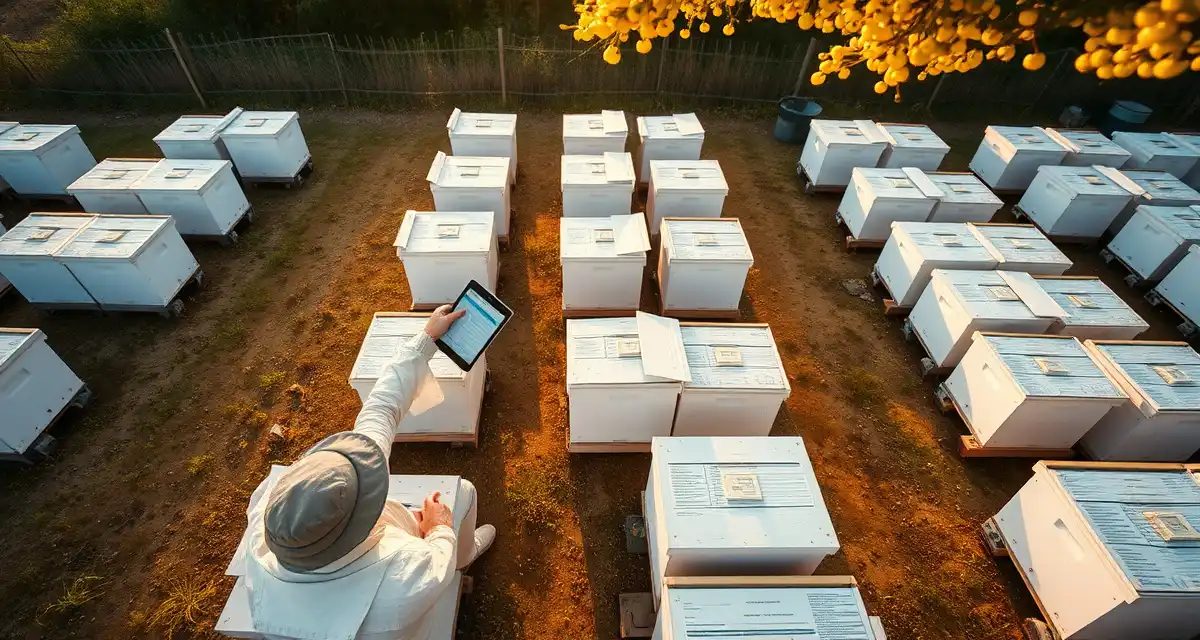
Yard History Reporting for Beekeeping Operations
Yard history reports reduce state inspection preparation time from days to minutes. That's a real, practical benefit for any commercial beekeeper who's been through a state apiary inspection and knows how much time goes into assembling location records, hive count histories, and movement documentation.
But yard history reporting isn't just about inspections. It's the operational foundation for rate negotiations, grower audits, season planning, and contract dispute defense. If you're managing your history in a spreadsheet or a notebook, you can answer some of these questions. A dedicated platform lets you answer all of them, accurately, in seconds.
TL;DR
- Commercial beekeeping operations face two primary management challenges: operational logistics (hive health, transport, placement) and administrative coordination (contracts, payments, documentation).
- Most disputes and revenue losses in commercial beekeeping are preventable with better documentation and clearer contract terms.
- The operations that run most profitably are those with disciplined systems for tracking hive health, contract status, and fleet logistics in one place.
- PollenOps is built specifically for the operational complexity of commercial-scale pollination services, not adapted from a hobbyist tool.
- The most important management decisions (treatment timing, contract renewal, hive allocation) require accurate current data to make well.
What a Yard History Report Contains
A complete yard history for a specific location should include:
Hive count history: What was the hive count at this yard on each visit date? A three-year history of counts shows how the yard was used over time.
Move records: When did hives arrive at this yard? When did they depart? What was the origin and destination of each move? GPS timestamps for arrivals and departures provide objective documentation.
Contract associations: Which pollination contracts used this yard? What grower? What service period? What was the contracted hive count vs. the actual delivered count?
Strength assessment records: What were the hive strength scores recorded at this yard across time? Pre-move assessments show colony condition before each contract placement.
Yield data (if applicable): For yards used in honey production alongside or between pollination contracts, any recorded honey yield data.
Notes and observations: Any yard-specific notes about site conditions, access changes, pest observations, or landowner communications.
Lease information: The landowner name, lease term, and renewal history associated with the yard location.
Why Yard History Matters for Planning
When you're deciding whether to use a specific yard location for a new season, history answers the questions that matter most:
- How did hive strength scores look when colonies came out of this yard?
- Were there any health or pest issues flagged during inspections here?
- Did this yard's contract placement result in disputes or inspection problems?
- Is the lease current and when does it renew?
- What was the bloom timing pattern for the crop this yard serves?
None of these questions can be answered well without records. The beekeepers who make the best yard decisions are the ones whose history records make the patterns visible.
How Do I Generate a History Report for a Specific Bee Yard?
In PollenOps, pulling a yard history report takes about 30 seconds. You navigate to the yard record, select the date range you want to review, and generate the report. The output includes every hive count entry, move record, contract association, and assessment in the system for that location.
The report can be exported as a PDF for state inspections, grower audits, or court proceedings. The three-year yard history export is particularly useful for state inspections, which often ask about historical use patterns for locations that were recently registered or recently changed ownership.
Commercial bee yard management in PollenOps maintains these records automatically as you log field check-ins, complete strength assessments, and close contracts. You're not maintaining a separate historical log; the history is a byproduct of your daily operational documentation.
Using Yard History for Grower Audits
Some commercial growers, particularly large almond operations, conduct retrospective audits of beekeeper performance. They want to verify that hive counts across prior seasons matched contracts, that delivery timing was consistent, and that strength standards were met.
A yard history report gives you everything you need for this audit in one document. If your records are in a spreadsheet, you're assembling the same information manually from multiple sources, with the associated risk of gaps and errors.
For growers you want to retain for multiple seasons, proactively offering a performance history at renewal time signals the kind of professionalism that earns renewals.
Can I See Which Growers Have Used a Particular Yard Location in the Past?
Yes. The contract associations in each yard's history record show every grower contract that used that yard location, including the grower name, contract period, hive count, and delivery records.
This matters for a few practical reasons:
Conflict checking: If you're considering a new grower for a yard location, knowing who else has used it confirms there's no prior relationship that creates an awkward situation.
Performance reference: If a prospective grower asks whether you've worked near their property before, your yard history shows the complete record.
Lease negotiation: When renewing a landowner lease, showing the full history of your operation at that location, including the growers who have benefited from the placement, demonstrates the value of the yard to the agricultural community.
How Far Back Does PollenOps Store Yard History Data?
PollenOps retains full yard history data for the life of your account. There's no data expiration or rolling window that drops old records. Your history from year one of your subscription is as accessible as your records from last week.
For operations that have been running spreadsheets and paper logs for years, your pre-PollenOps history won't be in the system until you enter it. Some operators do a one-time historical data entry when they start, entering key yard records from prior seasons to build a meaningful baseline. Others start fresh and let the system build the record from their current season forward.
Either approach works. The value of the historical record grows over time, so starting earlier is better, but even a single season of systematic yard history documentation is more useful than years of scattered notebook entries.
Yard History for State Inspection Preparation
State apiary inspectors typically ask about:
- How many hives are at each registered location?
- When were these hives last inspected?
- Have there been any health issues documented at this location?
- How long have hives been at this location?
A yard history report answers all of these questions directly. You can print the report for the inspector, or share the digital version, and the inspection proceeds from documentation rather than from memory.
Contract compliance documentation in PollenOps stores related compliance records alongside yard history, so you have one place for the inspection-relevant documentation that used to live in multiple folders, notebooks, and email threads.
Frequently Asked Questions
How do I generate a history report for a specific bee yard?
Navigate to the yard record in PollenOps, select the date range, and generate the report. The output includes every hive count entry, move record, contract association, and strength assessment for that location. The report exports as a PDF for inspections, audits, or legal proceedings. Generating the report takes about 30 seconds because the history is built from your ongoing field documentation.
Can I see which growers have used a particular yard location in the past?
Yes. Every yard history record includes contract associations that show every grower contract linked to that location, with grower name, contract period, contracted hive count, and actual delivery records. This information is useful for conflict checking with new growers, performance references, and landowner lease negotiations where showing the full history of the yard strengthens your renewal position.
How far back does PollenOps store yard history data?
PollenOps retains yard history data for the full life of your account with no data expiration. Records from year one are as accessible as records from last week. Historical data from before your PollenOps subscription can be entered manually to build a baseline record. The value of the historical record compounds over time, so starting earlier and documenting consistently produces more useful planning and compliance data each subsequent season.
What is the difference between commercial and hobby beekeeping?
Commercial beekeeping is distinguished by scale (typically 100+ hives, often 500-5,000+), revenue source (pollination contracts and bulk honey sales rather than local honey retail), and management approach (systematic protocols applied across yards rather than individual colony attention). Commercial operators manage bees as an agricultural enterprise, with the administrative, regulatory, and logistical complexity that entails. Most commercial operators derive the majority of their income from pollination services; honey production is a supplementary revenue stream.
How many hives are needed to make commercial beekeeping a full-time income?
Most beekeeping economists put the full-time commercial threshold at 500-800 hives, assuming efficient operations management and a combination of pollination and honey revenue. At 500 hives and $200/hive for almond pollination, almond season alone generates $100,000 in gross revenue before expenses. Net margins depend on operational efficiency, but well-run operations can achieve 30-50% net margins on pollination revenue. Additional crops and honey production improve per-hive economics but require additional management capacity.
What is the annual revenue potential for a 1,000-hive commercial operation?
A 1,000-hive operation running an almond season ($200/hive) plus blueberry or apple contracts ($80-100/hive) plus summer honey production ($25-40/hive after extraction costs) can generate $300,000-360,000 in annual gross revenue. Net margins after transport, crew, equipment, and hive replacement costs typically run 25-40% for well-managed operations, putting net income at $75,000-145,000 annually. The specific number depends heavily on circuit efficiency, loss rates, and contract quality.
Try These Free Tools
Sources
- USDA Agricultural Research Service
- Bee Informed Partnership
- American Beekeeping Federation (ABF)
- American Honey Producers Association
- Project Apis m.
Get Started with PollenOps
Managing a commercial beekeeping operation involves more data, more deadlines, and more moving parts than any general-purpose tool was designed to handle. PollenOps brings contracts, yard records, health documentation, and fleet logistics together in one platform built for the realities of commercial-scale beekeeping.