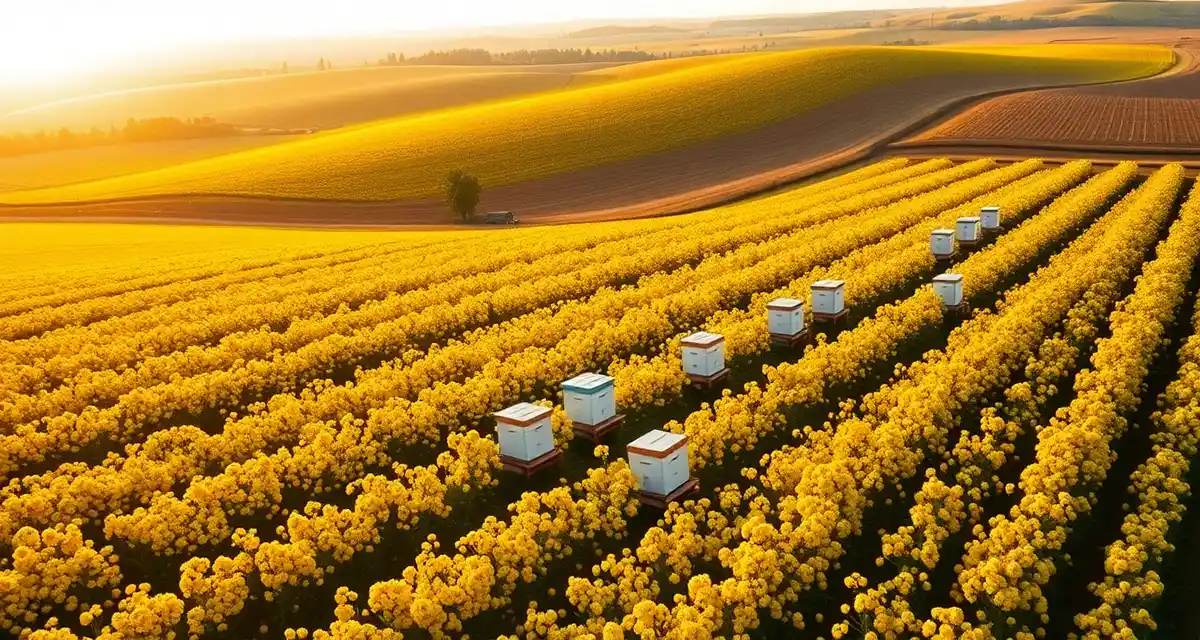
Canola Pollination in Minnesota: Data and Contract Opportunities
Minnesota canola acreage has grown substantially over recent decades as upper Midwest farmers adopted canola as a rotation crop alongside soybeans, corn, and small grains. The crop's strong fit in northern Minnesota's shorter growing season and the state's proximity to the Red River Valley's established canola production in eastern North Dakota created natural conditions for expansion.
Minnesota canola bloom runs July through August alongside the state's clover honey season, creating a natural integration between pollination income and honey production for operators positioned in the northern and western parts of the state. The dual income stream makes Minnesota canola one of the more financially attractive summer opportunities for operators in the Great Lakes region.
TL;DR
- Minnesota's primary commercial beekeeping role is shaped by its crop mix, climate, and position on the national pollination circuit.
- Pollination rates in Minnesota range $65-220/hive depending on crop depending on crop and colony strength requirements.
- Out-of-state operators entering Minnesota for pollination contracts must register with the state agricultural authority and obtain a Certificate of Health.
- Minnesota functions as either a primary pollination destination, a seasonal honey production location, or a transitional stop depending on the circuit.
- Tracking permit status, registration documents, and yard records for Minnesota operations requires organized record-keeping before the season opens.
Minnesota Canola Geography and Acreage Context
Minnesota canola production is concentrated in the northwestern counties of the state, particularly in the Red River Valley counties: Kittson, Marshall, Roseau, and Pennington in the far northwest, with expansion into Clay, Norman, and Polk counties. This geography overlaps directly with the eastern edge of North Dakota's primary canola production zone, creating a contiguous regional market for operators running the Northern Plains circuit.
Minnesota canola acreage has grown substantially from minimal levels in the early 2000s to a significant commercial crop status today, though it remains smaller than North Dakota's output. The USDA National Agricultural Statistics Service publishes annual Minnesota canola acreage data that provides current context for market planning.
The proximity of Minnesota canola production to the state's prime clover honey production areas is an important advantage. Northwestern Minnesota's clover acreage, which supports the state's historic honey production, overlaps geographically with canola production, meaning operators positioned for honey in this region can often add canola pollination contracts from nearby yard locations.
Canola Bloom Timing and Clover Integration
Minnesota canola bloom runs July through August, directly overlapping with the sweet clover and alsike clover honey flows that drive Minnesota's summer honey production. The practical implication: your honey supers are working on clover and wildflower while your hives are potentially contracted for canola pollination in adjacent fields.
This overlap works in your favor because canola bloom itself produces substantial nectar. Hives contracted for canola pollination in July also produce canola honey from the crop they're pollinating. Like in North Dakota, canola honey in Minnesota crystallizes quickly, so extraction timing matters if you want to keep it as a separate varietal product rather than blending it into your general crop.
Comparing Minnesota canola to North Dakota sunflower pollination rates and timing is useful for operators planning multi-state summer routes. North Dakota sunflower runs July through September in the southern part of the state, while Minnesota canola peaks in July, allowing some operators to do Minnesota canola and then transition south to North Dakota sunflower in August and September.
Getting Minnesota Canola Contracts
The Minnesota Canola Council and the Northwest Minnesota Farm Managers and Rural Appraisers Association are your primary contact networks for northwest Minnesota canola growers. The University of Minnesota Extension Service's northwest Minnesota regional specialists work with canola growers and can provide context on which counties have the highest commercial acreage concentration.
Direct outreach to large-acreage operations in Kittson, Marshall, and Roseau counties is viable in February and March for July placements. Minnesota canola growers, like most Northern Plains row crop farmers, are business-oriented about input management and will respond to agronomic yield data for pollination benefit if you present it clearly.
Use PollenOps Minnesota commercial beekeeping resources to structure your compliance documentation. Minnesota apiary registration requirements apply to all commercial operations, and out-of-state operators need current health certificates and import permits for cross-state movement.
Colony Performance in Minnesota Summer
Minnesota's summer climate is significantly more favorable for bees than the arid heat of the Central Valley or the desert Southwest. Long daylight hours, abundant wildflower and clover forage, and moderate temperatures through July support strong colony development. Colonies positioned in northwest Minnesota for summer honey production often reach excellent strength by late June and early July, which is ideal timing for canola placement.
Summer storm risk in Minnesota is real. Hail, heavy rain, and high winds in July and August can damage both crops and colonies. Ensure your equipment is secured against summer weather events, and factor storm risk into your discussion of what happens to the contract if a weather event affects bloom timing.
Varroa monitoring during Minnesota summer is important given the extended brood-rearing season. The warm productive summer that supports great honey production also supports mite population growth. Plan a mite wash monitoring or alcohol roll in mid-summer to confirm your treatment timing is working.
Rates and Contract Terms
Minnesota canola pollination rates are similar to North Dakota, running $70 to $100 per hive. The state's smaller canola acreage relative to North Dakota means competition for pollination contracts is somewhat lower, which can support rate negotiation with progressive growers who understand the yield benefit data.
Sign contracts in February or March for July placements. Net-30 payment after placement is standard. Consider offering multi-year agreements to growers who want supply certainty, since Minnesota canola production is growing and demand for managed pollination is likely to increase.
Frequently Asked Questions
How do you access Minnesota canola pollination contracts?
Contact the Minnesota Canola Council and connect with University of Minnesota Extension Service specialists in northwest Minnesota, who work with commercial canola growers in the main production counties. Direct outreach to operations over 500 acres in Kittson, Marshall, Roseau, and Pennington counties in February and March for July placements is viable. Lead with canola yield data showing the pollination benefit for seed fill, and frame your service as an agronomic input rather than just a commodity rental. Minnesota row crop farmers respond to data-based input decisions.
When is canola bloom in Minnesota?
Minnesota canola bloom runs primarily in July, overlapping with the state's sweet clover and wildflower honey flows. The exact timing varies by planting date and year, but most commercial Minnesota canola blooms in mid-to-late July in the northwestern counties. The timing aligns well with summer honey production and creates the dual income opportunity from pollination fees plus honey production in the same period.
How does Minnesota canola pollination compare to North Dakota sunflower rates?
Minnesota canola rates run $70 to $100 per hive, similar to North Dakota canola and somewhat lower than North Dakota sunflower, which can reach $100 to $130 per hive depending on the operation. Minnesota canola's advantage over sunflower is the honey production dual income: canola bloom produces substantial nectar alongside pollination benefit. An operator running Minnesota canola in July and then transitioning to North Dakota sunflower in August can capture both the stronger sunflower rates and the canola honey production in a single extended Northern Plains summer circuit.
What is the process for registering an out-of-state apiary in a new state?
Most states require out-of-state operators to register with the state department of agriculture apiary program before placing colonies. The process typically involves submitting a registration application (online or paper), paying a fee (usually $10-50 per location), and providing contact information for the operation. Some states also require the registration to be renewed annually. Contact the destination state's department of agriculture apiary program at least 60 days before your planned arrival to confirm current requirements.
What documentation do state apiary inspectors typically review?
State apiary inspectors review health certificates for out-of-state colonies, registration documentation, and colony inspection records during apiary visits. Inspectors check for signs of American foulbrood, European foulbrood, and other regulated pests and diseases. Operations with organized digital records that include treatment history and mite counts typically have faster, less complicated inspections than operations without documentation. Some state inspectors also verify that varroa mite loads are below state entry thresholds.
What triggers a state apiary inspection?
State apiary inspections can be triggered by routine inspection schedules (most states inspect a percentage of registered apiaries annually), neighbor or landowner complaints, disease reports from nearby operations, or inspection requirements tied to state entry permits. California, in particular, has the right to inspect incoming loads at port of entry for commercial beekeeping operations. Maintaining current registration and organized records makes required inspections faster and less disruptive.
Try These Free Tools
Sources
- USDA Agricultural Research Service
- Bee Informed Partnership
- American Beekeeping Federation (ABF)
- Minnesota Department of Agriculture
- Project Apis m.
Get Started with PollenOps
Commercial operations working in Minnesota face the same registration, permit, and documentation requirements as any state on the national circuit -- plus Minnesota's specific regulatory requirements. PollenOps tracks your Minnesota yard records, contract assignments, and permit documentation alongside your full operation, so entering a new state doesn't add a separate administrative burden. See how the platform fits operations working across multiple states.