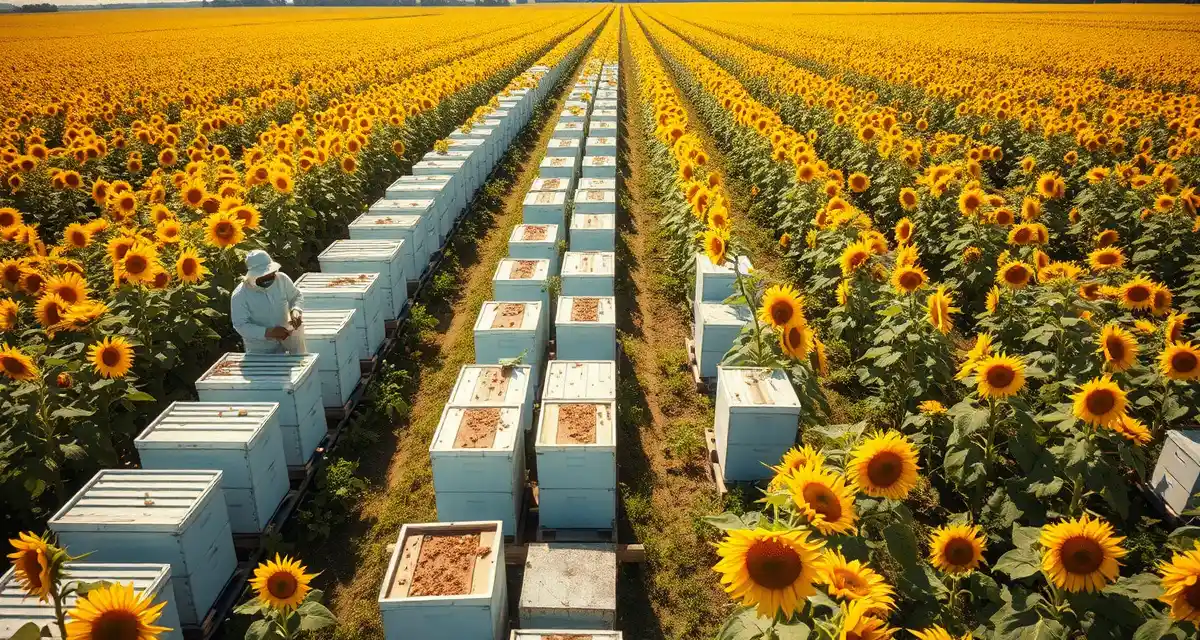
Sunflower Pollination Contracts: North Dakota and the Plains States
North Dakota is the largest sunflower producing state in the US, with over 1.5 million acres of oilseed and confection sunflower in most years. At 1 hive per acre and a mid-summer bloom window, sunflower pollination offers high-volume placements during July–August when your hives are building peak summer populations.
It doesn't pay as much as almonds. But North Dakota sunflower gives you something almonds can't: a productive home for your hives all summer while you harvest serious honey yields from the surrounding clover and wildflower forage.
TL;DR
- Clover seed and sunflower pollination represent two different models: clover seed requires 2-4 hives per acre, while sunflower typically requires 1 hive per acre.
- North Dakota is the center of both US sunflower and honey production, with summer flows that can generate 100+ pounds of honey per colony in good years.
- Clover seed production in the Pacific Northwest (Oregon, Idaho, Washington) requires precise placement timing tied to blooming stage.
- Sunflower pollination rates typically run $40-70 per hive; honey production value from the placement can supplement contract revenue.
- Managing clover or sunflower contracts alongside honey production requires tracking both revenue streams on the same calendar.
The Sunflower Pollination Market
Sunflower pollination demand in North Dakota, South Dakota, and Minnesota runs July through August, with the timing varying by planting date and growing region. The primary pollination belt runs from the southeastern North Dakota counties (Richland, Cass, Ransom) through the central and western production areas.
Confection sunflower (for seeds sold as snacks) pays better for pollination than oilseed sunflower. Confection sunflower growers have more economic incentive to invest in bee placement. Know which type you're placing on. The rate negotiation context differs.
Current market rates:
- Confection sunflower: $60–85/hive
- Oilseed sunflower: $50–70/hive
Lower than tree fruit and almond rates, but consider the context: you're placing hives that are also producing honey at the same time. The pollination rate is incremental revenue on top of what may be your most productive honey production period.
Why Sunflower + Honey = Better Economics
Operators who run North Dakota sunflower alongside summer honey production understand the economics better than those who look at the per-hive pollination rate in isolation.
A 1,000-hive North Dakota summer circuit might look like:
- 600 hives on sunflower pollination contracts: $60/hive × 600 = $36,000
- 400 hives on clover/wildflower honey yards (no pollination contract): 60–80 lb honey/hive × $1.50–2.50/lb = $36,000–80,000
- Total summer revenue: $72,000–116,000
Meanwhile, hives are building strength through the summer for maximum almond delivery populations in February.
The sunflower pollination revenue partially offsets the transport cost of moving to and from North Dakota. The honey revenue is the real summer profit driver.
Timing and the North Dakota Circuit
Sunflower in North Dakota is planted late May/early June and blooms approximately July 15 – August 20, varying by planting date and variety.
For operators running a California-to-North Dakota circuit:
- Exit California almonds late February/March
- Spring crop work (cherries, blueberries) April–June
- Move to North Dakota by early July for sunflower and summer honey
- Pull honey and remove from sunflower contracts late August/early September
- September: move hives to fall staging areas
The North Dakota summer circuit works particularly well for operators with 500+ hives because the scale justifies the logistics cost of moving long distances.
Contract Terms
Delivery timing: Sunflower pollination contracts specify delivery by a certain date relative to bloom stage. Unlike almonds, where delivery windows are tight, sunflower has a longer effective bloom and some flexibility. But get hives in place before peak bloom. 2–3 days before is standard.
Hive count requirements: Most sunflower contracts specify 1 hive per acre. Some large operations with significant confection acreage specify 1.5 hives per acre.
Strength requirements: Sunflower contracts typically specify 4–5 frames of bees. Mid-summer colonies should easily exceed this if spring management was adequate.
Pesticide issues: Sunflower receives insecticide applications, particularly for sunflower moth and sunflower beetle. These applications can be toxic to bees. Notification requirements in your contract are important, and some growers have adopted programs that avoid bee-toxic applications during bloom entirely.
Access: Much of the North Dakota sunflower belt is in flat terrain with good road access. This is a logistics advantage compared to California or Maine.
Long Hauls and Fuel
Moving hives from California to North Dakota is approximately 1,600–1,800 miles (Fresno to Fargo). A fully loaded 18-wheeler at 6 mpg and $4.50/gallon diesel burns roughly $1,200–1,350 in fuel one way, plus driver wages and time. Total one-way cost for a truck haul: $2,500–4,500.
On a load of 500 hives at $65/hive pollination rate, the pollination revenue is $32,500. Fuel is 8–14% of gross on that leg. Add honey production revenue and the economics are significantly better.
For operators running the California-to-Pacific Northwest-to-North Dakota circuit (common for larger operations), the North Dakota leg follows PNW spring work and the long haul cost is amortized across a multi-leg season.
FAQ
When is sunflower pollination season in North Dakota?
Sunflower pollination season in North Dakota runs approximately July 15 through August 20, with peak bloom varying by planting date and growing zone. Sunflower planted in late May typically blooms mid-July; later plantings bloom in early August. The effective bloom window for a single field is 2–3 weeks. For operators contracting with multiple growers across different planting dates, the effective pollination season can extend 4–5 weeks as different fields reach bloom sequentially. Bloom tracking from the North Dakota Department of Agriculture and NDSU Extension is useful for delivery timing planning.
How is sunflower pollination priced per hive?
Sunflower pollination rates run $50–85/hive depending on crop type and contract terms. Confection sunflower (snack seed production) typically pays $60–85/hive because growers have higher per-acre revenue justification for premium pollination. Oilseed sunflower runs $50–70/hive. Both are below almond and blueberry rates, but sunflower pollination during the summer period generates revenue from hives that are simultaneously producing honey. The combined economics of pollination plus honey yield make North Dakota summer placements profitable for most commercial circuits.
How far do operators typically haul hives for sunflower pollination?
North Dakota sunflower draws hives from significant distances. California-based operators make the 1,600–1,800 mile haul specifically for the North Dakota summer circuit. Minnesota, South Dakota, and Wisconsin operators are closer (500–900 miles). Some Pacific Northwest operators also run North Dakota summer yards. The long hauls work economically because: 1) North Dakota honey yields are among the highest in the US (60–100+ lbs/hive in good clover years), 2) sunflower pollination contracts generate revenue during transport recovery, and 3) the flat Plains terrain reduces yard access complications compared to other regions.
What is the difference between commercial and hobby beekeeping?
Commercial beekeeping is distinguished by scale (typically 100+ hives, often 500-5,000+), revenue source (pollination contracts and bulk honey sales rather than local honey retail), and management approach (systematic protocols applied across yards rather than individual colony attention). Commercial operators manage bees as an agricultural enterprise, with the administrative, regulatory, and logistical complexity that entails. Most commercial operators derive the majority of their income from pollination services; honey production is a supplementary revenue stream.
How many hives are needed to make commercial beekeeping a full-time income?
Most beekeeping economists put the full-time commercial threshold at 500-800 hives, assuming efficient operations management and a combination of pollination and honey revenue. At 500 hives and $200/hive for almond pollination, almond season alone generates $100,000 in gross revenue before expenses. Net margins depend on operational efficiency, but well-run operations can achieve 30-50% net margins on pollination revenue. Additional crops and honey production improve per-hive economics but require additional management capacity.
What is the annual revenue potential for a 1,000-hive commercial operation?
A 1,000-hive operation running an almond season ($200/hive) plus blueberry or apple contracts ($80-100/hive) plus summer honey production ($25-40/hive after extraction costs) can generate $300,000-360,000 in annual gross revenue. Net margins after transport, crew, equipment, and hive replacement costs typically run 25-40% for well-managed operations, putting net income at $75,000-145,000 annually. The specific number depends heavily on circuit efficiency, loss rates, and contract quality.
Try These Free Tools
Sources
- USDA Agricultural Research Service
- Bee Informed Partnership
- American Beekeeping Federation (ABF)
- Project Apis m.
- North Dakota Department of Agriculture
Get Started with PollenOps
Clover seed and sunflower pollination often overlap with summer honey production on the same circuit, creating two revenue streams from the same hives. PollenOps tracks both so your financial picture reflects the full value of each yard assignment.