Alcohol Wash Varroa Monitoring Protocol for Commercial Operations
Alcohol wash is the most accurate varroa monitoring method available to commercial beekeepers. Research consistently shows that sugar roll underestimates mite counts by 50% or more compared to alcohol wash on the same colony. At commercial scale, that gap is dangerous: it means treatment decisions based on sugar roll data will be systematically delayed, and colonies going into almond season or winter will carry higher mite loads than you think.
Monthly mite washes across 1,000 hives require standardized protocols that every crew member executes identically. One person's "full cup" of bees may be 200 bees; another person's may be 400. That difference directly affects your mite count reading. Standardization isn't optional when your contract compliance and colony survival depend on accurate data.
TL;DR
- Varroa and varroa-vectored viruses are the leading cause of commercial colony loss, with the Bee Informed Partnership reporting 30-40% annual winter losses nationally.
- At $200-300 per hive replacement cost, a 30% loss on 1,000 hives costs $60,000-90,000.
- Fall varroa treatment is the highest-stakes window: colonies entering winter with high mite loads have significantly elevated mortality.
- For almond-bound colonies, December treatment followed by a January mite wash confirming below 1 mite per 100 bees is increasingly standard.
- Rotation between treatment classes (amitraz, oxalic acid, formic acid) prevents resistance development that reduces efficacy over time.
Sample Collection Protocol
The standard alcohol wash uses a 300-bee sample, which is approximately half a cup of bees collected from the brood frames. Here's the protocol:
- Select 2 to 3 frames with capped and open brood, where nurse bees are concentrated
- Hold the collection jar or cup over a brood frame and shake bees directly into it
- Count or measure to the 300-bee line (a plastic measuring cup with 300-bee mark calibrated at the start of season)
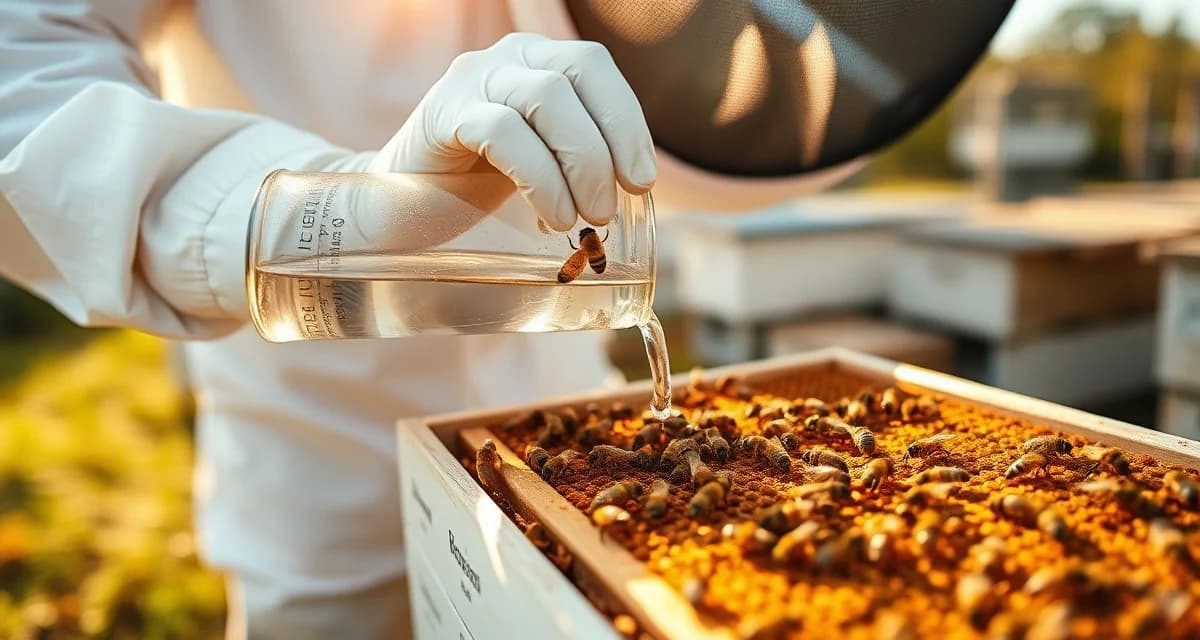
- Add 70% isopropyl alcohol to cover bees completely
- Shake vigorously for 30 to 60 seconds
- Pour through a mesh strainer into a white collection tray
- Count mites in the tray
- Calculate: mites counted divided by 3 = mite wash percentage (mites per 100 bees)
Do not sample from bees on the outer cover or frames of honey. Nurse bees on brood have the highest mite attachment rate. Sampling from the wrong location will underestimate mite load.
Calibrating Crew Consistency
Before the season starts, run a calibration exercise. Have each crew member collect a sample, then count bees in the samples together. Compare results. If one person consistently collects 200 bees and another collects 400, your data is not comparable across crew members.
Use a dedicated collection jar with a 300-bee volume line marked at the start of each season. Calibrate the line by counting 300 dead bees into a jar and marking the fill level. Plastic 16-oz wide-mouth jars work well. Make enough calibrated jars for the full crew.
For large-scale operations, this process fits into your varroa management program for large operations which should include a written SOP that every crew member signs.
Treatment Thresholds
Current thresholds from the Honey Bee Health Coalition and USDA AMS require action at the following mite wash levels:
- August through October (pre-winter): Treatment required at 2% or higher (2 mites per 100 bees)
- Spring buildup (February through May): Treatment required at 2% or higher
- Summer active season: Treatment triggered at 3% or higher
These thresholds are conservative for a reason. At 3%, mite populations are doubling roughly every 4 weeks. Waiting to treat at 4 or 5% means your winter bees will be heavily parasitized.
For colonies booked for pollination contracts, set your action threshold at 1.5% in the 60 days before delivery. A colony at 2.5% at almond placement is a problem you can't fix once it's in the orchard.
Sampling Frequency
At 1,000 hives, monthly sampling of every hive is not realistic. Use a stratified sampling approach:
- Sample 10% of colonies per yard per month (minimum 5 colonies per yard)
- Flag any yard where the average wash exceeds threshold for full-yard treatment
- Sample all colonies in a yard where 30% or more of sampled hives are above threshold
- After any treatment round, sample 10% of treated colonies 30 days post-treatment to confirm efficacy
Document every mite wash with colony ID, date, crew member, bee count, mite count, and calculated percentage. This data is essential for tracking treatment timing and documenting compliance for hive health monitoring purposes.
Data Recording and Action Triggers
Paper datasheets in the field that get lost in a truck cab are not a monitoring program. Every mite wash result needs to be recorded in a system that triggers action when thresholds are exceeded.
Your monitoring system should generate:
- A yard-level summary of average mite load
- Flags for individual colonies above threshold
- Automatic alerts when yard averages hit treatment triggers
- Treatment history records tied to monitoring data
This data also protects you in contract disputes. If a grower claims your hives were mite-infested at delivery, documented mite washes in the weeks before placement give you a clear record.
Frequently Asked Questions
How do you conduct alcohol wash monitoring across 1000 hives?
A 1,000-hive operation uses stratified sampling: test 10% of colonies per yard each month, selecting samples from frames with active brood where nurse bees are concentrated. Standardize crew collection with calibrated jars marked for 300-bee sample volume. Each crew member needs their collection calibrated before the season starts. After washing, count mites in a white tray and record: colony ID, date, sampler, bee count, mite count, percentage. When a yard's average exceeds threshold, escalate to full-yard sampling and treat accordingly. Document every result in a trackable system, not loose paper datasheets.
What mite count triggers treatment in a commercial operation?
The Honey Bee Health Coalition recommends treatment at 2 mites per 100 bees from spring through fall, dropping to 1 to 2 mites per 100 bees for winter bee production (August through October). For commercial operations with pollination contracts, set internal triggers slightly below the published thresholds. A colony at 1.5% in September will hit 3% by the time almond season starts if not treated. Build in buffer time for treatment efficacy. Apivar requires 42 to 56 days to reach full knockdown. If your first almond hive delivery is February 1, your treatment window closes in late December.
How do you train crew members to perform consistent mite washes?
Start each season with a hands-on calibration session. Have every crew member collect a sample independently, then count the bees together. Any person collecting significantly under or over 300 bees needs retraining on measurement. Provide each crew member with a calibrated collection jar. Walk through the full protocol: sample location on the brood frames, alcohol volume, shake time, straining technique, and mite counting in a white tray. Run paired sampling where a new crew member and an experienced one sample adjacent colonies in the same yard and compare results. Document each crew member's training completion.
What mite count threshold triggers treatment in commercial operations?
Most commercial operators use a 2-mite-per-100-bees threshold for treatment decisions during the active season. At 3 or more mites per 100 bees, treat immediately regardless of season. For colonies destined for California almond contracts in February, the target is below 1 mite per 100 bees at December assessment, which is stricter than general treatment thresholds. The December target reflects the need for winter bees to survive at full viability through February.
How do you treat 1,000 hives for varroa efficiently?
For oxalic acid vaporization, a battery-powered vaporizer setup allows a 2-person crew to treat 100-150 colonies per day, requiring 7-10 crew-days for 1,000 hives per treatment cycle. Apivar strip treatments are faster to apply (200-300 colonies per day for a 2-person crew) but require accurate tracking of installation and removal dates. Both methods require documentation of product, date, dosage, and crew member for each yard to meet commercial contract and state inspection requirements.
Can organic-certified colonies be treated for varroa?
Organic honey certification has specific treatment restrictions. Oxalic acid and formic acid (MAQS, Formic Pro) are permitted for use in organic-certified operations. Apivar (amitraz) and Apistan (tau-fluvalinate) are synthetic miticides not compatible with organic certification. For operations pursuing organic honey premiums, building a varroa management protocol around approved products is required. Some organic pollination contracts also specify treatment restrictions; review contract language carefully.
Try These Free Tools
Sources
- USDA Agricultural Research Service
- Bee Informed Partnership
- American Beekeeping Federation (ABF)
- Project Apis m.
- Pennsylvania State University Apiculture Program
Get Started with PollenOps
Varroa management at commercial scale requires documentation that satisfies growers, state inspectors, and your own year-over-year analysis. PollenOps structures mite monitoring records, treatment logs, and yard-level history so the data you need is there when you need it.