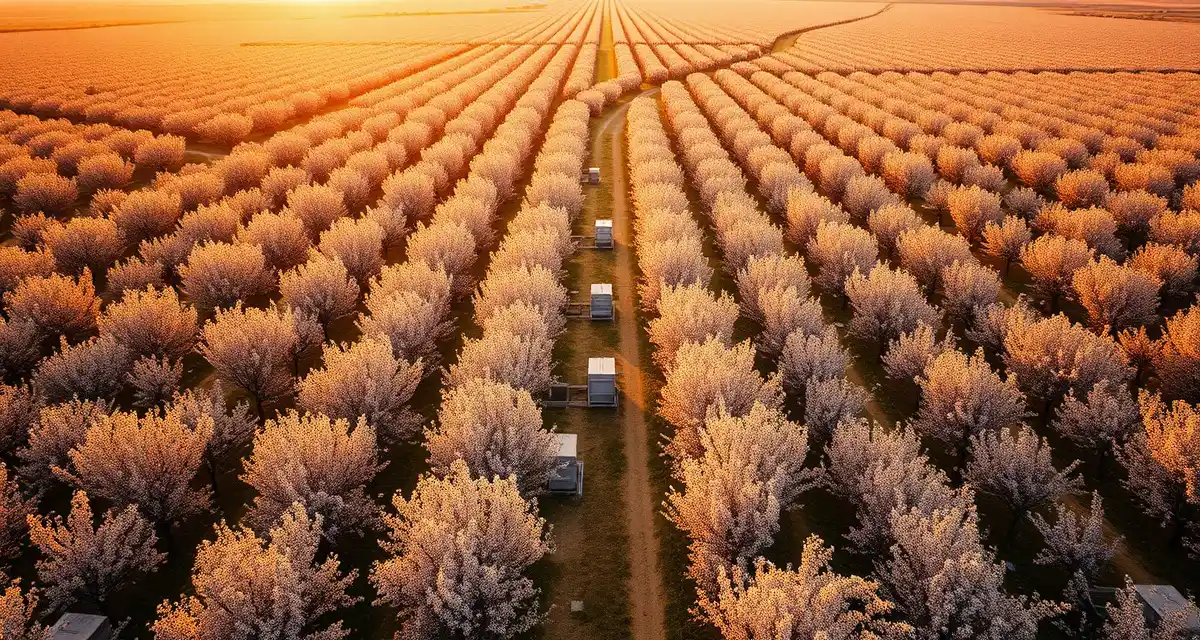
California Almond Production Data: Acreage Growth and Hive Demand
California almond acreage surpassed 1.5 million bearing acres in 2023 and the industry hasn't stopped planting. The scale is hard to fully absorb: almonds are now grown on more California farmland than any other tree crop, and the demand for managed pollinators that acreage creates is larger than any other single agricultural market in the world. For commercial beekeepers planning fleet investment, hive expansion, or multi-year contract commitments, understanding the data behind this market matters as much as understanding the bees.
Approximately 1.3 million managed honey bee colonies are required annually to pollinate California's almond crop, representing roughly 80 percent of the total US managed colony supply. That figure has grown in proportion with acreage, and it means the almond industry now dictates terms for a large fraction of commercial beekeeping operations nationwide. If you're in commercial pollination, almonds aren't just a contract; they're the core economic driver shaping every other decision you make about fleet size, winter management, and seasonal routing.
TL;DR
- California's primary commercial beekeeping role is shaped by its crop mix, climate, and position on the national pollination circuit.
- Pollination rates in California range $65-220/hive depending on crop depending on crop and colony strength requirements.
- Out-of-state operators entering California for pollination contracts must register with the state agricultural authority and obtain a Certificate of Health.
- California functions as either a primary pollination destination, a seasonal honey production location, or a transitional stop depending on the circuit.
- Tracking permit status, registration documents, and yard records for California operations requires organized record-keeping before the season opens.
Acreage Growth: What 20 Years of Data Show
California almond acreage has grown from roughly 490,000 bearing acres in 2003 to over 1.5 million in recent years, a more than three-fold increase in two decades. The growth has been concentrated in the San Joaquin Valley, particularly in Fresno, Kern, Tulare, and Merced counties, though plantings have extended into areas previously considered marginal for almonds.
The Almond Board of California publishes annual acreage and production reports that are the authoritative source for these numbers. The data shows that while growth has slowed from the rapid expansion years of the mid-2010s, new plantings continue to outpace removals in most years. There are also meaningful acres of non-bearing almonds that will become productive over the next three to five years, which means hive demand will continue to grow even without new plantings.
For beekeepers making decisions about whether to expand their fleet, the acreage data is more useful than production data because it reflects future demand. A drought year reduces production but doesn't reduce hive demand; the trees still bloom and still need pollination regardless of whether conditions favor a full crop.
Hive Demand Math
The standard industry requirement is 2 hives per bearing acre, though many growers in competitive supply years have moved to 2.5 or even 3 hives per acre in critical blocks. Applying 2 hives per acre to 1.5 million bearing acres gives 3 million hive placements, but this number gets adjusted down because some acreage is in non-commercial family situations, some is organically managed with lower pollination contract rates, and some is in young orchards with lower density requirements.
The practical working figure used by industry analysts is approximately 1.3 million colonies needed for the annual California almond crop. That number represents about 80 percent of all managed US colonies. In practical terms: if almond season has a supply problem, it cannot be solved quickly because there are no domestic reserves large enough to fill the gap.
The supply tightness has pricing implications that every commercial beekeeper should understand. Per-hive almond rates have increased 18 percent since 2020 according to contract data, driven by growing acreage against a managed colony supply that hasn't grown proportionally. Dead colonies, CCD-related losses, and varroa-driven winter mortality all constrain supply in ways that support rate growth, even in years with otherwise normal agricultural economics.
What the Data Means for Contract Planning
If you're building a commercial operation with almond pollination as the economic anchor, the most important number isn't the current per-hive rate. It's the ratio between contracted hive demand and your available hive count, including reasonable winter loss estimates. If you contract 500 hives and arrive with 420 because winter was hard, you've created a contract compliance problem that costs you more than the difference in per-hive revenue.
Building in a buffer by contracting 85 to 90 percent of your expected available count rather than 100 percent gives you insurance against the inevitable losses that occur between contract signing and delivery. The almond data supports charging premium rates for documented delivery of certified-strength colonies because growers understand supply is limited and quality is variable.
Tracking your own hive performance data against industry averages is something PollenOps contract management software facilitates through year-over-year fleet inventory reports. The national pollination market context behind these numbers helps you negotiate from data rather than anecdote.
Variety Diversity and Multi-Year Planning
California almond production is dominated by Nonpareil, but the industry has diversified significantly toward self-compatible varieties like Independence and Shasta. This matters for pollination economics: self-compatible varieties require fewer bees per acre and theoretically reduce total hive demand. However, growers planting self-compatible varieties haven't necessarily reduced their contracted hive counts because they're cautious about production risks from inadequate pollination.
The variety shift is something to watch over a 5-year planning horizon. If self-compatible acreage grows substantially and growers gain confidence in reduced hive density requirements, total industry hive demand could plateau or decline slightly even as bearing acreage grows. Current signals don't suggest this is imminent, but it's relevant background for anyone making long-term capital commitments to almond pollination capacity.
Frequently Asked Questions
How much has California almond acreage grown in the past 20 years?
California almond bearing acreage grew from approximately 490,000 acres in 2003 to over 1.5 million acres by 2023, more than a three-fold increase in two decades. Growth has been concentrated in the San Joaquin Valley, particularly Fresno, Kern, Tulare, and Merced counties, with additional expansion into historically marginal growing areas. The Almond Board of California publishes annual bearing acreage and production data that you can use for planning. Non-bearing almond acreage that will mature over the next several years means continued growth in hive demand even without new plantings.
How many hives does each almond acre require?
The industry standard is 2 hives per bearing acre, though many growers in supply-tight years have moved to 2.5 to 3 hives per acre for high-value blocks. Applying 2 hives per acre to California's 1.5 million bearing acres yields roughly 3 million hive placements annually in theory, though the working figure accounting for non-commercial and marginal situations is approximately 1.3 million colonies. Some newer self-compatible almond varieties may need fewer hives per acre, but most growers continue to contract at traditional densities to protect their crop in weather conditions that reduce individual bee effectiveness.
What does California almond growth mean for pollination contract pricing?
Growing almond acreage against a constrained managed colony supply has driven per-hive rates up approximately 18 percent since 2020. The almond crop already requires about 80 percent of all managed US colonies annually, and domestic supply cannot grow rapidly enough to match acreage expansion. This structural supply tightness supports continued rate growth for beekeepers who deliver certified-strength colonies reliably. Documented delivery history, professional contracts, and GPS-verified placement records give you negotiating credibility when pushing for higher rates at renewal time.
What is the process for registering an out-of-state apiary in a new state?
Most states require out-of-state operators to register with the state department of agriculture apiary program before placing colonies. The process typically involves submitting a registration application (online or paper), paying a fee (usually $10-50 per location), and providing contact information for the operation. Some states also require the registration to be renewed annually. Contact the destination state's department of agriculture apiary program at least 60 days before your planned arrival to confirm current requirements.
What documentation do state apiary inspectors typically review?
State apiary inspectors review health certificates for out-of-state colonies, registration documentation, and colony inspection records during apiary visits. Inspectors check for signs of American foulbrood, European foulbrood, and other regulated pests and diseases. Operations with organized digital records that include treatment history and mite counts typically have faster, less complicated inspections than operations without documentation. Some state inspectors also verify that varroa mite loads are below state entry thresholds.
What triggers a state apiary inspection?
State apiary inspections can be triggered by routine inspection schedules (most states inspect a percentage of registered apiaries annually), neighbor or landowner complaints, disease reports from nearby operations, or inspection requirements tied to state entry permits. California, in particular, has the right to inspect incoming loads at port of entry for commercial beekeeping operations. Maintaining current registration and organized records makes required inspections faster and less disruptive.
Try These Free Tools
Sources
- USDA Agricultural Research Service
- Bee Informed Partnership
- American Beekeeping Federation (ABF)
- California Department of Agriculture
- Project Apis m.
Get Started with PollenOps
Commercial operations working in California face the same registration, permit, and documentation requirements as any state on the national circuit -- plus California's specific regulatory requirements. PollenOps tracks your California yard records, contract assignments, and permit documentation alongside your full operation, so entering a new state doesn't add a separate administrative burden. See how the platform fits operations working across multiple states.