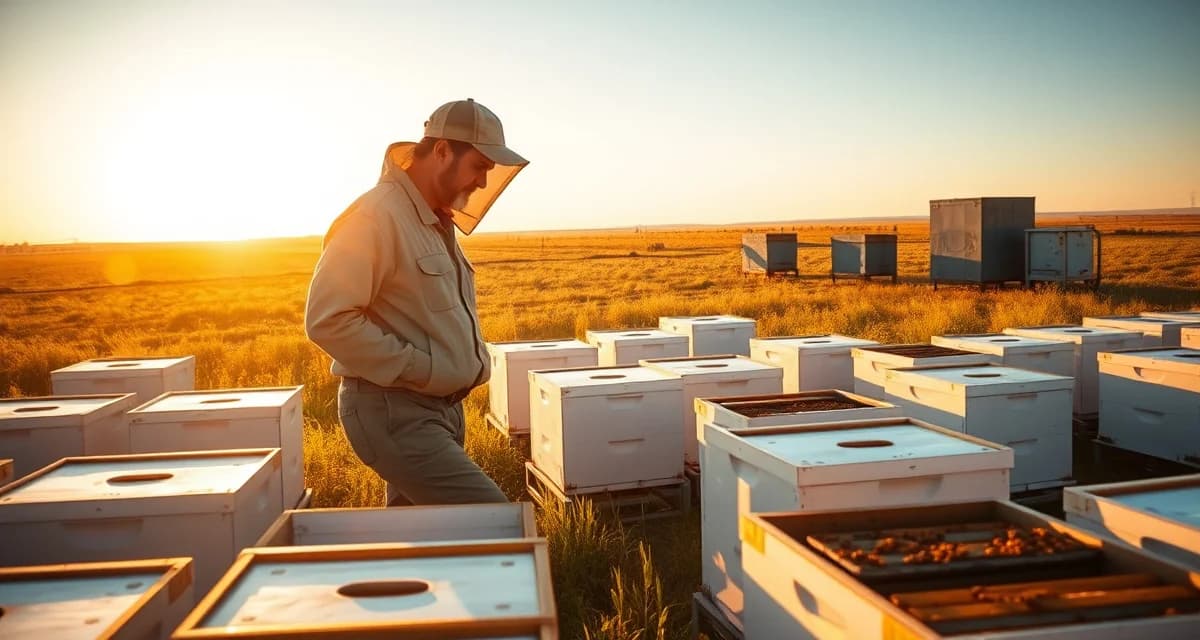
Selling North Dakota Honey: Markets Brokers and Distribution
North Dakota's top producers generate 500,000-1,000,000 lbs of honey annually, and operations at that scale require industrial distribution. Bulk honey brokers are the dominant channel for large North Dakota honey operations, and building the right broker relationships before the season ends is as important as the production itself.
TL;DR
- North Dakota's primary commercial beekeeping role is shaped by its crop mix, climate, and position on the national pollination circuit.
- Pollination rates in North Dakota range $65-220/hive depending on crop depending on crop and colony strength requirements.
- Out-of-state operators entering North Dakota for pollination contracts must register with the state agricultural authority and obtain a Certificate of Health.
- North Dakota functions as either a primary pollination destination, a seasonal honey production location, or a transitional stop depending on the circuit.
- Tracking permit status, registration documents, and yard records for North Dakota operations requires organized record-keeping before the season opens.
The Scale of North Dakota Honey Production
North Dakota is consistently the top honey-producing state in the US, producing 30-40 million pounds annually across all operations. The state's sunflower, alfalfa, and wildflower forage supports colony densities and production volumes that dwarf most other regions.
A large commercial operation running 3,000-5,000 hives in North Dakota can produce 500,000 to over 1,000,000 lbs of honey in a good year. That volume doesn't move through farmers markets. It requires industrial distribution infrastructure: bulk storage, brokers, and packer relationships.
Understanding the market landscape before you produce is critical. Most operators plan their distribution before the season, not after.
Bulk Honey Brokers: The Primary Channel
Bulk honey brokers purchase the majority of commercial North Dakota honey production. Brokers act as intermediaries between producers and honey packers, processors, and industrial buyers. The broker relationship is the central commercial relationship for most large North Dakota operations.
How brokers work: Brokers buy honey in 55-gallon drums or larger tote quantities at market rates. They handle logistics, storage, and resale to packers. Most brokers offer both spot pricing (current market rate at sale) and forward contracts (price agreed before or during production).
Current bulk pricing: North Dakota bulk honey (primarily sunflower, alfalfa, and mixed wildflower) sells to brokers at $1.80-$2.80/lb depending on variety, quality, and market conditions. Sunflower honey's strong crystallization characteristics mean it typically sells at the lower end of the range. Alfalfa and mixed wildflower command somewhat higher rates.
Key broker relationships: Major honey brokers operating in the Northern Plains include national buyers who contract annually with large operators. The American Honey Producers Association and North Dakota Agricultural Extension can provide current broker contact information. The landscape shifts as companies merge, and direct referrals from other operators are the most reliable source of active buyer contacts.
Negotiating with brokers: Large-volume operators have negotiating leverage. Brokers compete for reliable, quality-certified supply from established operations. Build relationships with multiple brokers rather than depending on one. Price shopping between brokers at sale time is standard practice in the industry.
Forward Contracts and Price Certainty
Forward contracts (where you agree on a price before or during production) provide planning certainty but limit upside if market prices rise. Spot sales capture market price at the time of sale but expose you to downside if prices fall.
Most large North Dakota operators use a combination: forward contract a portion of expected production for certainty, and sell the balance spot at market rates. A common approach is to forward contract 30-50% of expected production in spring when you have a sense of colony strength.
Forward contracts typically require volume guarantees. If you commit to 200,000 lbs and produce 150,000, you may face penalties or need to purchase from other producers to fulfill. Size forward contracts conservatively relative to expected production.
Co-ops and Producer Organizations
The American Honey Producers Association (AHPA) provides collective marketing support and market intelligence for commercial producers. State-level honey producer associations, including the North Dakota Honey Industry Association, offer market connections and peer networking.
True marketing co-ops (where producers pool product and sell collectively) are less common in honey than in some other agricultural commodities. Most operators sell independently through broker relationships rather than through formal co-ops.
Some producers with aligned marketing interests form informal pooling arrangements, agreeing to sell to the same broker at the same time to reach minimum quantity thresholds for premium pricing. This informal coordination captures some co-op benefits without formal organizational structure.
Direct Market Channels at Scale
For most large North Dakota operations, direct-to-consumer marketing is a secondary channel. The volume is simply too large for farmers markets and direct retail to absorb. However, a premium-positioned subset of production can move through higher-value channels.
Regional specialty retailers: Twin Cities, Chicago, and Denver specialty food retailers buy North Dakota honey if it's positioned with provenance. This requires consistent branding, packaging investment, and direct buyer relationships. It's more overhead than bulk sales but considerably better per-pound return.
Online direct-to-consumer: North Dakota clover and wildflower honey with provenance positioning sells online at $8-14/lb, which is 3-5x bulk rates. This works at the scale of 5,000-20,000 lbs per year, not 500,000 lbs. But carving out a premium-positioned subset is worth the effort.
Commercial honey market trends provides market data on honey pricing across channels.
For operations tracking production by yard and variety, PollenOps production logs help you document quality by source, which is important for both premium positioning and broker negotiations.
Frequently Asked Questions
How do you sell bulk honey from a North Dakota commercial operation?
North Dakota bulk honey sells primarily through broker relationships. Identify two to three brokers who actively buy Northern Plains honey. Ask other operators for referrals, and contact the American Honey Producers Association for current buyer lists. Establish relationships before the season, discuss pricing expectations and contract structures, and agree on logistics (drum pickup, storage, inspection). Most large operations negotiate annual broker relationships rather than selling on the spot market after production. The predictability of committed buyer relationships simplifies planning. Keep detailed production records by yard and variety. Quality documentation justifies premium pricing with buyers.
What brokers buy North Dakota bulk honey?
The bulk honey broker landscape in the Northern Plains includes national buyers like Barkman Honey, Dutch Gold Honey, and other large national packers who work directly with large producers, as well as regional brokers who aggregate supply. The American Honey Producers Association maintains a buyer directory, and state agricultural extensions have current market contacts. The most reliable broker referrals come from other operators. Ask at industry events who pays reliably, picks up on schedule, and offers fair market pricing. Broker relationships are long-term commercial relationships, not one-time transactions. Evaluating a broker's track record with existing clients before committing is worth the research investment.
Is there a honey co-op in North Dakota for commercial producers?
There isn't a major formal honey marketing co-op in North Dakota equivalent to grain co-ops. The North Dakota Honey Industry Association and the American Honey Producers Association provide market support, collective advocacy, and industry connections, but they don't typically function as collective selling organizations. Informal producer networks (where operators coordinate broker relationships to reach volume thresholds) serve some co-op functions in practice. Some multi-operator businesses in the Northern Plains co-pack and co-market under shared brands, which achieves similar economies. If formal co-op structure is attractive, investigate the organizational requirements with a cooperative extension specialist before committing.
What is the process for registering an out-of-state apiary in a new state?
Most states require out-of-state operators to register with the state department of agriculture apiary program before placing colonies. The process typically involves submitting a registration application (online or paper), paying a fee (usually $10-50 per location), and providing contact information for the operation. Some states also require the registration to be renewed annually. Contact the destination state's department of agriculture apiary program at least 60 days before your planned arrival to confirm current requirements.
What documentation do state apiary inspectors typically review?
State apiary inspectors review health certificates for out-of-state colonies, registration documentation, and colony inspection records during apiary visits. Inspectors check for signs of American foulbrood, European foulbrood, and other regulated pests and diseases. Operations with organized digital records that include treatment history and mite counts typically have faster, less complicated inspections than operations without documentation. Some state inspectors also verify that varroa mite loads are below state entry thresholds.
What triggers a state apiary inspection?
State apiary inspections can be triggered by routine inspection schedules (most states inspect a percentage of registered apiaries annually), neighbor or landowner complaints, disease reports from nearby operations, or inspection requirements tied to state entry permits. California, in particular, has the right to inspect incoming loads at port of entry for commercial beekeeping operations. Maintaining current registration and organized records makes required inspections faster and less disruptive.
Try These Free Tools
Sources
- USDA Agricultural Research Service
- Bee Informed Partnership
- American Beekeeping Federation (ABF)
- North Dakota Department of Agriculture
- Project Apis m.
Get Started with PollenOps
Commercial operations working in North Dakota face the same registration, permit, and documentation requirements as any state on the national circuit -- plus North Dakota's specific regulatory requirements. PollenOps tracks your North Dakota yard records, contract assignments, and permit documentation alongside your full operation, so entering a new state doesn't add a separate administrative burden. See how the platform fits operations working across multiple states.