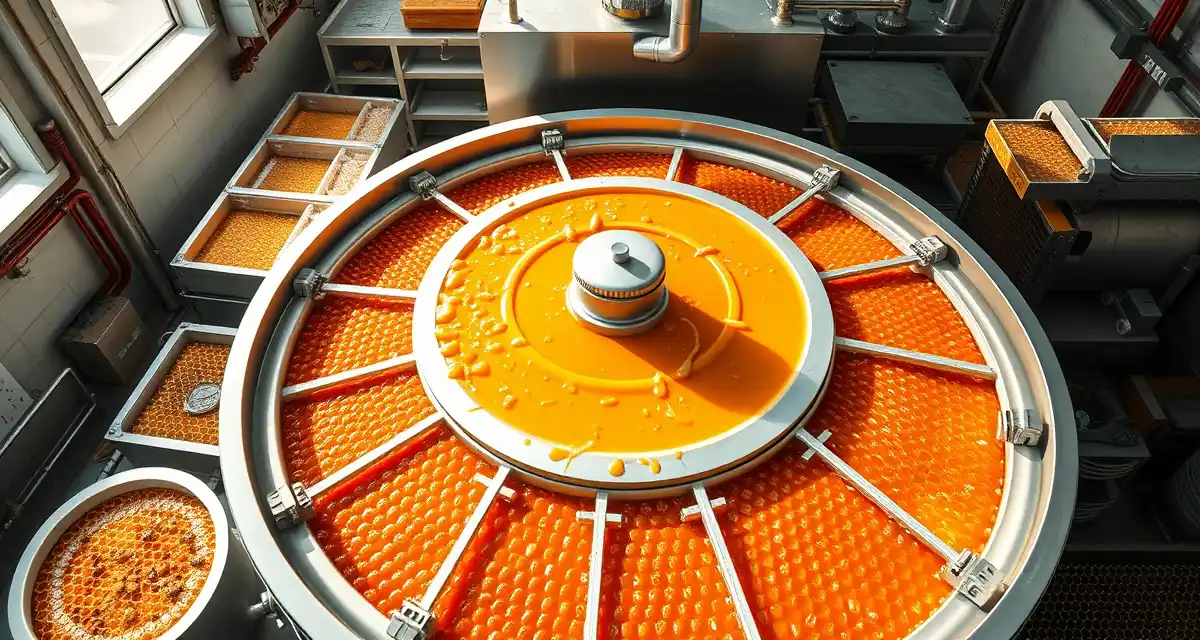
Commercial Honey Extraction Equipment for Large-Scale Operations
A 60-frame radial extractor runs $15,000 to $30,000, and it's the centerpiece of any commercial honey operation. Getting the extractor sizing right before you buy determines whether your extraction line is a bottleneck or an asset. Most operators at 1,000 hives undersize their extractor, then spend twice as many hours extracting as necessary. That's a capital decision with long operating consequences.
1,000 hives producing 50 pounds of honey per hive generates 50,000 pounds of honey per extraction cycle. Depending on how many crops you pull, that volume hits your extraction line 2 to 4 times a season. An underpowered extraction setup not only slows you down, it damages honey quality when you're handling frames for extended periods in warm weather.
TL;DR
- Wholesale honey prices for commercial producers have ranged from $1.50-2.50 per pound for bulk clover honey in recent seasons.
- Varietal honeys (buckwheat, tupelo, sourwood) command $3.00-5.00 per pound or more at wholesale.
- Summer honey production in North Dakota, Montana, and the Pacific Northwest is the primary source of bulk honey revenue for migratory operations.
- Honey production and pollination revenue streams can be combined on the same annual circuit, with most operations capturing both.
- Packing, storage, and distribution requirements for commercial honey production add cost and logistics complexity beyond the extraction stage.
Choosing Extractor Size
Radial extractors are rated by frame capacity. For commercial operations, practical size ranges are:
36-frame radial: Entry-level commercial. Handles small-scale commercial operations of 300 to 500 hives if you're running single-story honey supers. Typical price range $8,000 to $15,000. For most operations at this size, this extractor will be the bottleneck.
60-frame radial: The workhouse of mid-size commercial operations, 500 to 2,000 hives. Run time of 12 to 15 minutes per load, depending on honey viscosity and motor power. New units from Maxant, Lyson, or Cowen run $15,000 to $30,000. Used units in good condition can be found for $8,000 to $18,000.
120-frame and larger: For operations above 2,000 hives, or where a single operation runs multiple crews in peak extraction season. These full industrial extractors start at $40,000 and run to $100,000+ for complete automated setups.
Match your extractor size to your peak frame volume, not your average. If you're pulling 1,000 frames on a single day from a strong fall nectar flow, you need extraction capacity that doesn't leave frames sitting overnight in warm conditions.
Uncapping Equipment
Cold knife uncappers: Manual option for smaller operations or for finishing work after mechanical uncapping. Slow but effective on irregular comb.
Heated knife uncappers: Faster than cold knife, requires operator attention, around $500 to $2,000 for commercial-grade units.
Automatic uncappers (drum-type): The standard for commercial operations. Cowen and Maxant make drum uncappers that process frames through a set of rotating chains or paddles, scraping the cappings off both sides simultaneously. Rates of 20 to 30 frames per minute are achievable. Units run $8,000 to $20,000. These are essential for any operation extracting more than 500 frames per day.
Decapping tank: Catches cappings and allows honey to drain before cappings go to the wax melter. Size your decapping tank to hold at least one full extractor load of cappings without overflowing.
Processing Line Flow
A properly designed extraction line flows in one direction without backtracking:
- Uncapping station (automatic uncapper, decapping tank)
- Radial extractor
- Honey sump or holding tank with coarse strainer
- Pump to settling tank or bottling tank
- Fine strainer or filter before settling
- Settling tank with gate valve
Layout matters. Every frame a crew member carries across a path or backtrack is time wasted. Plan the building footprint around the extraction flow before installing equipment.
Honey sump tanks need to be sized for at least one full extractor load of honey. At 60 frames per load at 4 to 6 pounds of honey per frame, that's 240 to 360 pounds per extraction cycle going into the sump.
Bottling and Storage
Settling tanks: Honey settles best at 95 to 100 degrees Fahrenheit, allowing air bubbles and wax particles to rise. A 2-day settling period produces cleaner honey with less wax. Size your settling capacity for at least one full day's extraction volume.
Storage drums: Food-grade 55-gallon drums hold approximately 650 pounds of honey each. 50,000 pounds of honey from a 1,000-hive operation requires about 77 drums. Steel drums are industry standard; factor in storage footprint.
Temperature control: Honey heated above 110 degrees damages quality and HMF levels. Extraction rooms should be kept at 90 to 95 degrees for efficient extraction without overheating product.
Capital Costs for a 1000-Hive Setup
A realistic extraction setup for a 1,000-hive operation:
- 60-frame radial extractor: $18,000 to $28,000
- Automatic uncapper: $10,000 to $18,000
- Decapping tank, sump, settling tank: $3,000 to $8,000
- Pump, strainers, piping: $2,000 to $5,000
- 80 to 100 food-grade drums: $6,000 to $10,000
- Building/infrastructure modifications: variable
Total extraction setup: $40,000 to $70,000 before building costs. Factor this into your capital planning and equipment financing.
Frequently Asked Questions
What extraction equipment is needed for a 1000-hive honey operation?
A 1,000-hive operation producing 50 pounds of honey per hive needs a 60-frame or larger radial extractor, an automatic drum-type uncapper, a decapping tank, a honey sump with strainer, a pump, settling tanks, and food-grade storage drums. The automatic uncapper is the piece most operators skip that costs them the most time. Manual uncapping a 60-frame extractor load takes 20 to 30 minutes; an automatic uncapper handles the same load in 3 to 5 minutes. At several hundred extraction loads per season, the time savings justify the capital cost at this scale.
How do you size extraction equipment for commercial beekeeping?
Size to your peak single-day volume, not your average. If a strong fall flow means pulling 800 frames in one day, you need an extractor and uncapper capable of processing that volume without leaving frames sitting. A 60-frame radial extractor at 15-minute cycle time can process about 240 frames in an 8-hour day. For 800 frames in a day, you need either a larger extractor, multiple extractors, or extended operating hours. Undersizing creates a bottleneck that damages honey quality during peak flows and drives overtime labor costs.
What is the cost of a commercial honey extraction setup?
A functional commercial extraction setup for a 1,000-hive operation runs $40,000 to $70,000 for equipment, not including building infrastructure. The biggest individual cost is the radial extractor at $15,000 to $30,000 for a 60-frame unit. An automatic uncapper adds $10,000 to $18,000. Processing tanks, pumps, strainers, and storage drums add $10,000 to $20,000 more. Used equipment in good condition can reduce these costs by 30 to 50%. SBA and USDA FSA equipment financing programs are available for commercial beekeeping operations and can spread capital costs over 5 to 7 years.
How do commercial beekeepers choose summer honey yard locations?
Summer honey yard selection focuses on forage quality, density, and landscape characteristics. North Dakota and Montana white clover and sweetclover flows typically produce 80-150 pounds per colony in good years. The Pacific Northwest offers diverse flows from clover, fireweed, and wildflowers. Proximity to other apiaries reduces forager competition; bee-friendly state lands or rented agricultural properties with forage diversity are preferred. Water availability within 1-2 miles of each yard is a basic requirement.
What is the difference between selling honey as bulk versus packaged retail?
Bulk honey sales to brokers or packers provide simple logistics (55-gallon drums or totes shipped directly from extraction) but yield lower per-pound prices ($1.50-2.50/pound for clover at wholesale). Packaged retail sales through direct channels (farmers markets, online, specialty retailers) yield $6-12 per pound but require labeling, packaging equipment, food safety compliance, and distribution relationships. Most commercial operations rely primarily on bulk sales and use retail as a supplementary channel for premium varieties.
Can honey production records be tracked alongside pollination contract records?
Yes. PollenOps tracks yard assignments and honey production data alongside pollination contracts so the full economic picture of each yard and each season is visible in one system. This matters for operations that use the same yards for honey production in summer and pollination staging in winter and spring, since the value of a yard location depends on both revenue streams.
Try These Free Tools
Sources
- USDA Agricultural Research Service
- Bee Informed Partnership
- American Beekeeping Federation (ABF)
- American Honey Producers Association
- National Honey Board
Get Started with PollenOps
Running honey production alongside pollination contracts requires coordinating two revenue streams on a single annual calendar. PollenOps tracks both in one platform so your circuit planning reflects reality rather than optimistic assumptions.