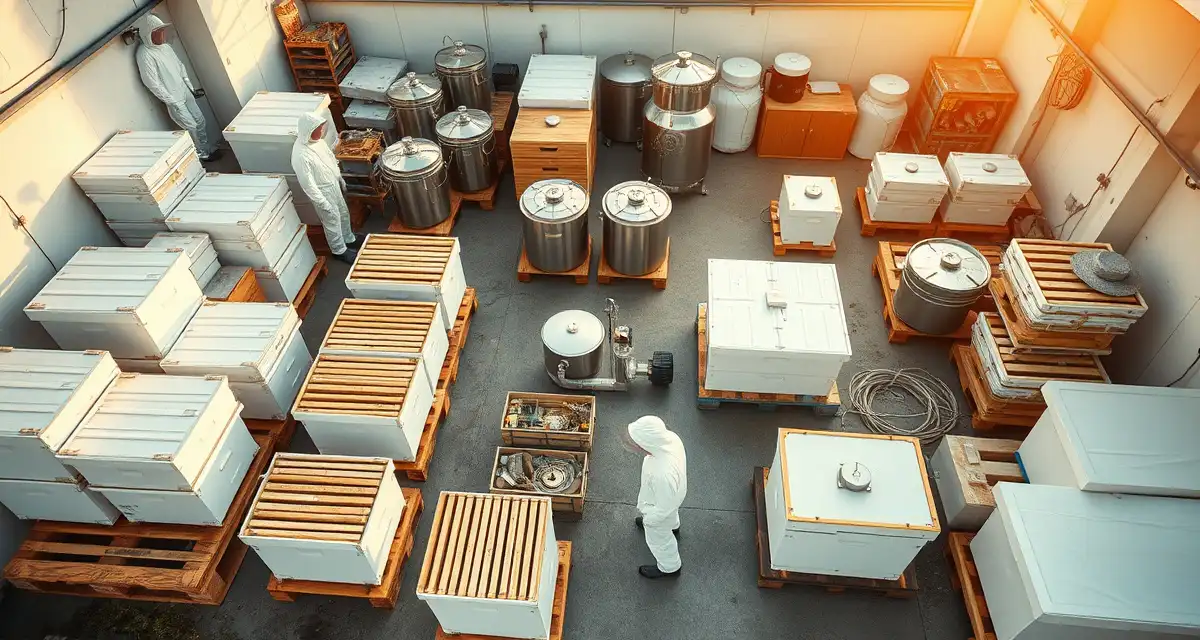
Commercial Beekeeping Equipment List: Everything a 500-Hive Operation Needs
A 500-hive commercial operation requires $150,000 to $200,000 in hive and extraction equipment before you account for trucks. That number surprises people who've only managed hobby hives, but the scale changes everything. Beehive bodies cost $150 to $250 per full colony setup including frames and foundation, which means 500 colonies represent $75,000 to $125,000 in hive hardware alone.
This is the practical equipment list for a 500-hive operation combining pollination and honey production. It's organized by category so you can budget and phase purchases appropriately.
TL;DR
- Core equipment for a 500+ hive commercial operation includes flatbed trailer or 18-wheeler capacity, a forklift or telehandler, commercial OAV vaporizers, and a honey extraction setup.
- Equipment needs scale with hive count; operations above 1,000 hives typically need multiple vehicles and a dedicated extraction facility.
- USDA Farm Service Agency operating loans and equipment financing from agricultural lenders are the primary financing options for commercial equipment purchases.
- Detailed equipment inventory with depreciation schedules supports loan applications and insurance coverage documentation.
- Equipment maintenance records and scheduling prevent breakdowns at peak-demand times when truck or forklift failures have maximum operational impact.
Hive Equipment
Hive bodies: Two deep hive bodies (9 5/8") or Illinois medium configuration per colony, depending on your preference. At 500 colonies with 2 boxes each, plus 20% spare inventory for splits and replacements, you need 1,200 hive bodies minimum.
Frames and foundation: Ten frames per box, beeswax or plastic foundation. Budget 12,000+ frames for the initial setup plus ongoing replacement. Commercial plastic frames ($1.50 to $2.50 each) or wooden frames with wax or plastic foundation.
Bottom boards: 500 + 10% spare = 550 screened or solid bottom boards.
Inner covers and outer covers: 500 of each, plus spare inventory.
Queen excluders: 250 to 300 for honey production hives (about half the operation typically has supers).
Honey supers: Medium depth (6 5/8") supers work well for commercial extraction. Plan 2 to 4 supers per honey-producing colony, meaning 500 to 1,000 supers for a fully equipped 250-hive honey operation.
Pallets: Commercial 4-hive pallets for forklift operation, approximately 125 for 500 hives at 4 hives per pallet.
Extraction Equipment
The extraction equipment decision is the biggest capital choice after trucks. For 500 hives producing 50 lbs per hive = 25,000 lbs of honey, you need extraction capacity that can process a full season's crop in a reasonable timeframe.
Radial extractor: A 60-frame radial extractor runs $15,000 to $30,000 and can process 500 to 800 supers per day with an efficient crew. For 500 hives at 25,000 lbs, this is adequate capacity.
Uncapper: Manual scratching with a hot knife works at small scale. A semi-automatic uncapping machine ($8,000 to $20,000) significantly improves throughput. An automatic inline uncapper runs $30,000 to $60,000+ and is designed for 1,000+ hive operations.
Settling tank: 30-gallon to 60-gallon food-grade settling tanks for post-extraction honey clarification. Plan for enough tank capacity to hold 2 to 3 days of extraction output.
Sump tank and pump: For moving extracted honey from the extractor to settling tanks and then to storage.
Bottling equipment: For direct retail, a simple manual filling station or bottling pump and fill valve handle small volumes. High-volume bottling requires dedicated equipment.
Honey storage tanks: Food-grade stainless steel or food-grade plastic drums for bulk honey storage. Plan for enough storage to hold the full season's crop: 25,000 lbs at 1.4 lbs/gallon = approximately 1,800 gallons of storage capacity.
Transport Equipment
Trucks: One flatbed or lowboy semi-truck per 200 to 250 hives for migratory operations, meaning 2 to 3 trucks for 500 hives. A new semi runs $150,000+; used commercial trucks suitable for hive hauling run $50,000 to $100,000.
Forklift or telehandler: At least one piece of lifting equipment for pallet loading and yard management. Budget $25,000 to $80,000 depending on equipment type and condition.
Pickup truck: Operations vehicle for yard visits, supply runs, and crew transport. At least 1, typically 2 for a 500-hive operation with multiple crew.
Protective Gear and Tools
Veils and suits: Commercial beekeeping suits for all crew. Budget $100 to $200 per person for quality protective gear, plus replacement as suits wear out.
Gloves: Ventilated leather or nitrile gloves for each crew member.
Smokers: Commercial beekeepers use multiple smokers. 3 to 5 commercial-grade smokers for a 500-hive operation.
Hive tools: 10 to 20 quality hive tools.
Entrance reducers: 500 entrance reducers for winter and transport.
Hive staples or ratchet straps: For securing hives on pallets during transport.
Frequently Asked Questions
What equipment does a 500-hive commercial operation need?
A 500-hive commercial operation needs hive equipment (1,200 hive bodies, 12,000+ frames, 500 bottom boards and covers, 125 pallets), extraction equipment (radial extractor, uncapper, settling tanks, storage tanks), transport equipment (2 to 3 semi-trucks, a forklift, pickup trucks), and personal protective gear for all crew. The total equipment investment, excluding trucks, typically runs $150,000 to $200,000 for a well-equipped operation. Many operators phase equipment purchases over 2 to 3 years as the operation grows rather than acquiring everything at startup.
What is the cost of hive equipment for 500 colonies?
At $150 to $250 per full colony setup (hive bodies, frames, foundation, bottom board, and covers), 500 colonies represent $75,000 to $125,000 in hive hardware. Adding pallets ($25 to $40 each × 125 pallets), honey supers, and queen excluders brings the total hive equipment cost to roughly $90,000 to $145,000. Buying used equipment in good condition from operators who are exiting the business can reduce this significantly, but used equipment requires careful inspection for disease exposure, structural integrity, and usability.
What extraction equipment is required for a commercial honey operation?
At minimum, a 500-hive honey operation needs a radial extractor (36-frame minimum, 60-frame preferred at this scale), an uncapping method (manual, semi-automatic, or automatic), settling and storage tanks with enough capacity for the full crop, and a pump system for moving honey between stages. A 60-frame radial extractor and semi-automatic uncapper represent the practical minimum for processing a 500-hive crop in a reasonable timeframe without crew bottleneck. Budget $30,000 to $50,000 for a basic but functional commercial extraction setup at this scale.
What is the difference between commercial and hobby beekeeping?
Commercial beekeeping is distinguished by scale (typically 100+ hives, often 500-5,000+), revenue source (pollination contracts and bulk honey sales rather than local honey retail), and management approach (systematic protocols applied across yards rather than individual colony attention). Commercial operators manage bees as an agricultural enterprise, with the administrative, regulatory, and logistical complexity that entails. Most commercial operators derive the majority of their income from pollination services; honey production is a supplementary revenue stream.
How many hives are needed to make commercial beekeeping a full-time income?
Most beekeeping economists put the full-time commercial threshold at 500-800 hives, assuming efficient operations management and a combination of pollination and honey revenue. At 500 hives and $200/hive for almond pollination, almond season alone generates $100,000 in gross revenue before expenses. Net margins depend on operational efficiency, but well-run operations can achieve 30-50% net margins on pollination revenue. Additional crops and honey production improve per-hive economics but require additional management capacity.
What is the annual revenue potential for a 1,000-hive commercial operation?
A 1,000-hive operation running an almond season ($200/hive) plus blueberry or apple contracts ($80-100/hive) plus summer honey production ($25-40/hive after extraction costs) can generate $300,000-360,000 in annual gross revenue. Net margins after transport, crew, equipment, and hive replacement costs typically run 25-40% for well-managed operations, putting net income at $75,000-145,000 annually. The specific number depends heavily on circuit efficiency, loss rates, and contract quality.
Try These Free Tools
Sources
- USDA Agricultural Research Service
- Bee Informed Partnership
- American Beekeeping Federation (ABF)
- USDA Farm Service Agency
- American Honey Producers Association
Get Started with PollenOps
Commercial equipment investments represent significant capital that needs to be tracked, maintained, and financed alongside day-to-day operations. PollenOps helps you manage the full picture of your operation, from hive inventory to equipment records to contract revenue.