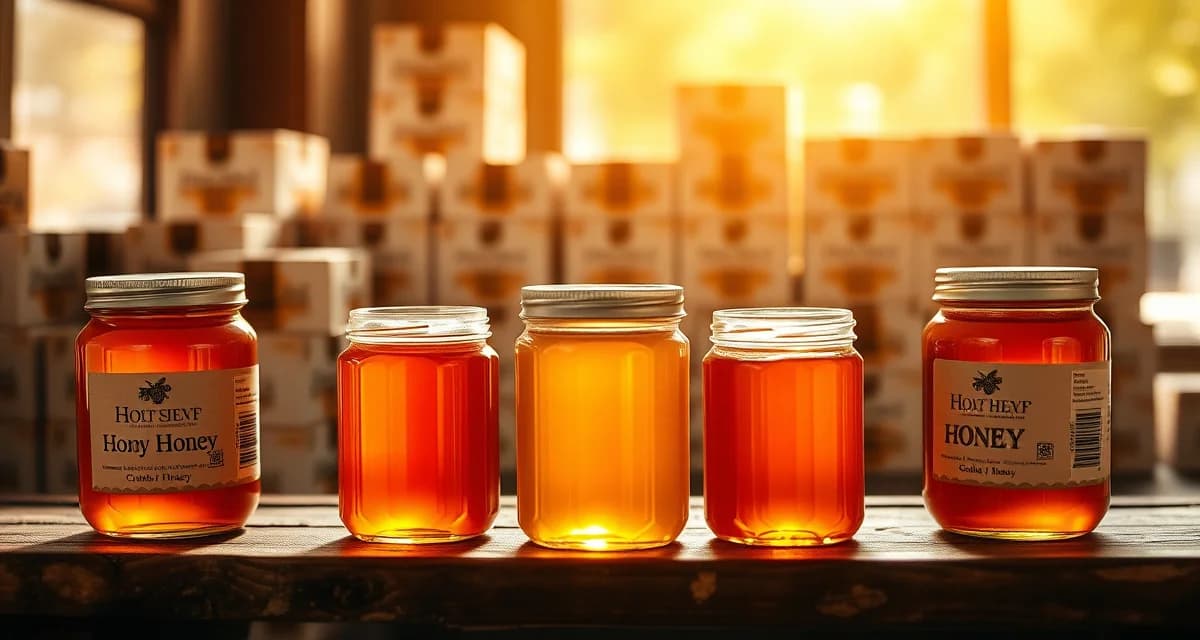
Honey Packing and Distribution for Commercial Beekeeping Operations
Bulk honey wholesale prices range from $1.80-3.50/lb while packed retail reaches $8-15/lb. That 3-5x difference is the opportunity in honey packing, but the capital, regulatory, and market-building requirements between bulk and retail are real. Most commercial migratory operations start as bulk sellers and work their way toward higher-value channels as they build capacity.
Commercial honey packing requires FDA food facility registration and state-specific label compliance. Before your first jar goes to a retailer, you're dealing with federal food safety rules, state agriculture labeling requirements, and buyer specifications that vary by channel. Getting this right the first time is cheaper than retrofitting labels and processes after a compliance issue.
TL;DR
- Wholesale honey prices for commercial producers have ranged from $1.50-2.50 per pound for bulk clover honey in recent seasons.
- Varietal honeys (buckwheat, tupelo, sourwood) command $3.00-5.00 per pound or more at wholesale.
- Summer honey production in North Dakota, Montana, and the Pacific Northwest is the primary source of bulk honey revenue for migratory operations.
- Honey production and pollination revenue streams can be combined on the same annual circuit, with most operations capturing both.
- Packing, storage, and distribution requirements for commercial honey production add cost and logistics complexity beyond the extraction stage.
Get Started with PollenOps
Running honey production alongside pollination contracts requires coordinating two revenue streams on a single annual calendar. PollenOps tracks both in one platform so your circuit planning reflects reality rather than optimistic assumptions.
The Packed Honey Business: What You Actually Need
Moving into packed honey production adds significant infrastructure and compliance requirements. Here's what it takes:
FDA Food Facility Registration
Any facility that packs, processes, or manufactures food products for interstate commerce must register with FDA under the Bioterrorism Act. This applies to your honey house if you're packing and selling across state lines. Registration is free, done online at fda.gov, and must be renewed every two years in even-numbered years.
Registration also subjects your facility to FDA food safety requirements under FSMA (Food Safety Modernization Act). For honey operations under $1 million in annual food sales, the requirements are streamlined but still exist: you need a written food safety plan, documented sanitation procedures, and pest control measures.
State Agriculture Department Requirements
Every state where you sell honey may require registration with the state's department of agriculture and compliance with state honey labeling standards. Requirements vary:
Most states require on the label:
- Product name (honey, raw honey, filtered honey)
- Net weight
- Packer's name and address
- Country of origin for imported honey (US-produced honey should indicate domestic origin)
- Ingredients list if any additions (flavored honeys)
Some states require: lot or batch number, harvest year, varietal designation if used on label, grade if using USDA grade terminology.
If you're selling at farmers markets or through farm direct channels in your home state only, state requirements are simpler. The moment you sell to a retailer in another state, you're in interstate commerce and FDA rules apply.
Equipment for Commercial Honey Packing
Moving from drum-to-bulk-buyer to packed product requires:
Settling tanks: 300-500 gallon stainless steel tanks where honey sits after extraction to allow air bubbles and debris to rise. Typical settling time: 2-3 days at room temperature. Temperature-controlled settling (80-90°F) speeds the process.
Filtration: Commercial honey filters (typically stainless screen filters at 200-400 micron) remove wax particles, propolis, and hive debris. Heated filtration at 110-120°F maintains honey fluidity without destroying enzymes that raw honey buyers value.
Filling equipment: Gravity-fed fillers for small operations; semi-automated or fully automated bottling lines for operations packing 20,000+ jars. A simple gravity filler and manual capping system works at entry scale but limits throughput. A semi-automated line (fill head, capper, labeler) processes 200-500 jars per hour.
Labeling: Roll-fed label applicators, sheet-fed applicators, or hand-labeling depending on volume. Compliant labels should be printed by a commercial label printer, not on an inkjet at home, which doesn't hold up in a retail environment.
Storage: Food-grade storage at controlled temperature (50-70°F). Honey stored warm granulates faster; stored cold maintains liquid state longer but requires food-safe refrigerated or climate-controlled space.
Co-Packing: Outsourcing the Packing Function
A middle path exists between bulk sale and running your own packing operation: contract packing, or co-packing. A co-packer takes your bulk honey, packs it to your specifications and label, and returns finished product to you for sale.
Co-packing fees vary: $0.15-0.35 per jar for basic filling and capping at a co-packer's facility, plus label costs. On a 12-oz jar that retails for $8, co-packing adds $0.35-0.55 per unit, which is meaningful but manageable against retail margins.
Benefits: no capital investment in packing equipment, co-packer handles FDA facility compliance, scales up or down with your production. Drawbacks: less control over quality and timing, co-packer relationships can be unreliable, and you still need to handle labeling and distribution logistics.
Good co-packers with honey experience: regional operations in honey-producing states. Ask your state beekeeping association for recommendations. This is exactly the kind of referral network those organizations provide.
Distribution Channels and Their Economics
Farmers markets and direct retail: The highest per-jar revenue ($8-15 per 12-oz) but the lowest volume and highest labor cost. Works well as a premium brand-building channel and for getting cash quickly during the season. Not a scalable primary channel for an operation producing 80,000 lbs.
Natural food retailers (regional chains and co-ops): Typically buy at $4.00-6.00 per 12-oz jar wholesale. Good volume potential with established regional chains. Entry requires samples, compliance with retailer supplier requirements, and often payment terms of net-30 to net-60. Brokers can ease entry into regional retail for a 5-8% commission.
Specialty grocery (Whole Foods, regional natural food chains): Higher shelf visibility, higher volume potential. Whole Foods has a national supplier program; regional natural food chains are often more accessible for producers. These buyers want consistent supply, compliant labels, and product quality documentation (lab testing for moisture, HMF, pesticide residue for organic).
Food service and specialty manufacturing: Restaurants, bakeries, craft breweries, artisan food producers. Purchase in bulk (5-gallon pails, cases of jars) at $3-5/lb equivalent. Direct sales, no broker needed. Find these buyers at food industry trade shows, through food business networking, and referrals.
Online retail: Amazon, your own website, Etsy for premium small-batch honeys. High margin potential but significant marketing effort required. Works well for premium varietal honeys (buckwheat, alfalfa, almond blossom) where the story and provenance justify $15-25 for a 12-oz jar to an informed consumer.
Wholesale to distributors: UNFI, KeHE, and regional specialty food distributors carry honey. They buy at 30-40% below retail and take a margin on everything they sell. Getting listed requires meeting minimum order quantities, label compliance, and sometimes promotional fees. The benefit: access to hundreds of retail accounts through a single relationship.
The Economics: Bulk vs. Packed
For a 1,000-hive operation producing 80,000 lbs annually, here's a simplified comparison:
Bulk only:
- 80,000 lbs × $2.10/lb = $168,000
- No packing costs, minimal labor
- Net from honey: ~$155,000-160,000 after drums and transport
Packed product (20% of volume direct/retail, 80% bulk):
- 64,000 lbs bulk × $2.10 = $134,400
- 16,000 lbs packed at equivalent $4.50/lb after co-packing and distribution = $72,000
- Total: $206,400
- Incremental over all-bulk: ~$38,000-48,000
- Against co-packing, labels, distribution, and marketing costs of $20,000-30,000: net gain of $10,000-25,000
The math suggests that a modest shift toward packed product generates real incremental income, but the business-building work to get there is substantial. Most commercial operations that do this successfully build the packed channel over 2-3 years while maintaining their bulk sales base.
FAQ
How do you start packing and selling honey from a 500-hive operation?
Start with your state's label requirements and FDA registration if you'll sell interstate. Get a few hundred jars, a gravity filler, and compliant labels. Sell direct at farmers markets and to local specialty retailers to test your pricing and packaging. Use co-packers for larger retail orders until you have the volume to justify packing equipment. The goal in year one is building buyer relationships and proving the market before committing capital to packing infrastructure.
What equipment is needed for commercial honey packing?
The core equipment list: settling tanks (300-500 gallon stainless), commercial screen filters, heated filling equipment (gravity filler or semi-automated bottling line), a capping system, and a label applicator. For a mid-scale operation packing 50,000-100,000 jars per season, a semi-automated line processing 300-500 jars per hour is practical. Initial equipment investment runs $25,000-75,000 for a functional commercial setup, more for fully automated lines.
What labeling requirements apply to commercial honey sales?
Federal FDA requirements cover net weight, facility name and address, and ingredient listing. State requirements add country of origin, varietal or type designation, and sometimes lot numbers. If you use USDA grade designations (US Grade A, US Fancy), those grades must meet USDA honey grading standards. Raw honey on the label implies unheated or minimally processed honey; if you use that claim, be prepared to substantiate it with your processing temperature records. Certified organic claims require certification documentation.
How do commercial beekeepers choose summer honey yard locations?
Summer honey yard selection focuses on forage quality, density, and landscape characteristics. North Dakota and Montana white clover and sweetclover flows typically produce 80-150 pounds per colony in good years. The Pacific Northwest offers diverse flows from clover, fireweed, and wildflowers. Proximity to other apiaries reduces forager competition; bee-friendly state lands or rented agricultural properties with forage diversity are preferred. Water availability within 1-2 miles of each yard is a basic requirement.
What is the difference between selling honey as bulk versus packaged retail?
Bulk honey sales to brokers or packers provide simple logistics (55-gallon drums or totes shipped directly from extraction) but yield lower per-pound prices ($1.50-2.50/pound for clover at wholesale). Packaged retail sales through direct channels (farmers markets, online, specialty retailers) yield $6-12 per pound but require labeling, packaging equipment, food safety compliance, and distribution relationships. Most commercial operations rely primarily on bulk sales and use retail as a supplementary channel for premium varieties.
Can honey production records be tracked alongside pollination contract records?
Yes. PollenOps tracks yard assignments and honey production data alongside pollination contracts so the full economic picture of each yard and each season is visible in one system. This matters for operations that use the same yards for honey production in summer and pollination staging in winter and spring, since the value of a yard location depends on both revenue streams.
Try These Free Tools
Sources
- USDA Agricultural Research Service
- Bee Informed Partnership
- American Beekeeping Federation (ABF)
- American Honey Producers Association
- National Honey Board