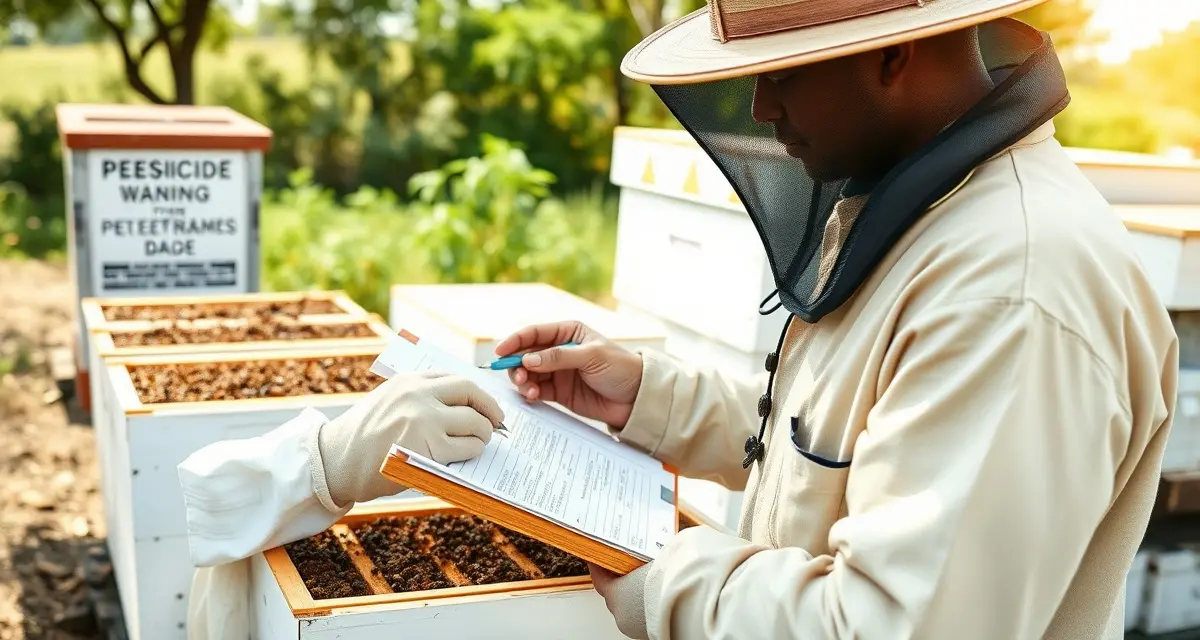
Pesticide Exposure Documentation for Commercial Beekeepers
Commercial beekeepers lose an estimated $12 million annually to pesticide exposure events. The ones who recover meaningful compensation share one thing in common: they documented the incident properly, starting within hours of discovery. The ones who don't recover do one of two things: they clean up immediately before collecting evidence, or they never collect it at all, assuming nothing can be done.
Properly documented pesticide kills recover 5-10x more compensation than undocumented events. That ratio comes from the difference between having lab-confirmed residue samples, photographs, and a registered apiary location versus calling your state apiarist a week later with a verbal account of what happened.
TL;DR
- Commercial beekeeping operations face two primary management challenges: operational logistics (hive health, transport, placement) and administrative coordination (contracts, payments, documentation).
- Most disputes and revenue losses in commercial beekeeping are preventable with better documentation and clearer contract terms.
- The operations that run most profitably are those with disciplined systems for tracking hive health, contract status, and fleet logistics in one place.
- PollenOps is built specifically for the operational complexity of commercial-scale pollination services, not adapted from a hobbyist tool.
- The most important management decisions (treatment timing, contract renewal, hive allocation) require accurate current data to make well.
Understanding Your Legal Position
When a pesticide kills your colonies, several potential legal and regulatory avenues exist:
FIFRA (Federal Insecticide, Fungicide, and Rodenticide Act): Pesticides are required to be applied according to label instructions. Most pesticide labels include bee precaution statements, at minimum restrictions on applying to blooming crops when bees are present. Applying in violation of label requirements is a federal law violation, regardless of state law. EPA can levy civil penalties against applicators.
State pesticide regulations: Most states have their own pesticide application laws with civil and criminal penalty provisions. State departments of agriculture investigate reported kills.
Civil liability: If the applicator's negligence or label violation caused your colony losses, you may have a civil damages claim. The value of a colony for legal purposes is generally $150-250 per colony, plus the contract value of any pollination services lost.
Insurance: Crop insurance, livestock insurance, or specific apiary insurance policies may cover pesticide kills. Policy terms vary widely.
Which avenue you pursue depends on how well you can document what happened.
The First 2 Hours: What to Do
The evidence quality that determines your outcome is established in the first 2 hours after you discover a kill. This is not an exaggeration.
Step 1: Don't touch anything. Resist the instinct to clean up. Dead bees at hive entrances are evidence. A field of dead foragers in front of the hive is evidence. Don't brush it away, don't move the hives, don't start inspecting until you've documented the site.
Step 2: Photograph everything. Take 50+ photos. Include:
- Wide shots of the full yard showing the scale of the kill
- Close-up shots of dead bees at colony entrances and on the ground in front
- Any bees showing abnormal behavior (crawling, trembling, flight disorientation)
- Vegetation in the surrounding area: check for spray residue, dead insects on nearby plants
- Any visible spray equipment, tank mixes, or application evidence in adjacent fields
- GPS coordinates or a screenshot from your maps app with the yard location marked
Step 3: Collect dead bee samples. 100-200 dead bees per sample, sealed in zip-lock bags and placed immediately on ice or in a cooler. If you have multiple hives affected, sample from several different colonies, as residue concentrations vary. Label each sample: date, time, yard name/GPS, which hive it came from.
Step 4: Note conditions. Write down or record verbally: current time, approximate time of discovery, weather conditions, wind direction and estimated speed, temperature. Note any agricultural activity you observed: equipment in adjacent fields, spray rigs, helicopter applications in the area.
Step 5: Identify the potential source. Look around the yard. What crops are within foraging range? Who farmed them? Has there been recent activity? Talk to neighboring landowners or the property owner where your yard is located if you can do so within the first few hours.
Sample Collection for Laboratory Analysis
Dead bee samples submitted to certified laboratories can identify the specific pesticide involved. This is critical for a viable compensation claim.
Where to submit:
- USDA AMS National Science Laboratory, Gastonia NC: The primary federal lab for pesticide residue in bees. Accepts samples from beekeepers and investigators. Current submission fees approximately $150-350 per sample depending on the analysis panel.
- State university extension labs: Several land-grant university extension programs accept bee samples for residue screening. Faster turnaround, sometimes lower cost.
- Private certified labs: Commercial labs with food or agricultural pesticide residue capabilities can analyze bee samples. Ensure the lab is certified for the specific analytes you need.
Request a broad pesticide screening panel. You don't know what you're looking for until the results come back. The common culprits in commercial beekeeping kills: neonicotinoids (clothianidin, imidacloprid, thiamethoxam), organophosphates (chlorpyrifos, malathion), pyrethroids (bifenthrin, lambda-cyhalothrin), and fungicides when combined with other products (DMI fungicides with neonics create synergistic toxicity).
Keep samples frozen until submission. Deterioration affects detectability. Overnight shipping on dry ice is the appropriate method for mailed samples.
Documenting Colony Count Before and After
The compensation calculation depends on documented colony count. If you can't prove how many colonies were in the yard before the kill, your claim starts from a weak position.
This is where advance documentation matters enormously. Your PollenOps yard management records, your state apiary registration documents, your interstate movement permit (which lists colony count), and photographs from your last yard visit before the kill all establish the pre-event colony count. This is one of the practical reasons commercial operators should use digital colony management. The audit trail it creates has real legal and financial value.
After the kill, document surviving colony counts as carefully as pre-kill counts. Dead-out colonies are worth something; surviving colonies that are significantly weakened represent future lost production. Photograph weakened colonies showing reduced bee population.
Regulatory Reporting
File a pesticide incident report with your state department of agriculture. Every state has a process for this, typically through the state plant health or pesticide division. Some states have online forms; others require phone or written reports. File within 24-48 hours if possible.
What happens after you file: a state pesticide investigator may visit your yard, inspect the site, collect their own samples, and interview you. Cooperate fully. Provide copies of your documentation, your sample collection information, and your colony count records.
Notify the local county agricultural commissioner (in California and other western states). CAC offices have investigators who respond to pesticide kills and have authority to require access to application records from growers and pesticide applicators.
Report to EPA if applicable. Significant kill events (100+ colonies, involvement of a pesticide with documented patterns of bee toxicity, or violation of a specific label restriction) can be reported directly to EPA's pesticide incident reporting system. EPA tracks these events and they influence future label language and regulatory actions.
Working With Your Apiarist
Your state apiarist is a resource after a pesticide kill, not just a regulatory officer. Call them. An official report from the state apiarist's office carries more weight with insurance companies, civil attorneys, and regulators than your documentation alone. They may conduct an independent investigation and can testify about findings if your case goes further.
State apiarists also maintain records of other kill events in the area. If a particular applicator or a particular pesticide-crop combination is generating repeated reports, the regulatory response escalates.
Compensation Pathways
Direct negotiation with the grower or applicator: Many pesticide kill situations are resolved through direct conversation. A grower who knows they (or their applicator) caused the kill may prefer to settle quickly rather than face regulatory scrutiny. With documentation, you have a basis for negotiation. Without it, you have a he-said/she-said situation.
Pesticide applicator's liability insurance: Commercial pesticide applicators carry liability insurance. If an applicator's error caused the kill, their insurance carrier may pay a claim. Your documentation package (photos, lab results, colony count records) is what their adjuster needs to evaluate the claim.
Your own insurance: If you carry apiary or livestock insurance with pesticide kill coverage, file a claim. Provide all documentation. Policy terms on pesticide coverage vary; read your policy before assuming coverage exists.
Civil litigation: For significant losses (50+ colonies, documented lab results, clear liability), civil litigation through an agricultural attorney may be the path to full compensation. Attorney fees and litigation costs need to be weighed against the potential recovery. A 50-colony kill at $200/colony plus lost pollination income (50 × $200 almond contract) equals $20,000. The litigation math gets serious at that scale.
Building Preventive Documentation
The best pesticide kill documentation is the documentation that exists before any incident. Registering in your state's Managed Pollinator Protection Plan and on FieldWatch creates a dated record that your apiary existed and was registered at a specific location. Combine that with your PollenOps colony records showing colony count by yard and regular inspection dates, and you have a documentation foundation that makes any subsequent claim far stronger.
Proactively photograph every yard on arrival and at regular intervals. Date-stamped photos showing a healthy yard 2 weeks before a kill establish the pre-incident condition better than any written description.
FAQ
What evidence should you collect after a pesticide kill event?
Collect dead bee samples immediately: 100-200 bees per sample in sealed bags on ice, labeled with date, time, and yard location. Photograph the site extensively before touching anything: dead bees at entrances, kill field patterns, nearby vegetation with spray residue. Note date, time, weather, and wind direction. Identify potential source fields and observe any application equipment in the area. Your state apiary registration records, colony count records, and photos from your last pre-incident yard visit all become supporting documentation for a claim.
Which agencies do you report pesticide kills to?
File reports with your state department of agriculture's pesticide division (within 24-48 hours), your county agricultural commissioner if in California or western states, and your state apiarist's office. For large-scale kills or documented label violations, you can also file with EPA's pesticide incident reporting system. Notify your insurance carrier within any required timeframe specified in your policy. Each filing creates an official record and may trigger an official investigation with subpoena power for application records.
How do you recover compensation from a pesticide-related colony loss?
Recovery depends on documentation quality. With lab-confirmed residue identification, dated photos, and documented colony counts, you can pursue: direct negotiation with the grower or applicator, a claim against the applicator's liability insurance, a claim under your own apiary insurance, or civil litigation for larger losses. Compensation in direct settlements typically values colonies at $150-250 each plus lost contract income. Lab-confirmed residue results and a documented pre-incident colony count are the two most important elements for a viable claim.
What is the difference between commercial and hobby beekeeping?
Commercial beekeeping is distinguished by scale (typically 100+ hives, often 500-5,000+), revenue source (pollination contracts and bulk honey sales rather than local honey retail), and management approach (systematic protocols applied across yards rather than individual colony attention). Commercial operators manage bees as an agricultural enterprise, with the administrative, regulatory, and logistical complexity that entails. Most commercial operators derive the majority of their income from pollination services; honey production is a supplementary revenue stream.
How many hives are needed to make commercial beekeeping a full-time income?
Most beekeeping economists put the full-time commercial threshold at 500-800 hives, assuming efficient operations management and a combination of pollination and honey revenue. At 500 hives and $200/hive for almond pollination, almond season alone generates $100,000 in gross revenue before expenses. Net margins depend on operational efficiency, but well-run operations can achieve 30-50% net margins on pollination revenue. Additional crops and honey production improve per-hive economics but require additional management capacity.
What is the annual revenue potential for a 1,000-hive commercial operation?
A 1,000-hive operation running an almond season ($200/hive) plus blueberry or apple contracts ($80-100/hive) plus summer honey production ($25-40/hive after extraction costs) can generate $300,000-360,000 in annual gross revenue. Net margins after transport, crew, equipment, and hive replacement costs typically run 25-40% for well-managed operations, putting net income at $75,000-145,000 annually. The specific number depends heavily on circuit efficiency, loss rates, and contract quality.
Try These Free Tools
Sources
- USDA Agricultural Research Service
- Bee Informed Partnership
- American Beekeeping Federation (ABF)
- American Honey Producers Association
- Project Apis m.
Get Started with PollenOps
Managing a commercial beekeeping operation involves more data, more deadlines, and more moving parts than any general-purpose tool was designed to handle. PollenOps brings contracts, yard records, health documentation, and fleet logistics together in one platform built for the realities of commercial-scale beekeeping.