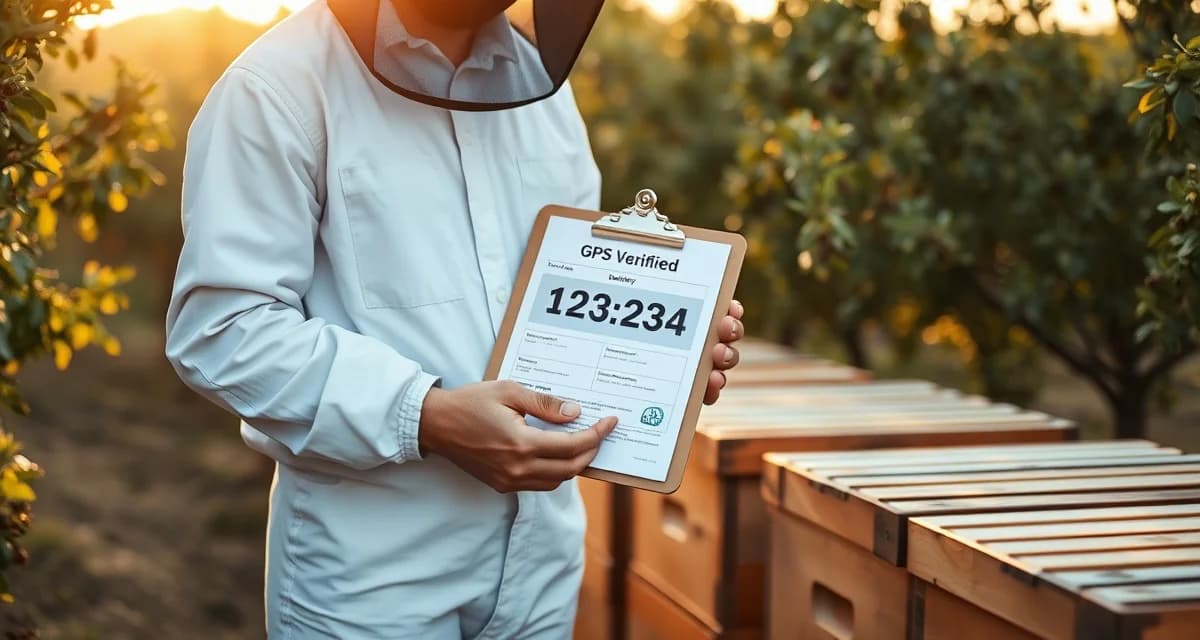
Hive Delivery Documentation for Pollination Contracts
Growers who receive delivery confirmation reports are 3x less likely to dispute final invoices than those who don't. That gap isn't accidental. It reflects something simple: when a grower has a timestamped, GPS-verified record of your delivery in their hands, there's nothing to argue about.
Hive delivery documentation is one of the highest-leverage habits you can build as a commercial beekeeper. Done right, it prevents disputes before they start, speeds up payment, and builds the kind of professional reputation that earns repeat contracts.
This guide covers exactly what to document, how to do it efficiently in the field, and what PollenOps automates so you're not doing it all manually.
TL;DR
- Commercial beekeeping operations face two primary management challenges: operational logistics (hive health, transport, placement) and administrative coordination (contracts, payments, documentation).
- Most disputes and revenue losses in commercial beekeeping are preventable with better documentation and clearer contract terms.
- The operations that run most profitably are those with disciplined systems for tracking hive health, contract status, and fleet logistics in one place.
- PollenOps is built specifically for the operational complexity of commercial-scale pollination services, not adapted from a hobbyist tool.
- The most important management decisions (treatment timing, contract renewal, hive allocation) require accurate current data to make well.
The Problem with Undocumented Deliveries
Most hive count disputes don't start with bad faith. They start with bad records. A grower walks the orchard, does a rough count, and comes up with a number that doesn't match your invoice. Without a timestamped GPS delivery record, it's your word against theirs.
The problem compounds quickly. Disputes drag on an average of six weeks. During that time, you're not getting paid, you're spending time on calls and emails instead of managing your operation, and the relationship with that grower is strained.
No competitor captures GPS-verified delivery records in a grower-ready format the way PollenOps does. Most beekeepers still rely on handwritten count sheets, photos on a personal phone, or nothing at all. That approach worked when the industry was smaller and disputes were rare. It doesn't hold up at commercial scale.
What to Document at Every Hive Delivery
GPS Location
Record the precise GPS coordinates of the yard where hives are placed. This confirms you delivered to the correct site and creates a map record that growers can verify. If you're placing hives across a large orchard in multiple clusters, record each cluster location separately.
PollenOps captures GPS coordinates automatically when you check in at a yard with no manual entry required.
Timestamp
The delivery date and time, recorded at the moment of placement. This is your proof of on-time delivery under the contract. If the contract specifies delivery before a certain date relative to bloom, the timestamp is your compliance record.
Hive Count at Delivery
Count every hive you place. Record it immediately, not from memory later. If you're unloading across multiple trips, tally as you go and record the final count before you leave the site.
Hive Strength Score
A delivery count without a strength assessment is only half the picture. Record your pre-move strength assessment results for each load. Minimum frame counts, brood status, queen presence: record whatever your contracts require. This protects you if a grower later claims hives were understrength on delivery.
Condition Notes
Note anything unusual at the site. Water availability, shade conditions, proximity to chemical application areas, access road conditions. These notes protect you if there's later a question about why hive performance was below expectations.
Photo Documentation
Take photos of hives in place at the yard. Include at least one wide shot showing the full placement and one close-up showing a representative hive. Date and location metadata in the photo file provides additional verification.
Step-by-Step: Documenting a Hive Delivery in the Field
Step 1: Check In at the Yard Before Unloading
Before you move a single hive off the truck, check in at the yard in PollenOps. This captures your GPS location and timestamps the start of your delivery. You've now established that you were at that specific location at that specific time.
Step 2: Count Hives as They Come Off the Truck
Don't try to count from memory after you've unloaded. Use a tally counter or count directly in the app as hives are placed. If you have employees helping, designate one person to count and record.
Step 3: Record Strength Observations
After placement, walk the yard and record your strength observations. You should already have pre-move assessment data from your hive count verification checklist. Confirm that what arrived matches what you assessed pre-move.
Step 4: Take Photos
Get your placement photos before you leave the site. Wide shot, close-up shot, any notable site features. If you're using PollenOps, photos attach directly to the delivery record.
Step 5: Generate and Send the Delivery Report
This is where PollenOps changes the workflow entirely. Once your delivery data is recorded, the system generates a delivery report automatically. That report goes to your grower via email within an hour of hive placement, without you having to write anything.
The report includes GPS map, hive count, strength score, and delivery timestamp in one PDF. The grower receives professional documentation immediately, which sets the tone for the relationship and eliminates the most common source of later disputes.
Step 6: File Against the Contract
In PollenOps, the delivery record links directly to the contract for that grower and yard. When you generate an invoice at the end of the season, the delivery data is already there. You're not reconstructing it from notes.
Sharing Delivery Documentation with Growers
Sending documentation shouldn't require extra effort. The beekeepers who consistently send delivery reports do it because it's easy, not because they have extra time.
PollenOps emails the grower automatically on check-in. If you're not using PollenOps, set up a system that makes this frictionless. Create a PDF template you can fill in quickly on your phone. Keep a folder of grower email addresses on your phone so you can send it immediately while still at the site.
The timing matters. A delivery report sent within an hour of placement is far more credible than one sent two days later. It shows the data was captured in real time, not reconstructed.
For questions about contract compliance documentation, delivery records are also your primary evidence if an issue goes to dispute resolution.
Is a Delivery Record Legally Binding?
Delivery records don't replace your contract, but they support it significantly. In a contract dispute, a timestamped GPS delivery record with photos and a strength assessment is strong evidentiary support for your position.
Whether a specific record constitutes a "legally binding" document depends on your state's laws and how your contract is written. The safest approach is to have your contract explicitly reference delivery documentation, with language such as: "Delivery shall be confirmed by a GPS-verified delivery report provided to Grower within 24 hours of hive placement."
If the contract references the delivery record, and you have that record, you're in a strong position. Have an attorney review your contract template to make sure the language works in your state.
Building Documentation Into Your Team's Workflow
If you have employees handling deliveries, documentation only works if they actually do it. That means training, clear expectations, and a system that makes compliance easier than non-compliance.
PollenOps gives your field crew a mobile app that guides them through the check-in process. GPS captures automatically. They record hive count and snap photos. The record uploads when they have signal. You get visibility into every delivery without being physically present.
Set an expectation that no delivery is complete until the record is submitted. Build it into your crew's end-of-delivery checklist the same way you'd require them to secure the load and lock the gate.
FAQ
What should I document when delivering hives to a pollination site?
Document GPS coordinates of the placement location, timestamp of delivery, exact hive count placed, pre-move strength assessment data (frames of bees, brood frames, queen status), site condition notes, and photos of hives in place. The GPS timestamp and hive count are the two most dispute-critical data points. Everything else builds on that foundation.
How do I share delivery documentation with my grower?
The most professional approach is an automated delivery report sent by email within one hour of placement, which is what PollenOps does automatically. If you're doing it manually, create a PDF template you can complete on your phone and email directly from the field. Don't wait until you're back at the office. Prompt delivery of the report signals professionalism and gets the grower's acknowledgment before any memory of the delivery fades.
Is a delivery record legally binding in a pollination contract dispute?
A delivery record on its own isn't a binding contract, but it's significant evidence in a dispute. GPS-verified records with timestamps and photos are credible and difficult to refute. The strongest position is a contract that explicitly references delivery confirmation documentation, paired with records that were generated at the time of delivery. Have an attorney review your contract language to ensure your delivery records have maximum evidentiary weight in your state.
What is the difference between commercial and hobby beekeeping?
Commercial beekeeping is distinguished by scale (typically 100+ hives, often 500-5,000+), revenue source (pollination contracts and bulk honey sales rather than local honey retail), and management approach (systematic protocols applied across yards rather than individual colony attention). Commercial operators manage bees as an agricultural enterprise, with the administrative, regulatory, and logistical complexity that entails. Most commercial operators derive the majority of their income from pollination services; honey production is a supplementary revenue stream.
How many hives are needed to make commercial beekeeping a full-time income?
Most beekeeping economists put the full-time commercial threshold at 500-800 hives, assuming efficient operations management and a combination of pollination and honey revenue. At 500 hives and $200/hive for almond pollination, almond season alone generates $100,000 in gross revenue before expenses. Net margins depend on operational efficiency, but well-run operations can achieve 30-50% net margins on pollination revenue. Additional crops and honey production improve per-hive economics but require additional management capacity.
What is the annual revenue potential for a 1,000-hive commercial operation?
A 1,000-hive operation running an almond season ($200/hive) plus blueberry or apple contracts ($80-100/hive) plus summer honey production ($25-40/hive after extraction costs) can generate $300,000-360,000 in annual gross revenue. Net margins after transport, crew, equipment, and hive replacement costs typically run 25-40% for well-managed operations, putting net income at $75,000-145,000 annually. The specific number depends heavily on circuit efficiency, loss rates, and contract quality.
Try These Free Tools
Sources
- USDA Agricultural Research Service
- Bee Informed Partnership
- American Beekeeping Federation (ABF)
- American Honey Producers Association
- Project Apis m.
Documentation That Pays for Itself
The time you spend documenting deliveries is an investment. Every record you create is an asset that protects your revenue.
One prevented dispute covers hundreds of delivery records. And growers who receive professional delivery reports become long-term partners because they see you're running your operation at a level they can rely on.
Get Started with PollenOps
Managing a commercial beekeeping operation involves more data, more deadlines, and more moving parts than any general-purpose tool was designed to handle. PollenOps brings contracts, yard records, health documentation, and fleet logistics together in one platform built for the realities of commercial-scale beekeeping.