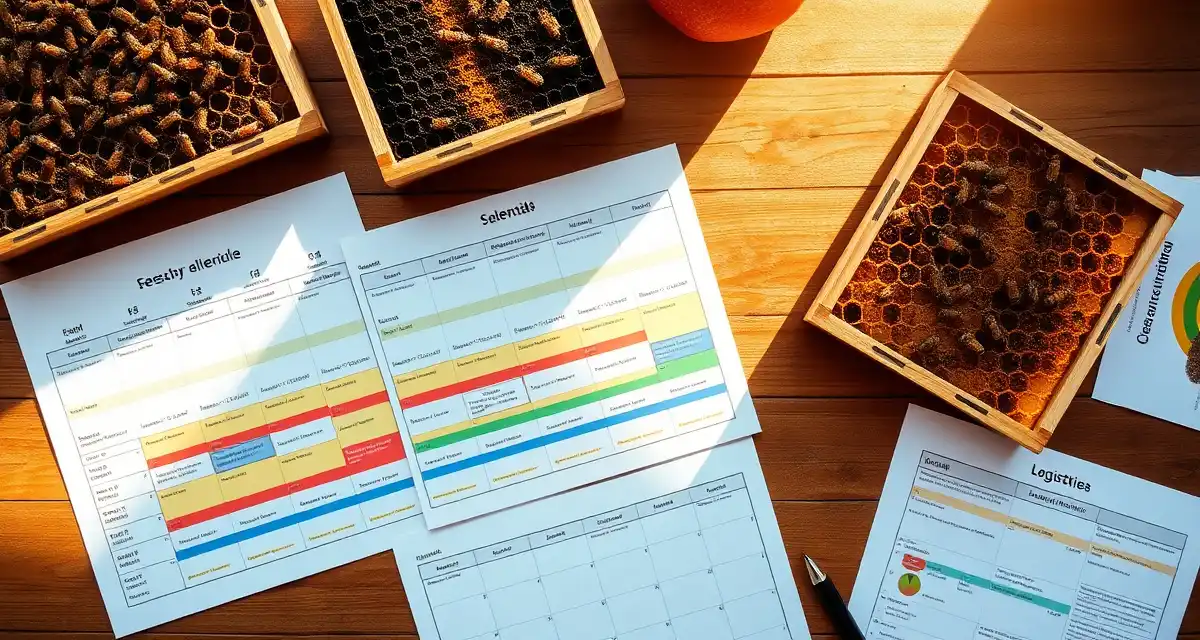
Seasonal Pollination Contract Calendar for Commercial Beekeepers
Almond season starts in February, followed by cherries in March, then apples, blueberries, and beyond. That sequence seems simple on paper. Managing it across multiple contracts, multiple states, and multiple truck schedules is anything but simple.
A seasonal pollination contracts calendar is how you turn a list of commitments into an executable plan. It shows you where your hives need to be on every date of the season, where conflicts exist, and where your windows for repositioning are tight. Without it, you're managing by memory and reaction. With it, you're managing by plan.
TL;DR
- A well-written pollination contract covers hive strength requirements, payment terms, delivery/removal windows, pesticide liability, and dispute resolution.
- Standard payment structure is 50% on delivery and 50% on removal; push for no longer than 14-day net on the back half.
- Hive strength disputes are the most common source of non-payment; third-party inspection at delivery is the cleanest resolution.
- Pesticide kill provisions should require grower notification 24-48 hours before any application within foraging range of placed hives.
- Contracts signed by November have stronger pricing leverage than those negotiated in December or January.
The Problem with Managing Season Schedules Manually
Most beekeepers build their season schedule in a spreadsheet or on a whiteboard. That works when you have three or four contracts with comfortable gaps between them. It breaks down when you have eight contracts, two overlapping crops, and a truck that can only be in one place at a time.
No competitor generates a dynamic season calendar from live bloom and contract data the way PollenOps does. Static spreadsheets don't update when bloom timing shifts. They don't flag conflicts between overlapping contracts. They don't tell you that your March cherry placement conflicts with your March apple contract deadline unless you've manually checked every row.
PollenOps calendar auto-populates from your active contracts and regional bloom timing data. When you sign a new contract, it appears on the calendar immediately. When regional bloom forecasts shift, the calendar reflects the updated timing.
How to Build Your Seasonal Contract Calendar
Step 1: Map Your Contracts by Crop and Date
Start with what's committed. List every signed contract with the contracted delivery date (or delivery window) and pickup date. This is your hard schedule: the dates you've agreed to meet.
Enter each contract into PollenOps. As contracts are entered, the system maps them to your calendar automatically, showing each placement period from delivery to pickup.
Step 2: Overlay Regional Bloom Timing
Contracts are based on anticipated bloom timing. Actual bloom timing shifts with weather. A warm January can push almond bloom two weeks earlier than projected. A cold spring can delay cherries.
PollenOps overlays regional bloom timing data from weather models and crop phenology onto your contract calendar. This lets you see when actual bloom is expected for each site and whether your contracted delivery dates align with current forecasts.
When there's a mismatch (your contract says deliver February 12, but current bloom forecasts show peak on February 7), you have advance notice to either move up your delivery or communicate with the grower about the situation.
Step 3: Identify Scheduling Conflicts
With all contracts on the calendar, PollenOps can flag conflicts: dates when multiple contracts require your presence or your hives simultaneously.
Common conflicts:
Concurrent placements. Two contracts with the same delivery date require either two truck runs or prioritization. If they're in different regions, you need two crews.
Pickup-delivery overlap. A contract pickup that overlaps with another contract's delivery date means your hives are in transit on both ends simultaneously. You need enough hive inventory and truck capacity to handle both.
Bloom compression. When weather compresses bloom timing, a three-week gap between two contracts can become a one-week gap. The calendar shows you this before it becomes an emergency.
Step 4: Build Your Move Schedule
With contracts and bloom timing on the calendar, build your move schedule: the sequence of truck runs that gets every hive to the right place at the right time.
For each move, plan:
- Hive count for each load
- Truck and driver assignment
- Departure date from origin yard
- Expected arrival at destination
- Time for hive check-in and delivery documentation
PollenOps annual pollination contract planning integrates with the move planning tools so you can build this schedule directly from your calendar.
Step 5: Set Alert Thresholds
For each contract on your calendar, set alert thresholds in PollenOps:
- Bloom alert: notify X days before expected peak bloom
- Move planning reminder: X days before contracted delivery date
- Contract payment reminder: X days before payment due date
These alerts turn your calendar from a static planning document into a live management tool.
The Typical US Pollination Season Calendar
Understanding the general seasonal sequence helps you plan around crop overlap and build a rotation that maximizes your hive utilization.
February: Almonds
California almond bloom is the largest single pollination event in US agriculture. Demand for hives peaks in January-February. If you're doing almonds, this is your season anchor. Everything else gets planned around almond commitments.
March–April: Cherries and Early Tree Fruits
Sweet cherry bloom follows almonds in the Pacific Northwest (Washington, Oregon) and parts of California. Cherry bloom windows are tight (typically 5-10 days), which makes timing critical. Apricot and early peach pollination also falls in this period in warmer regions.
April–May: Apples and Pears
Apple bloom timing varies by region and variety, generally running April through mid-May depending on latitude and elevation. Apple season overlaps with late cherry in some years and regions.
May–June: Blueberries and Small Fruits
Highbush blueberry bloom peaks in May in Michigan and the Northeast. Lowbush blueberry bloom follows a similar timeline in Maine. Cranberry bloom in Massachusetts and Wisconsin typically peaks in late June.
June–August: Summer Crops
Cucumber, squash, and melon pollination runs through summer. Sunflower pollination in the Dakotas runs July through August. Many migratory beekeepers move to honey production yards after summer pollination.
September–October: Late Season
Some late-blooming crops and fall honey production. This is also planning season for the following year.
Avoiding Overlap Between Two Simultaneous Yard Rotations
If you're running two simultaneous contract streams (say, almonds followed by blueberries on one route and cherries followed by apples on another), you need to manage them as separate track schedules.
Create sub-calendars in PollenOps for each truck or crew. This lets you see each track's schedule independently and identify where the tracks intersect for shared resources (hives, drivers, equipment).
The critical question at each transition: do you have enough hive inventory and truck capacity to support both tracks simultaneously at their peak overlap? If not, which contract can flex, and by how much?
For bloom timing alerts, PollenOps fires alerts by crop type and region. If you're running two tracks in different regions, both alert streams run simultaneously so you see the timing for each without confusion.
What Crops Should I Prioritize for Pollination Contracts?
Prioritization depends on your operation's specific strengths, geographic position, and risk tolerance.
Almonds have the highest per-hive rates and largest contract volumes, but California placement is competitive and requires strong hive strength documentation.
Cherries pay well and the tight bloom window means timing-capable operations command premium rates.
Blueberries have reliable regional demand and often attract smaller operations that can't manage almond logistics.
Cucumbers and squash typically pay lower rates but have more scheduling flexibility and lower strength requirements.
The most profitable operations build a diversified crop rotation that spreads weather risk, uses hive capacity across a longer season, and doesn't depend on any single crop for the majority of revenue.
FAQ
How do I plan my schedule for a full pollination season?
Start by entering every signed contract into PollenOps so the calendar can map your committed delivery and pickup dates. Overlay regional bloom timing data to verify that contracted dates align with current bloom forecasts. Identify scheduling conflicts where two contracts require your hives or trucks simultaneously. Build your move schedule with specific truck runs and arrival dates. Set alert thresholds for bloom events and contract deadlines. Review the full calendar at least monthly during planning season and weekly once the season is active.
What crops should I prioritize for pollination contracts?
Prioritize contracts that align with your hive strength capabilities, geographic positioning, and truck logistics. Almonds pay the most per hive but require strong documentation and reliable hive quality. Cherries have tight bloom windows that reward timing-capable operations. Blueberries are accessible for smaller operations and have consistent regional demand. Build a crop rotation that diversifies your revenue across multiple crops and regions rather than concentrating all your contracts in a single crop with weather exposure.
How do I avoid scheduling conflicts between overlapping bloom windows?
Enter all contracts into PollenOps so conflicts are visible on the calendar before they become operational emergencies. Build in buffer time between contract transitions. Assume bloom timing can shift by 7-10 days in either direction and verify your move schedule handles both early and late scenarios. For high-risk overlaps, establish which contract can flex and communicate proactively with both growers. Having a plan for overlap scenarios before they happen is far less stressful than improvising during active bloom.
What are the most common clauses in a commercial pollination contract?
A standard commercial pollination contract covers: hive strength minimums at delivery, payment terms (typically 50% on delivery, 50% on removal), delivery and removal dates, pesticide notification requirements, liability provisions for colony losses, truck access and yard location details, and dispute resolution procedures. Force majeure clauses addressing crop failure and operator inability to deliver the full hive count are also standard in well-written contracts.
How should pesticide liability be addressed in pollination contracts?
The contract should require growers to notify operators at least 24-48 hours before any pesticide application within foraging range (2-3 miles), specify the operator's right to remove hives immediately upon notification, and define liability for documented colony losses attributable to pesticide exposure. Without this clause, recovering compensation for pesticide kills requires proving causation after the fact, which requires lab testing, communication records, and timestamped photos of dead bees collected before cleanup.
What is a typical contract renewal strategy for commercial beekeepers?
Most successful commercial operators begin renewal conversations with existing growers in July, confirming the coming season's hive count and rate before new grower outreach. Existing grower relationships command better pricing stability than new contracts and require less pre-season sales effort. Sending growers a season-end report documenting hive placements and colony performance reinforces the relationship and creates a natural opening for renewal discussion.
Try These Free Tools
Sources
- USDA Agricultural Research Service
- Bee Informed Partnership
- American Beekeeping Federation (ABF)
- American Honey Producers Association
- Project Apis m.
Your Season, Visible Before It Starts
The beekeepers who execute their season without scrambling are the ones who built the calendar in December. By the time February almonds start, they know exactly where every hive is going and when.
Get Started with PollenOps
Managing pollination contracts across multiple growers and crops is where most commercial operations have the most to gain from better systems. PollenOps centralizes contract lifecycle management from initial quote through signed agreement, delivery documentation, and final invoice. Try it for your next season.