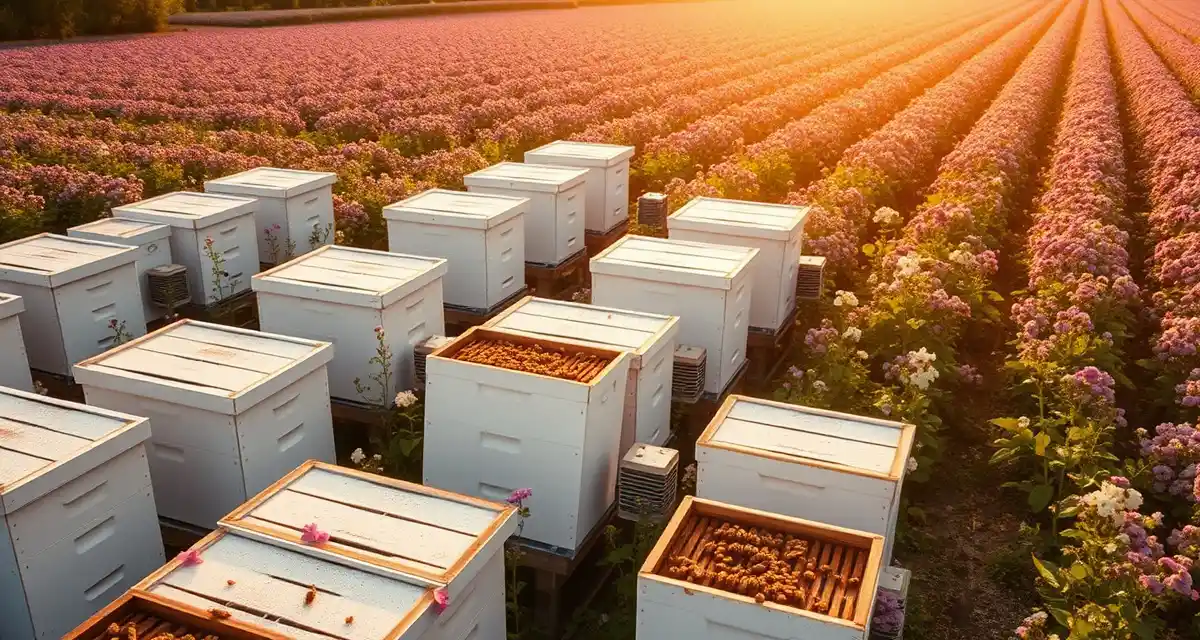
Bloom Timing Alerts for Commercial Beekeepers
Missing a 3-day peak bloom window can reduce a grower's crop set by 20-40%. That's not just bad for the grower, it's bad for your contract performance, your reputation, and your renewal rate. And it happens to experienced beekeepers every season, not because they weren't paying attention, but because bloom timing is genuinely hard to predict manually across a large, multi-crop operation.
Bloom timing alerts exist to solve this. You get notified days before peak receptivity, not after it starts. You have time to move trucks, confirm driver schedules, and get hives acclimating at the site before the critical window opens.
TL;DR
- Commercial beekeeping operations face two primary management challenges: operational logistics (hive health, transport, placement) and administrative coordination (contracts, payments, documentation).
- Most disputes and revenue losses in commercial beekeeping are preventable with better documentation and clearer contract terms.
- The operations that run most profitably are those with disciplined systems for tracking hive health, contract status, and fleet logistics in one place.
- PollenOps is built specifically for the operational complexity of commercial-scale pollination services, not adapted from a hobbyist tool.
- The most important management decisions (treatment timing, contract renewal, hive allocation) require accurate current data to make well.
Why Bloom Timing Is Hard to Track Without Alerts
Commercial beekeepers working multiple crops and regions are tracking dozens of variables at once. You've got almond orchards in the southern valley, cherry orchards in Central Washington, blueberry fields in Michigan, and maybe a Florida citrus contract wrapping up at the same time.
Each crop has a different timing model. Each region has different weather patterns. Each year deviates from the historical average by some amount, sometimes a little, sometimes a lot.
Tracking all of this manually means relying on:
- Last year's bloom dates (often wrong in unusual weather years)
- Grower phone calls (growers often don't know until it's happening)
- General regional farm bulletins (regional, not site-specific)
- Your own physical presence at each location (not possible at 20 yards simultaneously)
None of these approaches give you the lead time you actually need to move trucks and crews.
How PollenOps Bloom Timing Alerts Work
PollenOps monitors bloom conditions by tracking accumulated chilling hours in winter and growing degree days as temperatures rise through the bloom season. These are the same inputs that agronomists and crop consultants use to estimate bloom timing, combined into a model that generates location-specific estimates for each crop type.
When the model projects that bloom will reach the target threshold (typically 10-25% bloom, depending on crop) within 5-7 days, you receive an alert tied to the specific yard locations and contracts in that area.
The alert connects to your move planning workflow automatically. You don't just get notified. You go from alert to action in one step. The system shows you which contracts are affected, which yards need to move, and what the current truck availability looks like.
Alerts Trigger Move Planning, Not Just Awareness
This is the part that separates a genuine operations tool from a notification system. Lots of tools can tell you something is happening. The question is what happens next.
When a PollenOps bloom alert fires, it's connected to your seasonal pollination contract calendar. You can see immediately which contracts have delivery deadlines that the upcoming bloom window affects. If a contract requires placement by 10% bloom and the model shows bloom starting in 6 days, you have a flagged contract that needs action.
Move planning starts automatically because the data to plan is already in the system: yard locations, truck assignments, driver schedules, hive counts. You're coordinating, not re-entering data.
Which Crops Get Bloom Timing Alerts?
PollenOps covers more than 20 major pollination crops across US growing regions. The primary crops with full bloom monitoring include:
- Almonds (California Central Valley, Sacramento Valley)
- Cherries (Washington, Oregon, California; elevation-adjusted by orchard zone)
- Apples (Pacific Northwest, Northeast, Midwest)
- Blueberries (Michigan highbush, Maine wild, Oregon, New Jersey, North Carolina)
- Avocados (California, Florida; Type A/B synchrony tracking)
- Cranberries (Massachusetts, Wisconsin, New Jersey, Oregon)
- Citrus (Florida)
- Almonds in Arizona
- Sunflowers (North Dakota, Kansas)
- Clover seed (Pacific Northwest)
- Alfalfa seed (Idaho, California)
- Plus additional specialty crops by region
If you work a crop that's not on this list, the PollenOps team can discuss whether your target region and crop can be added to the monitoring network.
How Far in Advance Do I Get Bloom Timing Alerts?
You'll receive an alert 5-7 days before projected peak receptivity for most crops. For some crops with tighter timing windows, like cherries, alerts may fire 5-6 days ahead because the bloom window itself is shorter than almond.
The 5-7 day window is built around a specific operational question: how much lead time do you need to move hives from their current location to the target site and have them acclimated before peak bloom? For most operations, 5 days is enough to handle final logistics and have bees in place for 2-3 days of acclimation before the key window opens.
In years when weather shifts rapidly, the model updates alert timing automatically. If a warm spell accelerates bloom by several days, the alert adjusts to fire earlier. You're not waiting for a pre-scheduled notification that the conditions have already made inaccurate.
Can I Set Custom Alert Thresholds?
Yes. Default alerts fire at 5-7 days before projected 10% bloom, but you can adjust the trigger point for specific yards or contract requirements.
If your almond grower requires placement before 5% bloom rather than the standard 10%, you can set a custom threshold for that contract's associated yard. If you're placing bees at a cherry orchard where the grower wants hives 10 days ahead to maximize early forager orientation, you can set an earlier alert trigger.
Custom thresholds can also account for your specific logistics realities. An operation with limited truck availability may need 8-10 days of lead time rather than 5-7. Setting earlier alerts for your most time-sensitive contracts means you're never planning a move the night before it needs to happen.
Integrating Bloom Alerts with Your Contract Calendar
The most powerful use of bloom timing alerts is connecting them to your full contract calendar so you have a single view of what's coming and when.
When you look at your seasonal pollination contract calendar, you see both the bloom timing projections and the contract delivery deadlines together. If there's a gap between when bloom is expected and when your contract requires delivery, you see that conflict before it becomes a problem.
Beekeepers who integrate bloom alerts with contract planning typically handle season-level logistics in less than an hour per week during active season. That's a significant reduction from the daily coordination work that manual planning requires.
Frequently Asked Questions
How far in advance do I get bloom timing alerts from PollenOps?
You receive alerts 5-7 days before projected peak receptivity for most crops. Alert timing adjusts automatically when weather conditions indicate accelerated or delayed bloom. For crops with shorter bloom windows, like cherry, alerts are calibrated to your operational lead time needs. You can customize the trigger threshold for specific yards or contracts.
Which crops does PollenOps track bloom timing for?
PollenOps covers more than 20 major pollination crops across US growing regions, including almonds, cherries, apples, blueberries (highbush and wild), avocados, cranberries, citrus, sunflowers, clover seed, and alfalfa seed. Specialty crop monitoring can be discussed for regions not covered in the standard network.
Can I set custom alert thresholds for different crops?
Yes. Default alerts fire at 5-7 days before 10% bloom, but you can adjust thresholds for specific yards or contracts. If a grower requires earlier placement, or if your logistics require more lead time, you can set custom trigger points that match your specific operational and contractual requirements.
What is the difference between commercial and hobby beekeeping?
Commercial beekeeping is distinguished by scale (typically 100+ hives, often 500-5,000+), revenue source (pollination contracts and bulk honey sales rather than local honey retail), and management approach (systematic protocols applied across yards rather than individual colony attention). Commercial operators manage bees as an agricultural enterprise, with the administrative, regulatory, and logistical complexity that entails. Most commercial operators derive the majority of their income from pollination services; honey production is a supplementary revenue stream.
How many hives are needed to make commercial beekeeping a full-time income?
Most beekeeping economists put the full-time commercial threshold at 500-800 hives, assuming efficient operations management and a combination of pollination and honey revenue. At 500 hives and $200/hive for almond pollination, almond season alone generates $100,000 in gross revenue before expenses. Net margins depend on operational efficiency, but well-run operations can achieve 30-50% net margins on pollination revenue. Additional crops and honey production improve per-hive economics but require additional management capacity.
What is the annual revenue potential for a 1,000-hive commercial operation?
A 1,000-hive operation running an almond season ($200/hive) plus blueberry or apple contracts ($80-100/hive) plus summer honey production ($25-40/hive after extraction costs) can generate $300,000-360,000 in annual gross revenue. Net margins after transport, crew, equipment, and hive replacement costs typically run 25-40% for well-managed operations, putting net income at $75,000-145,000 annually. The specific number depends heavily on circuit efficiency, loss rates, and contract quality.
Try These Free Tools
Sources
- USDA Agricultural Research Service
- Bee Informed Partnership
- American Beekeeping Federation (ABF)
- American Honey Producers Association
- Project Apis m.
Get Started with PollenOps
Managing a commercial beekeeping operation involves more data, more deadlines, and more moving parts than any general-purpose tool was designed to handle. PollenOps brings contracts, yard records, health documentation, and fleet logistics together in one platform built for the realities of commercial-scale beekeeping.