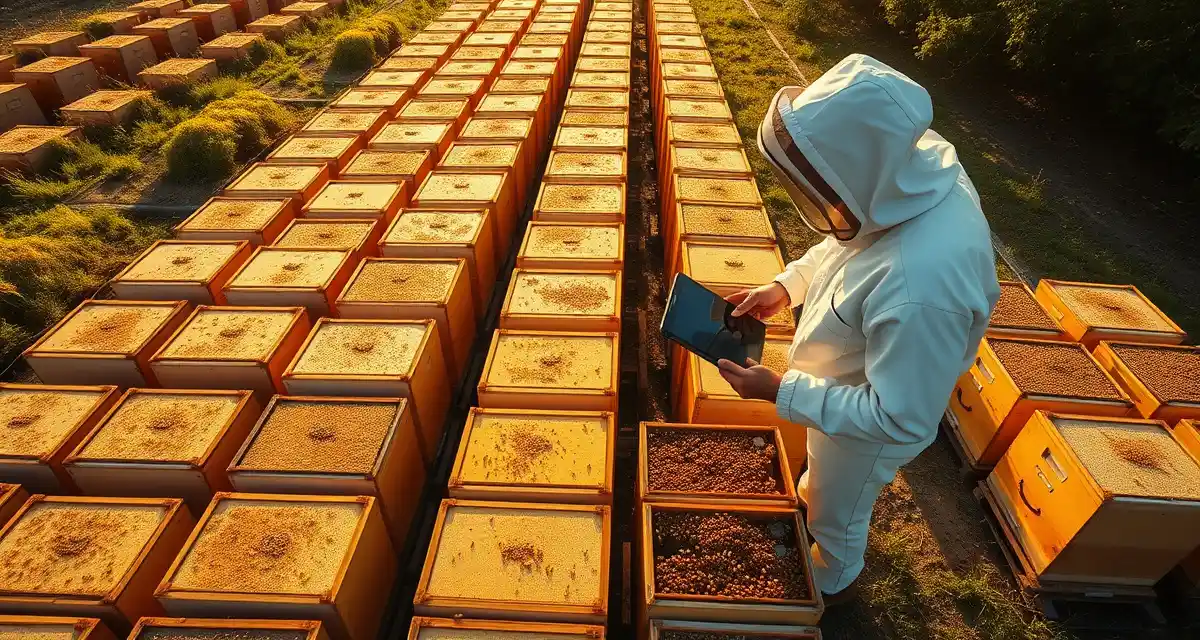
Hive Inventory Management for Commercial Beekeepers
Overbooking hives for simultaneous contracts is one of the most costly operational errors in commercial pollination. You commit 500 hives to an almond grower and 300 hives to a cherry grower with overlapping service periods, then discover that 200 of those hives are in winter buildup and not ready to deploy. The cascade of problems that follows, cancelled contracts, repositioning costs, damaged grower relationships, is exactly what a live hive inventory prevents.
Hive inventory management isn't just about knowing how many hives you own. It's about knowing how many hives are available, where they are, what condition they're in, and which ones are already committed to contracts.
TL;DR
- Commercial beekeeping operations face two primary management challenges: operational logistics (hive health, transport, placement) and administrative coordination (contracts, payments, documentation).
- Most disputes and revenue losses in commercial beekeeping are preventable with better documentation and clearer contract terms.
- The operations that run most profitably are those with disciplined systems for tracking hive health, contract status, and fleet logistics in one place.
- PollenOps is built specifically for the operational complexity of commercial-scale pollination services, not adapted from a hobbyist tool.
- The most important management decisions (treatment timing, contract renewal, hive allocation) require accurate current data to make well.
What a Commercial Hive Inventory Tracks
A working inventory for a commercial pollination operation needs to track:
Location: Where is each hive right now? Is it at a yard, in transit, in winter storage, or at a contract site?
Condition: What was the last assessed strength? Is it in production condition, in buildup, recovering from a health issue, or currently queenless?
Contract status: Is this hive assigned to an active contract? If so, what contract, what delivery date, and what service period?
Move history: Where has this hive been over the last 1-3 seasons? Which crops has it been through?
Equipment status: Is the hive on standard equipment, or does it have any special configuration (brood boxes, supers, transport screen)?
Most beekeeping operations track these things imprecisely across a mix of mental models and spreadsheets. As long as the operation is small, the imprecision doesn't matter much. Once you're managing 500+ hives across 10+ yards and multiple simultaneous contracts, the margin for imprecision gets very thin.
Available Capacity vs Total Inventory
The number that matters for contract planning isn't your total hive count. It's your available hive count: hives that are in deployable condition, not already assigned to a contract, and physically accessible within your planning window.
In a typical commercial operation, available capacity at any moment is significantly lower than total inventory:
- Some hives are committed to active contracts
- Some hives are in winter buildup or recovery condition
- Some hives have health issues that disqualify them from contract deployment
- Some hives are at yards that would take more than X days to mobilize
Understanding your real available capacity at any point in the season is what allows you to answer a grower's inquiry accurately. Can you place 200 hives by February 15? That answer requires a live inventory, not a guess.
How PollenOps Hive Inventory Works
PollenOps hive inventory maintains a live count that updates automatically as contracts are signed and hives are moved.
When you sign a contract for 150 hives with a delivery date of March 1, those 150 hives are flagged as committed in your inventory. Your available-for-assignment count adjusts immediately. When you come back the next day and a grower asks for 200 more hives, you can see whether you have the capacity before you say yes.
When hives move from a yard to a contract site, the location and contract status update in real time from the GPS field check-in. You don't manually update the inventory after every move; it updates because the move was documented.
This real-time accuracy is what makes the system useful for contract decisions rather than just record-keeping.
How Do I Track How Many Hives I Have Available for New Contracts?
The answer depends on having an inventory system that distinguishes between total hives, committed hives, and available hives.
In PollenOps, the available hive count shows you:
- Total hives in your inventory
- Hives currently assigned to active contracts
- Hives in buildup or non-deployable condition (flagged from health assessment records)
- Net available hives that can be committed to new contracts
This view is especially important during the late fall and early winter contract signing season, when you're securing almond contracts before February and need to know your true capacity without overcommitting.
Can I Manage Hive Inventory and Contracts in the Same Platform?
Yes, and this is one of the most important integration points in PollenOps. Keeping inventory and contracts in the same platform means the relationship between them is automatic.
When a contract is signed, the hive count in that contract reduces your available inventory. When a contract ends and hives are retrieved, they return to your available inventory. When a pre-move assessment flags a hive as below strength requirements, it's flagged as conditionally deployable in the inventory until the issue is resolved.
If you're managing inventory in one system and contracts in another, this relationship requires manual maintenance, which means it's always slightly out of date and always susceptible to synchronization errors.
Avoiding Double-Booking Hives for Two Different Pollination Contracts
Double-booking happens in operations that don't have a live inventory connected to their contract commitments. It typically happens because:
- Contracts are signed without checking current hive availability
- The person signing a contract doesn't have visibility into other commitments
- Available capacity is estimated from memory or a spreadsheet that isn't current
PollenOps prevents double-booking because the inventory is always current and the contract signing interface shows your current available capacity before you commit to a new contract.
If you're running a team where multiple people have authority to sign contracts, the platform shows each user the same live inventory. There's no information asymmetry between team members about what hives are already committed.
Hive Inventory for Multi-State Operations
Migratory operations add geographic complexity to inventory management. Your 1,000 hives may be split across three states in November: some in California for almond preparation, some in Texas for winter clustering, some in Florida for early-season buildup.
A live inventory shows you not just the count at each location but the condition and commitment status of hives at every location simultaneously. When you're planning your California almond deliveries and need to know which Texas yards have hives at the right strength level, the inventory tells you immediately.
PollenOps hive count verification connects the inventory to your GPS tracking so every hive's location is always current, even across a fleet of yards spanning multiple states.
End-of-Season Inventory Reconciliation
At the end of each season, your inventory needs to reconcile: every hive that started the season should be accounted for, whether it's still in production, was lost, or was sold. This reconciliation matters for financial records, insurance purposes, and planning the following season.
With a live inventory connected to move records and health assessments, end-of-season reconciliation is significantly faster. You're reviewing records rather than reconstructing them from memory and partial notes.
Frequently Asked Questions
How do I track how many hives I have available for new contracts?
A live inventory system that distinguishes between total hives, committed hives, and available hives answers this question in real time. PollenOps hive inventory updates automatically as contracts are signed and hives are moved, so your available capacity number is always current. When a grower asks if you can fill a new contract, you check the inventory before you answer, not after.
Can I manage hive inventory and contracts in the same platform?
Yes, and keeping them in the same platform is what makes the relationship between inventory and contracts automatic. When a contract is signed in PollenOps, the committed hive count updates immediately. When hives move from a yard to a contract site, the location and contract status update from the GPS field check-in. Manual synchronization between separate systems is eliminated.
How do I avoid double-booking hives for two different pollination contracts?
Use an inventory system where the available hive count reflects all current contract commitments in real time. PollenOps shows your actual available capacity when you're reviewing a new contract, so you commit only hives you actually have. For operations with multiple team members who sign contracts, every user sees the same live inventory, eliminating the information gaps that lead to double-booking.
What is the difference between commercial and hobby beekeeping?
Commercial beekeeping is distinguished by scale (typically 100+ hives, often 500-5,000+), revenue source (pollination contracts and bulk honey sales rather than local honey retail), and management approach (systematic protocols applied across yards rather than individual colony attention). Commercial operators manage bees as an agricultural enterprise, with the administrative, regulatory, and logistical complexity that entails. Most commercial operators derive the majority of their income from pollination services; honey production is a supplementary revenue stream.
How many hives are needed to make commercial beekeeping a full-time income?
Most beekeeping economists put the full-time commercial threshold at 500-800 hives, assuming efficient operations management and a combination of pollination and honey revenue. At 500 hives and $200/hive for almond pollination, almond season alone generates $100,000 in gross revenue before expenses. Net margins depend on operational efficiency, but well-run operations can achieve 30-50% net margins on pollination revenue. Additional crops and honey production improve per-hive economics but require additional management capacity.
What is the annual revenue potential for a 1,000-hive commercial operation?
A 1,000-hive operation running an almond season ($200/hive) plus blueberry or apple contracts ($80-100/hive) plus summer honey production ($25-40/hive after extraction costs) can generate $300,000-360,000 in annual gross revenue. Net margins after transport, crew, equipment, and hive replacement costs typically run 25-40% for well-managed operations, putting net income at $75,000-145,000 annually. The specific number depends heavily on circuit efficiency, loss rates, and contract quality.
Try These Free Tools
Sources
- USDA Agricultural Research Service
- Bee Informed Partnership
- American Beekeeping Federation (ABF)
- American Honey Producers Association
- Project Apis m.
Get Started with PollenOps
Managing a commercial beekeeping operation involves more data, more deadlines, and more moving parts than any general-purpose tool was designed to handle. PollenOps brings contracts, yard records, health documentation, and fleet logistics together in one platform built for the realities of commercial-scale beekeeping.