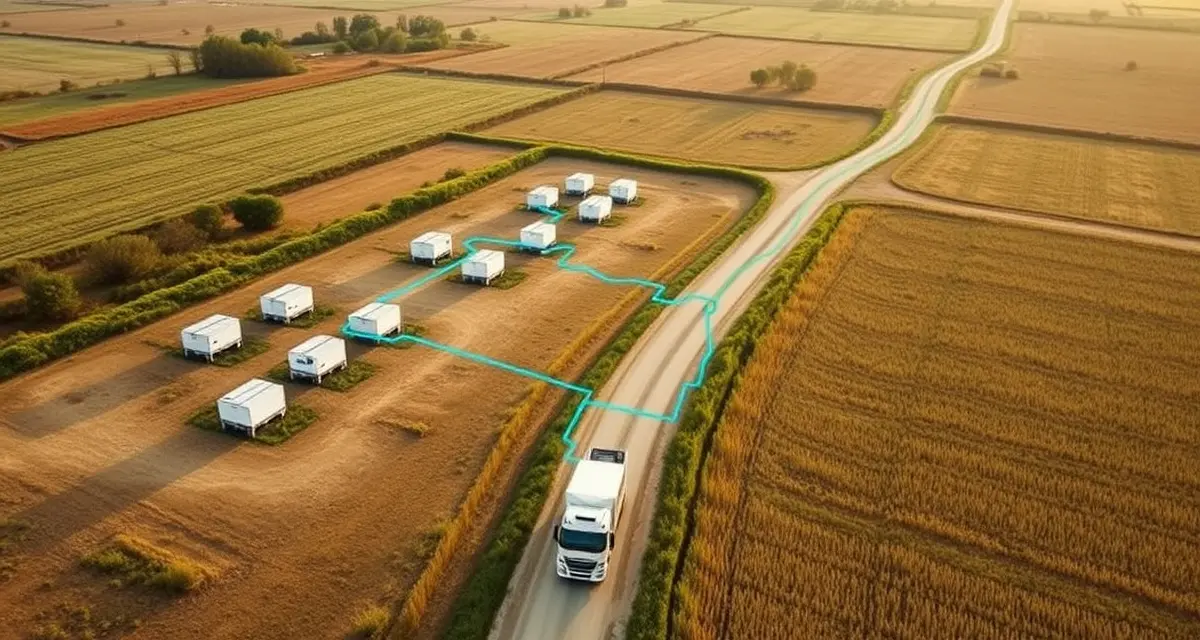
Yard Visit Route Optimizer for Commercial Beekeeping Operations
A 20-yard circuit without route optimization can add 200+ unnecessary miles per week. For a crew visiting 3-4 yards per day in a 150-mile operational radius, the difference between driving them in an optimized sequence versus whatever order they come to mind is 15-25% of total drive time, and at $0.65-0.70/mile for a truck, that's real money across a full season.
Route optimization across 20 yards can save 15-25% in fuel and labor costs annually. At 3 crew members driving 150 miles per day across 250 operating days, you're running 112,500 vehicle miles per year. A 20% reduction is 22,500 miles, roughly $14,000-16,000 in vehicle operating costs that stay in your pocket instead of going to the fuel pump.
TL;DR
- Most states require a Certificate of Health or Certificate of Veterinary Inspection issued by the origin state before out-of-state colonies can enter.
- A California-to-Florida-to-Pacific-Northwest-to-Northern-Plains circuit is the most common full-year migratory route for large commercial operations.
- Interstate permit coordination requires lead time; certificates typically need to be obtained 7-30 days before entry depending on the destination state.
- Moving 1,000 hives requires 2-3 truck loads per move, with fuel, driver wages, and DOT compliance as the primary variable costs.
- Operations that plan their annual circuit 6-8 months in advance can sequence pollination contracts and honey production to maximize annual revenue per hive.
What Route Optimization Does
Route optimization is the process of calculating the sequence in which to visit multiple locations that minimizes total travel distance or travel time. It's the traveling salesman problem applied to yard visits.
For a single-crew member visiting 5 yards in a day, optimization is simple, with 5 stops, there are only 120 possible sequences and any competent person can mentally find a reasonable one. For a fleet of 4 crews visiting a combined 16 yards in a day across a 3-county area, the number of possible sequences is too large to mentally optimize, and the difference between a well-planned route and a poorly planned one can be 60-90 minutes of drive time per crew per day.
At $25/hour per crew member plus $0.65/mile vehicle cost, 60 minutes of extra drive time costs $40-50 per crew per day. Across 4 crews, that's $160-200/day in unnecessary cost. Over a 30-day summer rotation period, that's $4,800-6,000 in recoverable efficiency.
How PollenOps Yard Route Optimizer Works
PollenOps's route optimization tool is integrated directly into the yard management system, which means your route is calculated with context that a standalone mapping tool doesn't have:
Yards are already in the system. You don't re-enter addresses each time you build a route. Every yard location is stored with GPS coordinates, access notes, and task history. You select the yards for a given day or rotation period and the optimizer calculates the route.
Visit urgency affects route priority. Yards with active health monitoring alerts, overdue visit schedules, or upcoming contract deliveries get weighted priority in the route. A yard that's 3 days overdue on its rotation gets visited before a yard that's 5 days away from its scheduled date, even if the overdue yard is geographically less efficient.
Access constraints are respected. Yards flagged as requiring specific vehicle types, limited to specific access hours, or requiring advance notice to landowners are incorporated in the route schedule rather than discovered when the crew arrives.
Crew assignment integrates with routes. When you assign a crew member to a set of yards, their route is optimized within their assigned geographic area, not across the entire operation. Multiple crews working in parallel get non-overlapping, individually optimized routes.
The route exports to the mobile app. Crew members follow turn-by-turn navigation to each yard in sequence on the mobile app, mark visits complete with any findings, and the system automatically updates the schedule.
Calculating Your Current Route Efficiency
Before implementing route optimization, establish your baseline. For one typical week:
- Log the starting and ending mileage for each crew vehicle
- Note which yards were visited each day
- Map the actual routes driven on a satellite map
Compare to the theoretically optimal route for the same set of yards. Tools like Google Maps multi-stop routing or RouteXL can calculate the optimal sequence retrospectively. The difference between what you drove and the optimized route is your current inefficiency.
Most operations running 15-25 yards find 15-35% route inefficiency when they first measure it. This is normal, without a systematic tool, humans default to visiting yards in the order they come to mind, by familiarity, or by the sequence they appear on a list, none of which are optimization criteria.
Beyond Yards: Delivery Route Optimization
The same principles apply to contract delivery runs. When you're delivering hives to multiple grower locations in a California county over 3-4 days, the sequence of those deliveries affects:
- Total miles driven between delivery locations
- Time available at each delivery (rush fewer stops into each day)
- Fuel cost for the delivery legs
- Driver fatigue on long multi-day delivery runs
For a delivery run with 8 grower locations in Fresno and Kern counties, route optimization often saves 1-2 hours per day compared to ad-hoc sequencing. Over a 4-day delivery run, that's 4-8 hours of saved time, potentially enough to eliminate a half-day of driver overtime.
Integrating Route Optimization with Crew Scheduling
Route optimization is most powerful when it's integrated with crew scheduling, not treated as a separate calculation. In PollenOps:
Schedule building: When you create the weekly crew schedule, the system simultaneously calculates the optimal route for each crew's assigned yards. The schedule shows both who's going where and in what order.
Real-time adjustment: If a crew member calls in sick or a mechanical issue sidelines a truck, re-optimizing the remaining crews' routes is a one-button action rather than a manual rescheduling exercise.
Cross-crew rebalancing: If one crew has a yard cluster that's very close together (efficient) while another crew has yards spread widely (inefficient), the optimizer can suggest rebalancing yard assignments between crews to improve overall efficiency.
The Fuel Savings Calculator
For your specific operation, calculate the annual saving potential:
Weekly miles per crew vehicle: ___
Number of crews: ___
Operating weeks per year: ___
Total annual miles: ___
Estimated inefficiency rate (start with 20%): ___
Recoverable miles: ___
Vehicle operating cost per mile: $0.65-0.70
Annual fuel/vehicle cost saving: ___
For an operation running 3 crews over 40 weeks, averaging 150 miles per crew per day, 5 days per week:
- Total miles: 3 × 150 × 5 × 40 = 90,000 miles
- 20% inefficiency: 18,000 recoverable miles
- At $0.68/mile: $12,240 annual fuel and vehicle saving
This doesn't include the labor cost of the extra drive time, which adds another $8,000-12,000 for 3 crew members. Combined saving potential: $20,000+ annually from route optimization alone.
FAQ
How does route optimization work for beekeeping yard visits?
Route optimization calculates the visiting sequence for multiple yard locations that minimizes total drive time or distance. In PollenOps, your stored yard GPS coordinates are used directly, select the yards you're visiting and the system calculates the optimal sequence, accounting for visit priority (health alerts, overdue schedules), access constraints (road type, time-of-access restrictions), and crew assignment areas. The optimized route is pushed to the crew member's mobile app for navigation.
Can route optimization integrate with crew scheduling?
Yes, in PollenOps the route optimizer and crew scheduler are integrated. When you assign crew members to yard groups and set the weekly schedule, routes are calculated simultaneously. If crew assignments change or yards are added or removed from a day's schedule, the route automatically recalculates. This means your schedule and route are always consistent rather than requiring separate manual updates to two different tools.
How much fuel can route optimization save for a 20-yard operation?
A 20-yard operation running 3 crew vehicles covering 120-180 miles per day can typically reduce drive distance by 15-25% through optimization. At $0.65-0.70/mile vehicle operating cost, that translates to $8,000-18,000 in annual fuel and vehicle cost savings depending on your specific yard geography and current route efficiency. Operations with yards clustered in geographic groupings see smaller gains (10-15%); operations with highly dispersed yard locations see larger gains (25-35%).
What is the most common full-year circuit for US migratory beekeepers?
The classic commercial circuit runs: winter buildup in Florida or southern Texas, California almonds in February, Pacific Northwest tree fruit (cherry, apple, pear) in April-May, Pacific Northwest or northern Midwest berry and clover crops in June-July, summer honey production in North Dakota, Montana, or Minnesota in July-August, and fall honey extraction and requeening before the cycle restarts. The exact circuit depends on contracted commitments, hive capacity, and the operator's regional relationships.
How do you coordinate state entry permits for a multi-state circuit?
State entry permits and health certificates require lead time: most states want certificates issued 7-30 days before entry. For a circuit that crosses 5-6 states, this means overlapping certificate applications where a certificate for the next state must be initiated before the current state's placement ends. Some operators use a permit tracking calendar that accounts for the lead time required for each destination state. PollenOps includes a permit tracking feature that alerts operators when certificates need to be initiated based on planned move dates.
What are the most common mistakes new migratory operators make?
The most common errors are underestimating transport costs, failing to secure contracts before building hive capacity, not accounting for state entry permit lead times, and neglecting varroa management during the compressed pre-almond preparation period. New operators often also underestimate the administrative load of managing 10-20 contracts across multiple states -- tracking payment status, compliance documentation, and crew scheduling simultaneously requires systems, not just a spreadsheet.
Try These Free Tools
Sources
- USDA Agricultural Research Service
- Bee Informed Partnership
- American Beekeeping Federation (ABF)
- American Honey Producers Association
- USDA Animal and Plant Health Inspection Service (APHIS)
Get Started with PollenOps
Migratory operations face the most complex coordination challenges in commercial beekeeping: permits across multiple states, staggered delivery windows, and fleet logistics that have to work precisely across hundreds of miles. PollenOps was built to handle multi-state, multi-grower, multi-crop operations at this level of complexity.