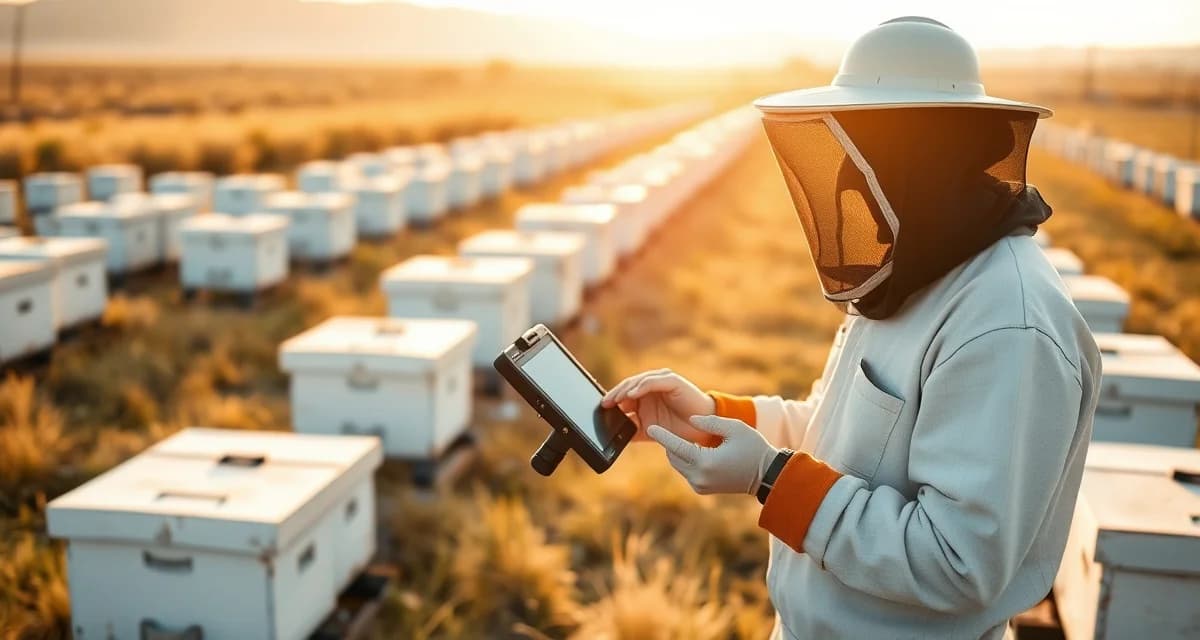
GPS Yard Tracking for Commercial Beekeepers
Remote bee yards in rural areas have no cell coverage 60% of the time during active operations. This is the fundamental challenge of field data capture for migratory beekeepers: you're doing your most important documentation work in exactly the places where connectivity is worst.
GPS yard tracking only works if it works where your yards actually are. Not in towns. Not on the highway between yards. At the yard site, in the field, when you're standing next to your hives at 2 AM with your phone and no signal.
PollenOps GPS yard management works offline and syncs when you have signal. That design choice makes the difference between a tracking system you can actually use and one that fails in the field.
TL;DR
- Moving 1,000 hives to almonds requires 2-3 truck loads, with fuel costs of $3,500-5,000 per run at current California diesel prices.
- Loading at night when bees are clustered inside reduces escape and minimizes defensive behavior during transport.
- GPS-confirmed yard coordinates, not just addresses, should be in every contract to prevent access failures on delivery night.
- Load planning that sequences multiple drops on a single truck run reduces total miles driven per hive.
- fleet logistics coordination -- vehicle assignments, load manifests, and crew scheduling -- requires a structured system at 500+ hives.
What GPS Yard Tracking Actually Does
GPS yard tracking is more than putting pins on a map. Done right, it creates a spatially anchored record for every yard visit: a timestamped GPS event that confirms you were at that specific location at that specific time.
This matters for several reasons:
Contract compliance. A GPS arrival event at the contracted yard location proves delivery timing. A spreadsheet entry does not.
State inspection. State inspectors can verify GPS yard coordinates against physical apiary locations. A GPS record is a credible inspection document. A handwritten address is not.
Employee verification. When you're not physically present at a yard, GPS check-ins confirm your crew was actually at the site, not sitting in the truck down the road.
Dispute prevention. In a hive count dispute, your GPS delivery record with timestamp anchors the count to a verified time and place. It's much harder to dispute a count that's attached to GPS evidence than one that's just a number in a spreadsheet.
BeeTrack GPS is designed for NZ farm scales, not large US migratory operations. For multi-state US commercial beekeeping, you need a GPS system that handles the scale, the offline requirement, and the integration with contract and bloom management.
Key Features of PollenOps GPS Yard Tracking
Offline GPS Capture
The PollenOps mobile app captures GPS coordinates using your device's onboard GPS with no cell signal required. When you open a yard record and check in, the app records your current coordinates immediately from the device hardware.
Notes, hive counts, photos, and all other field data are stored locally on the device. When you regain cell or Wi-Fi signal, the data syncs automatically to your account. Nothing is lost in the gap.
This is what field-ready offline capture looks like. Compare it to systems that require an active connection to record data, which means lost records every time you're in a dead zone.
GPS Map Dashboard
Your PollenOps yard dashboard shows every yard on an interactive map. Active yards (currently occupied with hives under contract) and inactive yards (available for future placement) display as separate markers. Clicking any yard brings up the current hive count, last visit date, and any upcoming scheduled events.
For commercial bee yard management, this map view is the operational overview you need at the start of every day. Where are all my hives right now? Which yards have upcoming moves? Which yards haven't been visited recently?
GPS Accuracy for Remote Yards
Standard smartphone GPS is accurate to 3-5 meters under open sky, more than sufficient for yard location documentation. In areas with heavy tree cover or narrow canyon terrain, accuracy may be slightly reduced, but still far more precise than any address or written description.
For yards with complex internal geography (a large orchard with multiple hive clusters, or a yard with multiple access points), you can record multiple GPS points for a single yard: one for the entrance gate, one for each cluster location.
Sharing GPS Yard Locations with Your Team
When you add a new yard to PollenOps with GPS coordinates, every team member with access can see it on the map. New employees don't need to learn oral directions to get to a yard. They navigate directly to the GPS pin.
For hive movement tracking, sharing yard locations with drivers is particularly important for remote locations where the destination might be difficult to find from an address alone. The GPS pin is the navigation target.
Team access levels in PollenOps control who can view, edit, or create yard records. A field crew member might have view access to yard locations and check-in capability, but not the ability to modify contract records.
How GPS Tracking Works in Practice
Arriving at a New Yard for the First Time
Drive to the site. Open PollenOps on your phone. Create a new yard record or open an existing one. The app offers to capture your current GPS location as the yard coordinates; accept it. You're now standing at the yard pinning its location in the system.
Add basic details: yard name, any access notes, contact information for the landowner or grower. Take a photo if you want to attach a visual reference to the record. The yard is now in your GPS database.
Checking In at an Established Yard
Open the yard record in PollenOps. Tap check-in. The app captures your GPS coordinates and timestamps the event. You record your hive count and any notes. When you have signal, the data syncs.
The check-in creates a visit record: GPS location, timestamp, hive count, notes. This is your documentation of that visit. The GPS confirms you were there, and the count is attached to that confirmed location.
Checking the Accuracy of Your Records
After a few check-ins at a yard, open the yard record and look at the GPS history. Are all your check-in events registering at the same location? If one shows you a quarter-mile away, there may have been a GPS accuracy issue at that visit.
For yards where you regularly park in different spots relative to the hive placement, the GPS events will cluster within a few hundred meters. That's normal and doesn't affect the evidentiary value. You can see from the cluster that all visits were to the same site.
How Accurate Is GPS Yard Tracking for Beekeeping?
Accurate enough for every practical purpose.
For yard identification and navigation: completely accurate. Coordinates recorded at the yard are the navigation destination for your crew.
For contract compliance documentation: completely sufficient. The GPS coordinates confirm the delivery location, and the timestamp confirms the delivery time. A difference of 3-5 meters is irrelevant to whether hives were at the contracted site.
For state inspection records: acceptable. State inspectors verify that hives are at a registered apiary location. A GPS record showing coordinates that correspond to the apiary address satisfies this requirement.
For litigation: GPS records from a standard smartphone are admissible as evidence in most jurisdictions. They're not treated as infallible, but they're credible documentation.
Can I Track Bee Yards Without Cell Service?
Yes. PollenOps captures GPS data using device-level GPS, which doesn't require a cell signal or internet connection. Your phone's GPS chip communicates with GPS satellites directly with no network connection required.
What you do need: location services enabled on your device and the PollenOps app installed and opened. The app needs to have been launched with a connection at least once to ensure your account data is loaded for offline use.
Once those conditions are met, you can capture yard check-ins, hive counts, photos, and notes at any remote location, regardless of cell coverage. All data queues locally and syncs automatically when connectivity returns.
This offline capability is why PollenOps GPS yard tracking works for remote US apiary locations. It's also why systems that require a live connection fail for commercial beekeepers.
FAQ
Can I track bee yards without cell service?
Yes. PollenOps uses device-level GPS (the GPS chip in your phone), which communicates directly with satellites and requires no cell signal or internet connection. Data captured offline (GPS coordinates, hive counts, photos, notes) is stored on your device and syncs automatically when you're back in range. This offline capability is fundamental to field-usable tracking for remote apiary locations.
How accurate is GPS yard tracking for beekeeping?
Standard smartphone GPS is accurate to 3-5 meters under open sky. In wooded areas or terrain with sky obstruction, accuracy may be reduced to 10-15 meters. For beekeeping documentation purposes (yard identification, delivery verification, state inspection records), this level of accuracy is more than sufficient. The GPS record confirms you were at the yard location, which is the primary evidentiary purpose of tracking.
How do I share GPS yard locations with my employees?
GPS yard locations in PollenOps are accessible to any team member with account access. They can view the yard on the map dashboard and navigate directly to the GPS pin using their phone's navigation app. For new yards or yards at complex sites, you can add multiple GPS pins (entrance, cluster locations) and notes describing the route. Employee access levels control what they can see and edit, so sharing yard locations doesn't require giving crew members full account access.
What is the standard approach for loading hives for overnight transport?
Load at night when bees are clustered inside, after temperatures have dropped below 60 degrees Fahrenheit. Secure entrances with foam or screened netting to prevent bee escape during transit. Use ventilation boards between layers for stacked hives to prevent heat buildup. Drive overnight to take advantage of cooler temperatures, which reduces stress on colonies during transport. Confirm GPS coordinates and truck access routes for every delivery yard before departure.
How do you track fleet movements and hive assignments across multiple delivery stops?
The practical requirement is a system that connects each truck assignment to specific hive pallets, which connect to specific yard locations, which connect to specific grower contracts. Paper manifests and phone calls work for a single delivery, but a 20-yard almond placement across 10 growers and 3 trucks requires digital coordination. PollenOps fleet module tracks load assignments, delivery sequencing, and yard confirmation in the same system as your contracts and health records.
What DOT requirements apply to commercial beekeeping trucks?
Commercial beekeeping vehicles hauling hives are subject to DOT regulations for commercial motor vehicles, including driver hours of service requirements, commercial driver license requirements for vehicles over 26,001 pounds GVWR, and vehicle inspection requirements. Some states have additional agricultural exception provisions that may apply to beekeeping operations. Consult with a transportation compliance specialist familiar with agricultural operations before your first large-scale move.
Try These Free Tools
Sources
- USDA Agricultural Research Service
- Bee Informed Partnership
- American Beekeeping Federation (ABF)
- USDA Animal and Plant Health Inspection Service (APHIS)
- American Honey Producers Association
Every Yard, Every Visit, Verified
GPS yard tracking turns your operational knowledge into organizational knowledge. When you know a yard because you've been there a hundred times, that knowledge lives in your head. When it's in PollenOps, it lives in the system, accessible to your crew, verifiable in a dispute, and searchable years later.
Start tracking your yards in PollenOps, and build the operational record your business deserves.
Get Started with PollenOps
Moving hundreds of hives across multiple counties or states requires logistics coordination that goes beyond what a spreadsheet can manage reliably. PollenOps handles load planning, route scheduling, and crew assignments alongside your contract and yard records so your fleet operations are organized before the truck rolls.