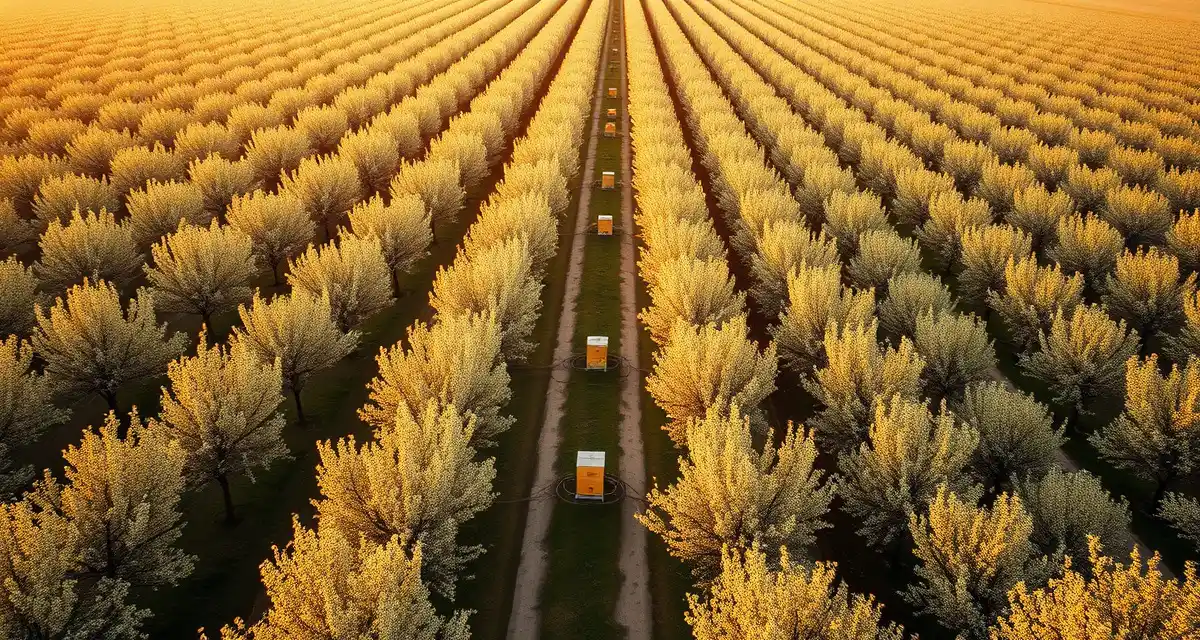
Almond Board Pollination Statistics and Industry Data
California almond acreage has grown more than 50% over the past 20 years while US colony counts have remained roughly flat. That's the single most important data point for a commercial beekeeper deciding where to invest in fleet expansion. The demand side keeps growing. The supply side doesn't keep pace. That structural imbalance is what keeps almond pollination contracts rates at $200-220/hive in 2026 and trending upward.
1.3 million hives are placed in California almonds each February, representing 80% of all US commercial colonies. Understanding what drives that number, how it's changed, and what it means for contract dynamics puts you in a much better negotiating position than operators who just take whatever rate the grower offers.
TL;DR
- California almond pollination consumes roughly 80% of the US commercial hive population every February, making it the most supply-constrained pollination market in the country.
- Per-hive rates have held between $185 and $220 for 6-8 frame colonies over recent seasons.
- Contracts are typically signed October through November for the following February season; operators without agreements by December are working from a weak position.
- Hive strength minimums range from 6 to 8 frames of bees depending on the grower, with premium-strength colonies commanding $200-215/hive.
- varroa management, documentation, and logistics coordination in the 6-8 weeks before delivery determine whether almond season is profitable or a breakeven event.
The Core Numbers
Almond acreage: California almonds were planted on approximately 1.3 million bearing acres as of the 2024-2025 season. When non-bearing acreage (orchards planted but not yet producing) is included, total planted almond acreage exceeds 1.4 million acres.
Hive requirement: Industry standard for commercial almond pollination is 2 colonies per acre. At 1.3 million bearing acres, that's 2.6 million colony placements needed. Note that this is placements, not unique colonies. Some operators place multiple times at different locations.
Available US commercial colonies: USDA NASS estimates approximately 2.7-3.0 million managed honey bee colonies in the US at any time, with the count varying by season. Commercial migratory operations account for the majority of colonies placed in almonds; small-scale hobbyist and sideliner operations don't generally participate in California almond contracts.
The math: 2.6 million placements needed, approximately 2.7-3.0 million available colonies nationally. Almond season is consuming essentially all available commercial capacity. There is no meaningful slack.
Acreage Growth vs. Colony Supply
The California Almond Board tracks acreage by county and reports annual planting data. The trajectory over the past two decades:
- 2000: ~500,000 bearing acres
- 2010: ~740,000 bearing acres
- 2015: ~950,000 bearing acres
- 2020: ~1,180,000 bearing acres
- 2024: ~1,300,000+ bearing acres
That's more than doubling in 24 years. The pace of growth slowed in the most recent years as almond prices softened and some growers reduced new plantings, but the existing acreage base means demand will remain at current levels for the life of those orchards (typically 25-30 years).
On the colony supply side: USDA NASS reported approximately 2.88 million colonies in 2024. In 2000, the count was approximately 2.62 million. In 24 years, US colony counts grew by less than 10% while almond acres more than doubled. The supply constraint is structural and decades in the making.
Regional Distribution of Almond Acreage
Where almonds are grown matters for placement logistics:
San Joaquin Valley (Central Valley): Kern, Tulare, Fresno, Madera, Merced, Stanislaus, San Joaquin, and Sacramento counties contain the vast majority of almond acreage. Kern County has seen the most rapid recent expansion. Stanislaus County has the longest history of commercial almond production.
Sacramento Valley: Colusa, Glenn, Tehama, Butte, and Yolo counties. Smaller overall acreage than the San Joaquin Valley but significant commercial production. Bloom timing here often leads the San Joaquin Valley by 5-10 days for northern varieties.
Bay Area and foothill regions: Much smaller acreage, boutique and specialty operations. Not commercially significant for large-scale pollination contractors.
Understanding the geographic distribution helps with placement scheduling. If your first contract deliveries are to Kern County operations (typically late January to early February for southern varieties), you can sequence northern Sacramento Valley deliveries for the following week as bloom moves north.
Per-Hive Contract Rate History
The Almond Board doesn't publish official per-hive contract rates, but industry tracking through the American Bee Federation, extension research, and commercial operator surveys documents the trend:
- 2000-2005: $50-80/hive
- 2006-2010: $80-130/hive (CCD period drove rates up sharply)
- 2011-2015: $130-170/hive
- 2016-2020: $160-190/hive
- 2021-2023: $190-210/hive
- 2026: $200-220/hive for standard commercial contracts
The CCD period was a price inflection point. When tens of thousands of colonies collapsed between 2006 and 2008, the supply shock pushed rates to levels that had never been seen before. Rates haven't meaningfully retreated since because the structural supply constraint hasn't been resolved.
For operators entering California almond contracts for the first time, the rate hierarchy matters:
- 8+ frame premium contracts: $220-240/hive from growers willing to pay for documented strong colonies
- Standard 6-frame contracts: $200-215/hive
- Late-place fill contracts: $160-185/hive (colonies needed after primary contractors are placed; somewhat lower rate)
- Spot market last-minute: Highly variable; sometimes premium, sometimes discounted depending on how short the grower is
Hive Strength Requirements and Grower Standards
The California Almond Board's research supports 6-frame minimum as the standard strength requirement for effective pollination. Studies comparing yield in orchards with 4-frame vs. 6-frame colonies show meaningful nut set differences at 6 frames vs. below threshold.
More recent research has explored whether higher-strength colonies (8-10 frames) provide additional yield benefit. Results are mixed. The incremental benefit of frames above 6 appears to vary with weather, orchard design, and variety. But growers with premium contracts are requesting 8-frame minimums, and some are paying $220-240/hive for documented delivery of 8-frame strength.
The implication for beekeepers: colonies at exactly 6 frames are compliant but not differentiated. Operations that consistently deliver 8-frame colonies to growers willing to pay for them capture $20-25/hive premium. At 500 hives on premium contracts, that's $10,000-12,500 in additional revenue per season.
Bloom Timing Data
The Almond Board conducts annual bloom timing surveys and publishes data by variety and region. Key bloom windows:
Nonpareil: The dominant variety. Typically blooms February 8-25 in the San Joaquin Valley, with earlier bloom (February 1-15) in warmer, lower-elevation southern locations.
Carmel: Overlapping bloom with Nonpareil, good cross-pollination partner.
Butte/Padre: Blooms 5-10 days later than Nonpareil. Important for operations wanting to extend placements into late February.
Independence: A self-compatible variety that reduces reliance on cross-pollination. If Independence plantings increase, it could eventually reduce per-acre hive requirements, a long-term trend worth watching.
Bloom timing varies by year based on chill hours in December-January. Low-chill years (warm winters) delay bloom; high-chill years can push Nonpareil bloom into late January. Extended cool springs stretch the bloom period; warm conditions compress it.
For practical delivery planning: assume hives need to be on site by February 1-5. In early-bloom years, Nonpareil opens February 8-12; late years it's February 20-25. Growers who've ordered colonies for February 1 delivery are not flexible on that date. They're preparing for the earliest possible bloom scenario.
What These Numbers Mean for Your Contracts
The market data tells a clear story for contract negotiation:
- Almond growers need your colonies more than they'll openly admit during negotiation. There's no slack in the supply chain.
- Per-hive rates have risen consistently for 20 years and have structural support to continue rising.
- Documented colony strength above the 6-frame minimum is a real differentiator that commands premium rates from growers who understand the research.
- Late-contract fill positions exist for operations that can't fill early, but the rates are lower and the placement quality is often worse.
Early contracting (signing agreements in September-October for February delivery) gives you the best rate, the best placement selection, and grower relationships that generate multi-year commitments. Walk into a grower's office in January asking for a spot-market contract and you're negotiating from the other side of that power balance.
FAQ
How many hives does California almond production require each year?
California's approximately 1.3 million bearing almond acres require roughly 2.6 million colony placements at the industry standard of 2 colonies per acre. This represents about 80% of all US commercial honey bee colony capacity placed in a single crop over a 6-8 week window in January-March. The number grows slightly each year as new almond orchards reach bearing age.
How has almond acreage grown relative to US colony supply?
California almond acreage has grown more than 100% since 2000, while US commercial colony counts have grown less than 10% over the same period. This structural imbalance between demand (growing) and supply (constrained by biology and mortality) is the primary driver of per-hive rate increases from $50-80/hive in 2000 to $200-220/hive in 2026. Unless there's a major improvement in colony survival rates or a significant contraction in almond acreage, this imbalance persists.
What does the almond board data mean for pollination contract pricing?
The data supports continued strong per-hive rates. When you're one of thousands of operators competing for the same limited supply, the leverage is with the suppliers (commercial beekeepers), not the buyers. The data also shows that documented colony strength above the 6-frame minimum commands real premiums from sophisticated growers who understand the yield research. Operations that invest in quality verification tools and maintain relationships with premium-paying growers capture the top of the rate curve rather than the average.
How early should almond pollination contracts be negotiated?
Large almond growers and broker networks begin securing hive commitments in July and August for the following February season. Written contracts are typically signed October through November. Operators who do not have signed agreements by December are working from a weak position since most quality hive inventory is already committed. Start grower outreach in mid-summer and target signed agreements before Thanksgiving.
What documentation is required for hive delivery to California almonds?
California requires a Certificate of Health for out-of-state colonies, issued by the origin state's apiary inspection program within 30 days of entry. The certificate must certify freedom from American foulbrood, European foulbrood, and Varroa destructor below treatment threshold. Some states require small hive beetle freedom for California entry. In addition, many growers now expect documentation of pre-delivery mite counts confirming colonies are below threshold.
What happens to hives after almond season ends in late March?
Post-almond options include moving north for Pacific Northwest cherry or apple pollination in April-May, routing to Michigan or Maine blueberries in May-July, transitioning to summer honey yards in North Dakota or Montana, or staying in California for splits and rebuilding. The right choice depends on hive strength coming out of almonds and downstream contract commitments. Operators who plan their full-year circuit in advance can optimize both pollination revenue and honey production.
Try These Free Tools
Sources
- USDA Agricultural Research Service
- Bee Informed Partnership
- American Beekeeping Federation (ABF)
- Almond Board of California
- University of California Cooperative Extension
Get Started with PollenOps
Almond season is the revenue event that defines the commercial beekeeping year, and the details -- contract terms, delivery timing, hive strength documentation, and invoicing -- determine whether the season is profitable. PollenOps manages the full almond contract lifecycle from quote to final payment, with yard tracking, crew scheduling, and grower communication built in. See how it works for operations from 200 to 5,000 hives.