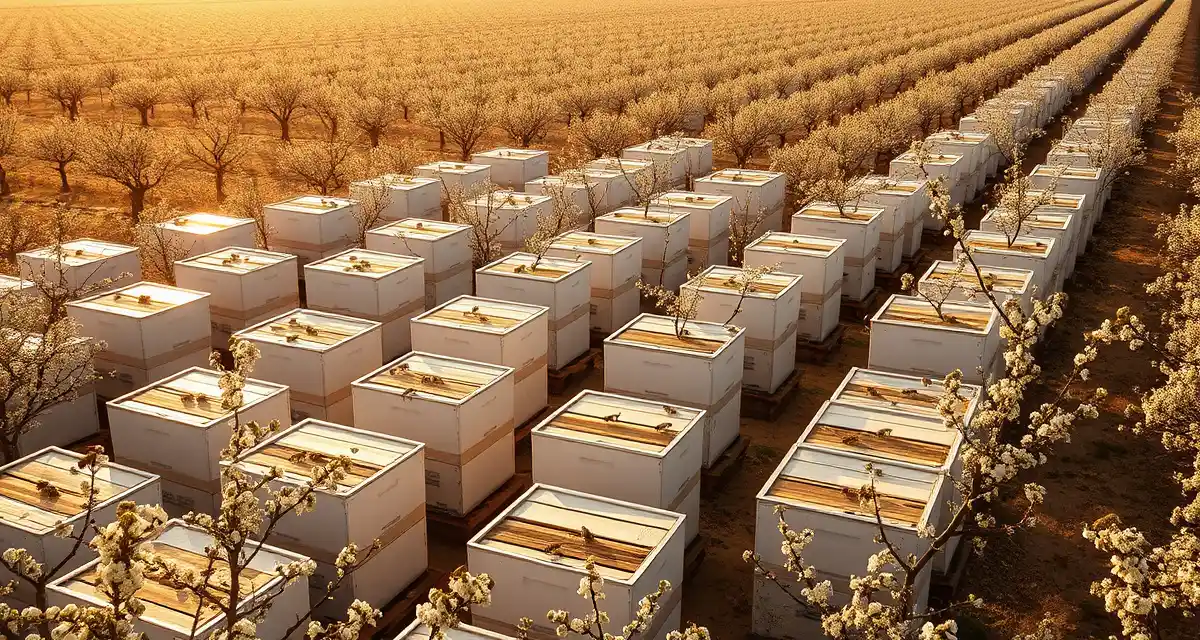
Almond Pollination 2026 Season Outlook for Commercial Beekeepers
California almond acreage grew 8% from 2023 to 2025, increasing hive demand by an estimated 80,000 colonies. That demand surge lands on a national colony supply that hasn't grown proportionally. For commercial beekeepers, the arithmetic is straightforward: more acres competing for the same pool of available colonies means continued upward rate pressure and a strong market for operators who can document quality delivery.
This 2026 outlook covers the acreage situation, rate trends, timing forecast, and how to use PollenOps to position your operation for the best contracts.
TL;DR
- California almond pollination consumes roughly 80% of the US commercial hive population every February, making it the most supply-constrained pollination market in the country.
- Per-hive rates have held between $185 and $220 for 6-8 frame colonies over recent seasons.
- Contracts are typically signed October through November for the following February season; operators without agreements by December are working from a weak position.
- Hive strength minimums range from 6 to 8 frames of bees depending on the grower, with premium-strength colonies commanding $200-215/hive.
- varroa management, documentation, and logistics coordination in the 6-8 weeks before delivery determine whether almond season is profitable or a breakeven event.
Acreage and Demand Forecast
Bearing acreage: California almond bearing acreage is projected to reach approximately 1.45-1.50 million acres in 2026, up from 1.38 million in 2023. Acreage planted in 2021-2022 is now entering full production.
Non-bearing acreage: New plantings have moderated since the 2020-2022 expansion peak, as water costs and commodity price uncertainty slowed grower investment. This means the 2026-2028 period won't see the same dramatic demand increases as 2022-2025.
Hive demand estimate: At 2 hives per acre for bearing almond acreage, 2026 demand sits at 2.9-3.0 million hive placements. US colony counts are approximately 2.7-2.9 million total, with not all available for California.
What this means for operators: Supply remains constrained relative to demand. The structural shortage that has driven rate increases since 2010 persists in 2026.
Rate Trends for 2026
Based on 2025 contract rates and the demand picture above:
Strong colonies (8+ frames): $210-$235 per hive for premium large-grower contracts committed before November 2025. This range reflects the top tier of the market.
Standard colonies (6-7 frames): $185-$215 per hive for standard commercial contracts. Mid-range for established beekeeper-grower relationships.
Spot market (January commitments): $170-$195 for operators committing in December-January. Spot market pricing reflects higher grower uncertainty and typically lower colony quality expectations.
Rate trajectory: Rates have increased approximately 3-5% per year since 2020. Absent a significant change in either acreage growth or colony supply, modest continued rate increases are expected through 2026-2027.
Timing Forecast for 2026
Almond bloom timing in California correlates strongly with winter temperature patterns. PollenOps annual pollination contract planning tools integrate NOAA long-range forecasts as they become available to refine bloom timing estimates.
Average historical timing:
- Nonpareil: February 14-22 (peak bloom)
- Carmel: February 16-24
- Monterey: February 18-26
- Butte/Padre: February 20-28
These are historical averages. In any given year, bloom can run 7-14 days early (warm January) or 7-14 days late (cold February). The 2024 season ran approximately 5 days early; 2023 ran about 4 days late due to cold January temperatures and atmospheric river events.
PollenOps bloom timing alerts fire based on growing degree day accumulation in specific California counties, giving you county-level precision rather than statewide averages.
2026 forecast: NOAA's winter outlook for California indicates a high probability of near-average temperatures for January-February 2026. Near-average temperatures typically produce bloom timing within 5 days of historical averages. Watch for updates as seasonal forecasts sharpen in November-December 2025.
Water and Acreage Risk
California's long-term water situation continues to create structural uncertainty for almond acreage. When water allocations are cut significantly, some growers reduce irrigation and some abandon marginal acreage.
2025 water status: California snowpack and reservoir levels going into winter 2025-2026 are at or above average following two wet years. Water stress that constrained some 2022-2023 operations is less acute for 2026.
Long-term risk: Climate-driven drought cycles will periodically reduce almond acreage in water-challenged areas (primarily west of Highway 99 and south of Fresno). Operators who are building long-term California almond businesses should monitor water allocation policy, particularly the SGMA groundwater sustainability requirements taking effect through 2030.
Contract Strategy for 2026
Given the market conditions above, here's how to position your operation:
Commit early: Premium growers are filling their committed beekeeper supply in September-October 2025. If you're reading this in late 2025, you may still be able to reach growers for favorable 2026 terms. If you're reading in 2026, your almond contracts are already determined.
Price for strong colonies: With rates favoring documented quality, invest in pre-season build-up and document your colony strength. Strong operations with professional documentation can command the top of the $210-235 range for 8-frame colonies.
Consider multi-year relationships: Growers who've had positive experiences are willing to offer multi-year commitments at fixed or rate-capped terms. Trading slight pricing flexibility for multi-year certainty is worth considering in an uncertain rate environment.
For almond pollination management in California with full documentation, bloom alerts, and contract management, PollenOps provides the tools to execute a professional 2026 season.
Frequently Asked Questions
What is the almond hive demand forecast for 2026?
California's 2026 almond bearing acreage is projected at 1.45-1.50 million acres, generating estimated demand of 2.9-3.0 million hive placements at the standard 2 hives per acre. US colony counts sit around 2.7-2.9 million total, with not all available for California due to other pollination commitments, winter losses, and geographic constraints. The supply gap that has driven rate increases persists in 2026. Acreage growth is moderating compared to the 2020-2022 expansion peak, so demand increases will be more gradual than in recent years, but supply remains constrained enough to support continued strong pricing for documented-quality operators.
Are almond pollination rates expected to rise or fall in 2026?
Rates are expected to remain strong in 2026, with modest upward pressure continuing from the supply-demand gap. Strong colony rates of $210-235 for pre-November commitments and $185-215 for standard commercial contracts are the expected range. The rate increases of 3-5% per year seen since 2020 are likely to continue at a similar pace unless a significant change in either acreage growth or colony supply occurs. Operations that document strong colonies and maintain professional grower relationships can command the top of the rate range. Spot market rates (January commitments) will sit $20-30 below early-commitment rates, as they consistently have.
How early should I lock in almond contracts for the 2026 season?
The window for premium 2026 contracts opened in September 2025. Large almond operations make commitments with their trusted beekeepers in fall, before other operators are actively soliciting. By November, most of the premium contract supply is committed. December and January are the spot market, where rates are lower and you're competing for contracts that premium operators didn't take. If you're targeting 2026 almonds, the practical advice is to be in contact with your preferred growers by September and have contracts signed by November. For operations building new grower relationships, industry events in August and September are the best venues for initial contact.
How early should almond pollination contracts be negotiated?
Large almond growers and broker networks begin securing hive commitments in July and August for the following February season. Written contracts are typically signed October through November. Operators who do not have signed agreements by December are working from a weak position since most quality hive inventory is already committed. Start grower outreach in mid-summer and target signed agreements before Thanksgiving.
What documentation is required for hive delivery to California almonds?
California requires a Certificate of Health for out-of-state colonies, issued by the origin state's apiary inspection program within 30 days of entry. The certificate must certify freedom from American foulbrood, European foulbrood, and Varroa destructor below treatment threshold. Some states require small hive beetle freedom for California entry. In addition, many growers now expect documentation of pre-delivery mite counts confirming colonies are below threshold.
What happens to hives after almond season ends in late March?
Post-almond options include moving north for Pacific Northwest cherry or apple pollination in April-May, routing to Michigan or Maine blueberries in May-July, transitioning to summer honey yards in North Dakota or Montana, or staying in California for splits and rebuilding. The right choice depends on hive strength coming out of almonds and downstream contract commitments. Operators who plan their full-year circuit in advance can optimize both pollination revenue and honey production.
Try These Free Tools
Sources
- USDA Agricultural Research Service
- Bee Informed Partnership
- American Beekeeping Federation (ABF)
- Almond Board of California
- University of California Cooperative Extension
Get Started with PollenOps
Almond season is the revenue event that defines the commercial beekeeping year, and the details -- contract terms, delivery timing, hive strength documentation, and invoicing -- determine whether the season is profitable. PollenOps manages the full almond contract lifecycle from quote to final payment, with yard tracking, crew scheduling, and grower communication built in. See how it works for operations from 200 to 5,000 hives.