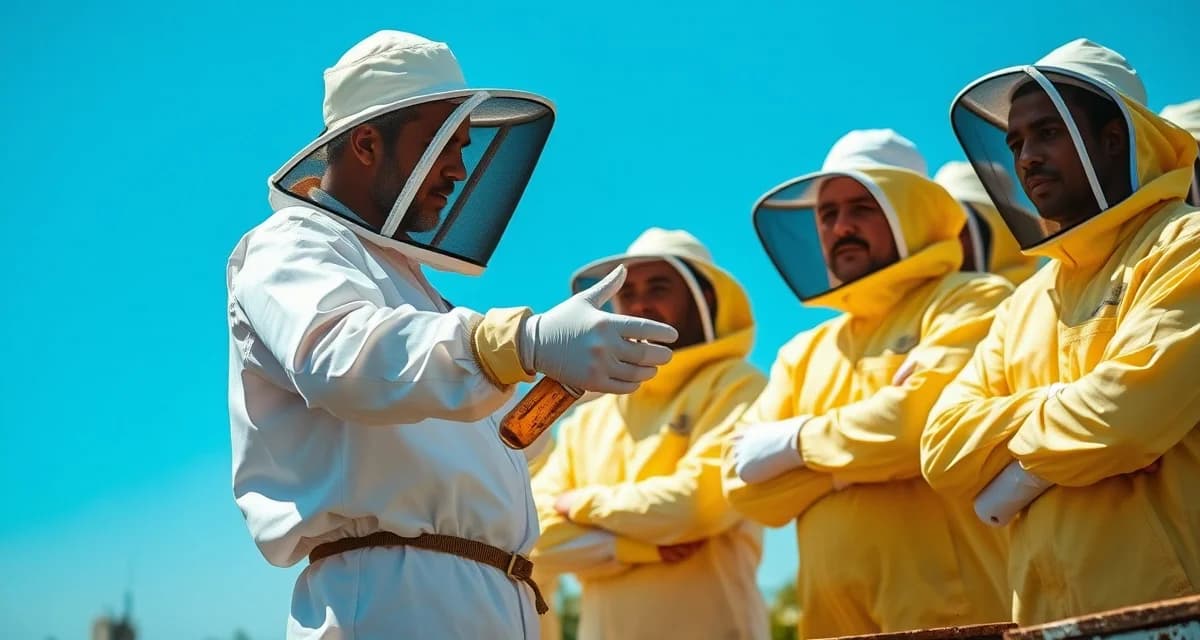
Beekeeping Crew Safety and Training for Commercial Operations
Anaphylaxis from bee stings is a legal liability that every commercial beekeeping employer must take seriously. It's not a hypothetical risk. According to OSHA, bee stings cause dozens of occupational fatalities in the US annually, and the agriculture sector sees a disproportionate share. When you're running a crew of 5 to 20 workers managing thousands of hives, you need documented safety training, pre-employment allergy screening, and EpiPens staged on every truck.
OSHA's agricultural safety standards apply to commercial beekeeping operations with employees. The specific standards under 29 CFR 1928 cover field sanitation, hazard communication, and general duty requirements. If your crew doesn't know what to do when someone goes into anaphylaxis 45 minutes from the nearest hospital, you have an unacceptable liability.
TL;DR
- A 2-person crew can place 200-300 hives per day for almond delivery; a 1,000-hive operation requires 7-10 crew-days for a single crop placement.
- Seasonal beekeeping labor is in high demand during February-May pollination season; recruiting begins months in advance for well-run operations.
- Clear task assignment and documentation requirements for crew work reduce errors and create accountability for inspection and treatment records.
- OSHA requirements for outdoor agricultural work apply to commercial beekeeping crews, including sting response protocols and appropriate PPE.
- Payroll, workers' compensation, and H-2A visa compliance (for operations using seasonal agricultural workers) add administrative complexity that scales with crew size.
Pre-Employment Screening
Before any new crew member works around bees, you need to screen for bee sting allergy. The standard approach is a written health questionnaire asking about prior sting reactions, allergy history, and whether the candidate carries epinephrine. Anyone who has had a systemic reaction to a bee sting should be evaluated by a physician before starting work.
Keep signed copies of the questionnaire in employee files. If someone discloses an allergy and you assign them to bee work anyway, your liability exposure is significant. Some operators require a physician sign-off clearing the employee for bee exposure as a condition of employment.
Never assume prior sting history makes someone safe. Sting allergies can develop at any time, including after years of uneventful exposure. First-year crew members and 10-year veterans can both develop anaphylaxis suddenly.
PPE Requirements
Minimum PPE for all hive manipulation work includes a full veil and bee suit or jacket. No exceptions. If you have crew members working without a veil because "they're comfortable with bees," you're one aggressive colony away from a workers comp claim and an OSHA inspection.
Your PPE standards should include:
- Full bee suit or jacket with attached hood/veil for all hive manipulation
- Gloves required for all crew members during initial training and for any colony known to be defensive
- Gloves optional for experienced crew on calm colonies after documented competency assessment
- Long sleeves and pants required even when not in full suit during yard setup and teardown
Maintain a PPE inventory log. Document that all crew members received their equipment, were trained on proper use, and that equipment is inspected and replaced when compromised.
Anaphylaxis Response Protocol
Every truck and every yard kit must include at minimum two auto-injector epinephrine units (EpiPen or generic equivalent) and a written response protocol. The written protocol needs to cover:
- Recognize anaphylaxis: hives, throat tightening, difficulty breathing, drop in blood pressure, loss of consciousness
- Administer epinephrine immediately, do not wait to see if it resolves
- Call 911 and give location coordinates or address
- Second dose after 5 to 15 minutes if no improvement
- Keep patient lying down with legs elevated until EMS arrives
Epinephrine expires. Set calendar reminders to replace units before expiration. In remote yard locations, replacement delays can be fatal.
Training every crew member in EpiPen use is not optional. Run a hands-on training session at the start of each season using a trainer auto-injector. Document attendance.
Smoke Safety and Burns
Burn injuries from smokers are among the most common beekeeping-related injuries beyond stings. Train crew on:
- Lighting and extinguishing smokers safely
- Never placing a hot smoker in a vehicle or enclosed space
- Keeping water available at yard sites
- Not overfilling with highly flammable material
Smoker burns to hands are routine. More serious burns from dropped smokers or improper fuel are preventable with training.
Heat Safety in Bee Suits
Working in a full bee suit in 95-degree summer conditions creates real heat illness risk. Schedule crew shifts to avoid peak heat hours when possible. Require hydration breaks every 30 to 45 minutes during hot weather work. Know the signs of heat exhaustion and heat stroke, which can escalate rapidly when workers are physically exerting in full PPE.
Keep a dedicated cooler with cold water and ice on every truck during summer operations.
Documentation and Training Records
Your employee management system should store training records including dates of safety training, PPE issuance, sting allergy screening, and any incident reports. This documentation is essential if you're ever subject to an OSHA inspection or workers comp dispute.
For the broader picture of running an employed commercial beekeeping operation, employee management for beekeeping crews and your commercial beekeeping business plan should both address safety program costs as a line item.
Frequently Asked Questions
What safety training is required for commercial beekeeping employees?
OSHA's agricultural standards under 29 CFR 1928 require employers to provide training on job-specific hazards, including bee sting risk and anaphylaxis response. At minimum, all crew members should receive training on: proper PPE selection and use, recognizing and responding to anaphylaxis, EpiPen administration, heat illness prevention, and smoker safety. Training must be documented with signed records including date, topics covered, and employee signature. OSHA can request these records during an inspection. Verbal training without documentation offers no protection in a compliance review or legal dispute.
How do you screen employees for bee sting allergies?
Pre-employment screening begins with a written health questionnaire asking about prior systemic sting reactions, known insect venom allergy, and whether the candidate currently carries epinephrine. Anyone reporting a prior systemic reaction should be cleared by a physician before assignment to bee-proximity work. Questionnaires should be signed and retained in personnel files. All crew members should be reminded at each annual safety training that sting allergies can develop at any time, and that new symptoms like hives, throat tightening, or shortness of breath after a sting require immediate medical attention and reporting.
What PPE is required for commercial beekeeping operations?
Minimum PPE for hive manipulation work includes a full veil and bee suit or jacket for every crew member. Gloves are required for all new employees and recommended for any colony showing defensive behavior. All PPE must be properly maintained and inspected at the start of each season. Damaged veils or suits must be replaced before work continues. Employers should maintain a PPE inventory log documenting issuance dates, equipment condition, and replacement records. Beyond bee-specific PPE, workers in full suits in hot weather need a heat illness prevention program including mandatory hydration breaks and access to cool water at all yard sites.
What is the difference between commercial and hobby beekeeping?
Commercial beekeeping is distinguished by scale (typically 100+ hives, often 500-5,000+), revenue source (pollination contracts and bulk honey sales rather than local honey retail), and management approach (systematic protocols applied across yards rather than individual colony attention). Commercial operators manage bees as an agricultural enterprise, with the administrative, regulatory, and logistical complexity that entails. Most commercial operators derive the majority of their income from pollination services; honey production is a supplementary revenue stream.
How many hives are needed to make commercial beekeeping a full-time income?
Most beekeeping economists put the full-time commercial threshold at 500-800 hives, assuming efficient operations management and a combination of pollination and honey revenue. At 500 hives and $200/hive for almond pollination, almond season alone generates $100,000 in gross revenue before expenses. Net margins depend on operational efficiency, but well-run operations can achieve 30-50% net margins on pollination revenue. Additional crops and honey production improve per-hive economics but require additional management capacity.
What is the annual revenue potential for a 1,000-hive commercial operation?
A 1,000-hive operation running an almond season ($200/hive) plus blueberry or apple contracts ($80-100/hive) plus summer honey production ($25-40/hive after extraction costs) can generate $300,000-360,000 in annual gross revenue. Net margins after transport, crew, equipment, and hive replacement costs typically run 25-40% for well-managed operations, putting net income at $75,000-145,000 annually. The specific number depends heavily on circuit efficiency, loss rates, and contract quality.
Try These Free Tools
Sources
- USDA Agricultural Research Service
- Bee Informed Partnership
- American Beekeeping Federation (ABF)
- USDA Farm Service Agency
Get Started with PollenOps
Crew management during peak season is one of the most operationally demanding aspects of commercial beekeeping. PollenOps coordinates crew scheduling with yard assignments and contract timelines so your team is always working on the right yards at the right time.