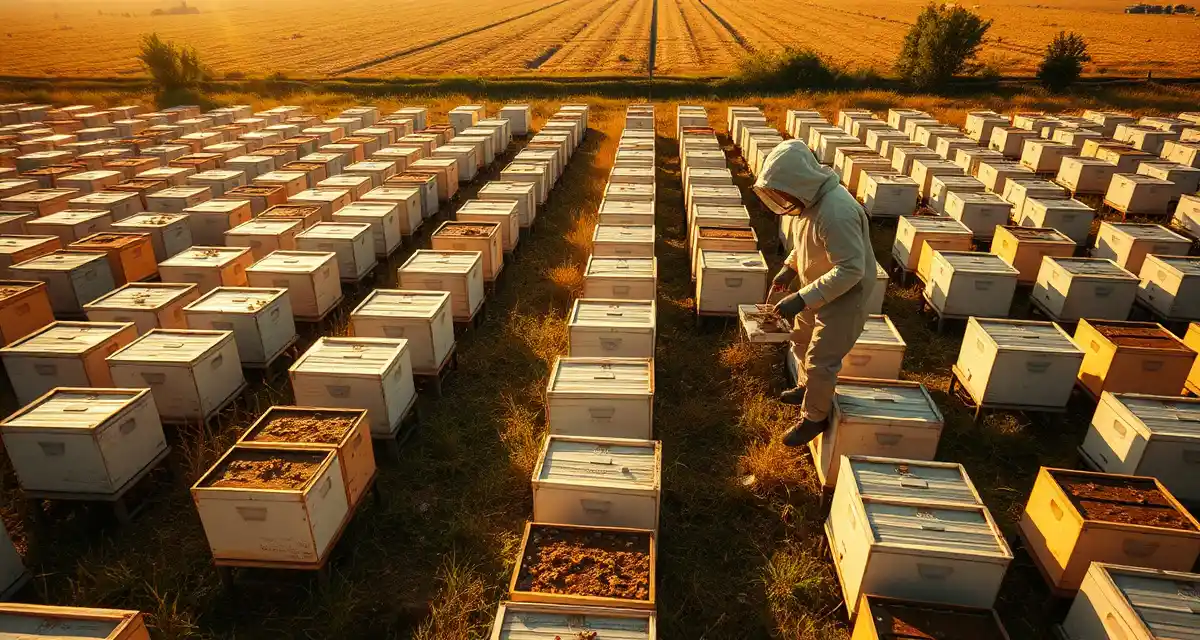
Commercial Beekeeping Business Plan: From 50 to 1000 Hives
The commercial beekeeping industry generates $700 million or more in pollination services annually in the US alone. That number doesn't include honey production. It doesn't include package bee sales, nucleus colony sales, or queen production. It's just pollination. And it's dominated by operations that figured out how to scale systematically.
A solid commercial beekeeping business plan doesn't start with passion for bees. It starts with a financial model, a capital requirements analysis, and a realistic growth timeline. This guide gives you that framework, from your first 50 hives to your first 1,000.
TL;DR
- Commercial beekeeping operations face two primary management challenges: operational logistics (hive health, transport, placement) and administrative coordination (contracts, payments, documentation).
- Most disputes and revenue losses in commercial beekeeping are preventable with better documentation and clearer contract terms.
- The operations that run most profitably are those with disciplined systems for tracking hive health, contract status, and fleet logistics in one place.
- PollenOps is built specifically for the operational complexity of commercial-scale pollination services, not adapted from a hobbyist tool.
- The most important management decisions (treatment timing, contract renewal, hive allocation) require accurate current data to make well.
Executive Summary: The Commercial Beekeeping Opportunity
The core revenue model for commercial beekeeping is straightforward. A 500-hive operation earns $100,000 or more per year from almond pollination alone, roughly $200 per hive for six to eight weeks of placement in California. That's before cherry, blueberry, apple, and other crop contracts, and before honey revenue.
But the path from 50 hives to 500 isn't smooth, fast, or cheap. Capital requirements, operational complexity, and the biology of bee colonies all constrain how quickly you can scale. A business plan that ignores those constraints will fail against reality.
Section 1: Business Model and Revenue Streams
Commercial beekeeping generates revenue through three primary channels.
Pollination Services
This is the core business for most large operations. pollination contracts are B2B agreements with agricultural producers (almond growers, apple orchardists, blueberry farms, cranberry operations) who pay you per hive to place bees in their crops during bloom.
Rates vary by crop and demand:
- Almond pollination: $170 to $230 per hive
- Cherry pollination: $100 to $160 per hive
- Blueberry pollination: $70 to $130 per hive
- Apple pollination: $60 to $100 per hive
- Specialty crops (cranberry, pumpkin, hybrid seed): $150 to $350 per hive
A migratory operation targeting multiple crops across multiple seasons can earn $300 to $400 per hive annually from pollination contracts if you run a tight circuit.
Honey Production
Honey revenue layers on top of pollination for most commercial operations. Bulk wholesale honey runs $1.80 to $3.50 per pound. A productive hive in a good nectar year yields 40 to 100 pounds of surplus honey. At 500 hives with average 50-pound yields and $2.50 per pound wholesale, that's $62,500 in honey revenue.
Direct retail and farmers market channels can push that to $8 to $15 per pound, dramatically improving margins, but they require additional labor and time that migratory operators often can't sustain.
Secondary Revenue: Queens, Packages, Nucleus Colonies
Operations with established queen rearing programs can sell surplus queens, packages, and nucleus colonies. At commercial scale, this can add $20,000 to $80,000 in revenue, but it requires dedicated infrastructure beyond your core pollination operation.
Section 2: Capital Requirements by Growth Phase
Phase 1: 50 to 150 Hives ($25,000 to $75,000)
At this stage, most beekeepers are still semi-commercial. You have enough hives to qualify for some local pollination contracts but probably not California almonds, which require reliable supply that most 150-hive operations can't consistently deliver.
Capital requirements:
- Hive equipment: $10,000 to $30,000
- Vehicle (used pickup with flatbed): $15,000 to $30,000
- Tools, protective gear, medications: $5,000 to $10,000
- Working capital: $5,000 to $15,000
Revenue potential at 150 hives: $30,000 to $60,000 annually. Margins are thin at this scale. Most operators at 150 hives have outside income or are actively reinvesting all revenue into growth.
Phase 2: 150 to 500 Hives ($100,000 to $200,000 additional capital)
This is the most critical and most difficult phase. You're scaling fast enough that your expenses are growing ahead of your revenue, and you're taking on enough operational complexity (multiple yards, multiple contracts, truck logistics) that spreadsheet management starts breaking down.
Additional capital requirements:
- Hive equipment (additional 350 hives): $50,000 to $100,000
- Second truck: $30,000 to $60,000
- Forklift or pallet mover: $15,000 to $40,000
- Working capital for first California season: $20,000 to $40,000
- Extraction equipment: $15,000 to $50,000
At 500 hives with California almond contracts established, annual revenue should reach $150,000 to $200,000. Net income improves as fixed costs get spread across more hives.
Phase 3: 500 to 1000 Hives ($200,000 to $400,000 additional capital)
Scaling from 500 to 1,000 hives is the step that separates serious commercial operations from large hobbyists. At 1,000 hives, you're running a legitimate agricultural business with employees, complex logistics, multiple contracts, and six-figure capital equipment.
Commercial beekeeping startup costs at this scale require serious capital planning and often outside financing.
Additional capital requirements:
- Hive equipment (additional 500 hives): $75,000 to $150,000
- Additional trucks (1 to 2): $60,000 to $120,000
- Employee costs (2 to 3 full-time workers): $80,000 to $120,000 per year
- Queen rearing infrastructure: $10,000 to $25,000
- Working capital and operating reserves: $50,000 to $100,000
Revenue at 1,000 hives: $300,000 to $500,000 annually from combined pollination and honey. Net income of $80,000 to $150,000 per year for a well-run 1,000-hive operation.
Section 3: Revenue Model at Scale
500-Hive Revenue Model
| Revenue Source | Calculation | Annual Revenue |
|---|---|---|
| Almond pollination (500 x $200) | 500 hives x 1 season | $100,000 |
| Spring fruit pollination (400 x $100) | 400 hives x 1 season | $40,000 |
| Summer honey (500 x 50 lbs x $2.50) | 500 hives x 50 lb x $2.50 | $62,500 |
| Gross Revenue | | $202,500 |
| Cost Category | Annual Cost |
|---|---|
| Labor (1 employee) | $40,000 |
| Truck operating costs | $20,000 |
| Treatments and supplements | $25,000 |
| Equipment depreciation | $20,000 |
| Insurance | $10,000 |
| Permits, fees, miscellaneous | $5,000 |
| Total Operating Costs | $120,000 |
Net Income: ~$82,500
1000-Hive Revenue Model
At 1,000 hives with a full migratory circuit, gross revenue of $350,000 to $500,000 is achievable. Net income of $100,000 to $200,000 for the operation's principals, after employee wages and all operating costs.
Section 4: Growth Milestones
A realistic growth timeline for a serious, well-capitalized commercial beekeeping business:
Year 1 to 2: Establish 50 to 100 hives. Learn varroa management, queen assessment, and seasonal management. Secure first local pollination contracts. Revenue covers expenses with modest profit.
Year 2 to 3: Scale to 150 to 200 hives. Purchase first commercial truck. Establish first California relationships. Even if initial California contacts don't result in contracts, you're building the network. Target $50,000 to $80,000 in annual revenue.
Year 3 to 4: Reach 300 to 400 hives. First California almond contracts, likely for partial hive count. Revenue reaches $100,000 to $150,000 annually.
Year 4 to 6: Scale to 500 hives. Full California almond contracts established. Second truck. Revenue reaches $150,000 to $200,000. Net income hits full-time owner salary plus some reinvestment capital.
Year 6 to 10: Scale toward 1,000 hives. First employees. Systematic operations management required. Revenue $300,000 to $500,000. Net income shared between operation principals and reinvested in growth.
This timeline assumes no catastrophic loss years, which is never guaranteed. Budget for setbacks.
Section 5: Financing Your Growth
USDA Farm Service Agency Loans
FSA Operating Loans and Equipment Loans are specifically designed for agricultural businesses. They can cover:
- Hive equipment purchases
- Vehicle purchases
- Operating costs (feed, treatments, supplies)
- Working capital for seasonal operations
Interest rates are typically lower than commercial rates, and FSA understands agricultural cash flow patterns. Starting this relationship early (even before you need major financing) is worthwhile.
Farm Credit System
Farm Credit System lenders (CoBank, AgriBank affiliates, regional Farm Credit associations) specialize in agricultural lending and understand seasonal cash flow. They're a better fit for commercial beekeeping than most commercial banks.
Equipment Financing
Truck and extraction equipment can often be financed separately through equipment lenders. Separating equipment debt from operating credit lines keeps your financing structure cleaner.
Section 6: What to Look for in Management Tools
At 500+ hives, the biggest operational risk isn't bee biology. It's administrative chaos. Contracts managed on paper or spreadsheets, yard records in notebooks, payment tracking across email threads: this is how disputes happen and contracts get lost.
Commercial pollination is a B2B services business. At scale, it requires B2B operations management. That means a system that tracks contracts, colony health, yard locations, fleet movements, and invoicing in one place.
Spreadsheets don't do this well. They don't send bloom timing alerts, don't flag contract delivery deadlines, and don't generate the documentation growers need to see. As you scale, the cost of spreadsheet-driven management (in lost contracts, disputes, and inefficiency) exceeds the cost of professional tools.
Section 7: Business Plan Template Summary
Your commercial beekeeping business plan should include:
Executive Summary: Your operation's current state, target scale, primary revenue model, and funding request if applicable.
Business Description: Legal structure, primary location, operational model (migratory vs. stationary), target markets.
Market Analysis: Pollination demand in your target regions, honey market prices, competitive landscape.
Operations Plan: Hive management approach, yard strategy, equipment inventory, staffing model.
Financial Projections: Three-year income statement, balance sheet, cash flow projections showing seasonal timing.
Capital Requirements: Itemized list of funding needs and intended use.
Risk Analysis: Colony loss scenarios, weather risk, market price risk, contract concentration risk.
FAQ
What revenue can a 500-hive operation generate from pollination?
At $200 per hive for almond pollination, 500 hives generates $100,000 in one six-week season. Adding spring fruit pollination, blueberry, or cherry contracts can add $30,000 to $60,000 more. Total pollination revenue for a 500-hive operation running a two or three crop circuit often reaches $130,000 to $160,000 annually, plus honey income on top.
How do you finance the growth from 100 to 500 hives?
The most accessible financing routes are USDA FSA loans (specifically designed for agricultural businesses), Farm Credit System lenders who understand agricultural cash flow, and equipment-specific financing for trucks and extraction gear. Most operators at 100 hives also reinvest all revenue and use owner savings as the primary scaling capital, supplemented by operating loans to cover seasonal cash flow gaps. Building banking relationships before you need them (even at 100 hives) makes future financing much more accessible.
What are the key milestones in scaling a commercial beekeeping business?
The critical milestones are: establishing first California almond contracts (typically requires 300+ reliable hives), acquiring a second truck (enables the logistics needed for multi-crop circuits), hiring a first full-time employee (enables growth beyond what one person can manage), and building a systematic operations management approach (required at 500+ hives to prevent administrative chaos from limiting growth). Each milestone requires capital and operational readiness that takes time to develop.
What is the difference between commercial and hobby beekeeping?
Commercial beekeeping is distinguished by scale (typically 100+ hives, often 500-5,000+), revenue source (pollination contracts and bulk honey sales rather than local honey retail), and management approach (systematic protocols applied across yards rather than individual colony attention). Commercial operators manage bees as an agricultural enterprise, with the administrative, regulatory, and logistical complexity that entails. Most commercial operators derive the majority of their income from pollination services; honey production is a supplementary revenue stream.
How many hives are needed to make commercial beekeeping a full-time income?
Most beekeeping economists put the full-time commercial threshold at 500-800 hives, assuming efficient operations management and a combination of pollination and honey revenue. At 500 hives and $200/hive for almond pollination, almond season alone generates $100,000 in gross revenue before expenses. Net margins depend on operational efficiency, but well-run operations can achieve 30-50% net margins on pollination revenue. Additional crops and honey production improve per-hive economics but require additional management capacity.
What is the annual revenue potential for a 1,000-hive commercial operation?
A 1,000-hive operation running an almond season ($200/hive) plus blueberry or apple contracts ($80-100/hive) plus summer honey production ($25-40/hive after extraction costs) can generate $300,000-360,000 in annual gross revenue. Net margins after transport, crew, equipment, and hive replacement costs typically run 25-40% for well-managed operations, putting net income at $75,000-145,000 annually. The specific number depends heavily on circuit efficiency, loss rates, and contract quality.
Try These Free Tools
Sources
- USDA Agricultural Research Service
- Bee Informed Partnership
- American Beekeeping Federation (ABF)
- American Honey Producers Association
- Project Apis m.
Get Started with PollenOps
Managing a commercial beekeeping operation involves more data, more deadlines, and more moving parts than any general-purpose tool was designed to handle. PollenOps brings contracts, yard records, health documentation, and fleet logistics together in one platform built for the realities of commercial-scale beekeeping.