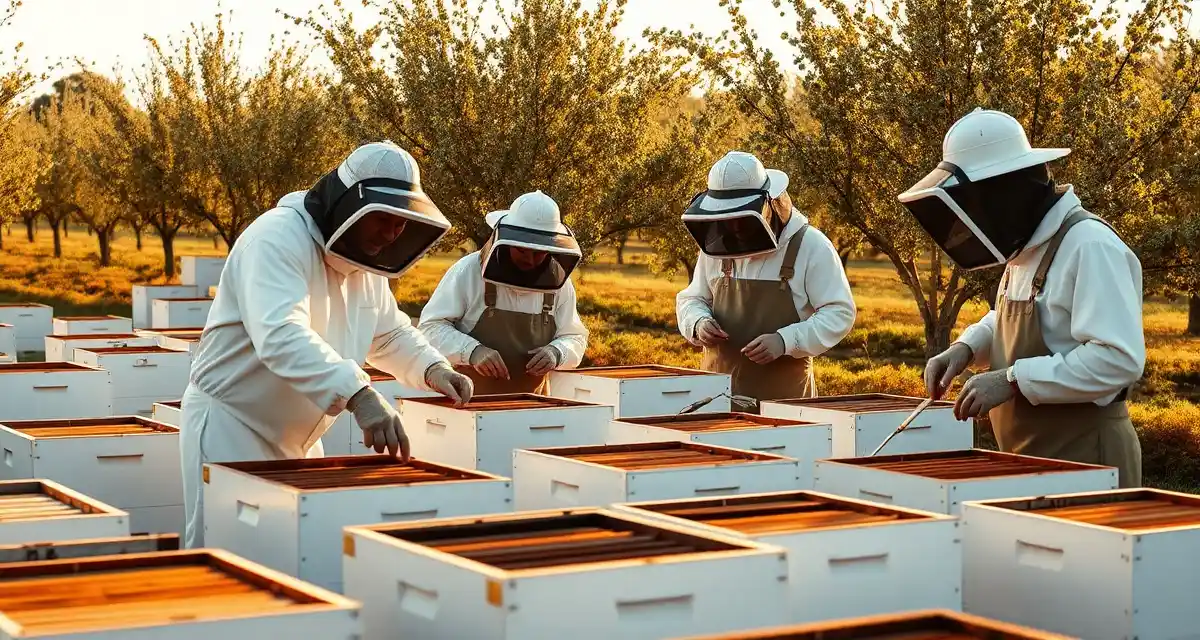
Employee Management for Commercial Beekeeping Crews
A 1,000-hive operation typically requires 3-5 full-time employees plus seasonal labor. Getting the crew side of the business right is as important as getting the beekeeping side right. You can have excellent colonies and tight contracts, but if you're short-staffed during almond season or have high turnover among your most experienced hands, the operation suffers.
H-2A agricultural worker visas are used by some large beekeeping operations, reflecting just how tight labor markets are in commercial beekeeping. Before you get to that point, there's a lot you can do with domestic hiring, training investment, and scheduling systems that make your operation a place people want to stay.
TL;DR
- A 2-person crew can place 200-300 hives per day for almond delivery; a 1,000-hive operation requires 7-10 crew-days for a single crop placement.
- Seasonal beekeeping labor is in high demand during February-May pollination season; recruiting begins months in advance for well-run operations.
- Clear task assignment and documentation requirements for crew work reduce errors and create accountability for inspection and treatment records.
- OSHA requirements for outdoor agricultural work apply to commercial beekeeping crews, including sting response protocols and appropriate PPE.
- Payroll, workers' compensation, and H-2A visa compliance (for operations using seasonal agricultural workers) add administrative complexity that scales with crew size.
Staffing Ratios by Operation Size
There's no universal rule, but industry practice suggests these rough ratios:
500-800 hives: 2-3 full-time employees plus owner-operator. The owner is still doing yard work. A dedicated driver/beekeeper and 1-2 assistants cover yard rotations and seasonal peaks.
1,000-2,000 hives: 3-5 full-time plus 2-4 seasonal during peak periods (California almond season, honey extraction). A full-time operations manager or foreman becomes necessary. The owner can't supervise every yard.
2,000-5,000 hives: 6-12 full-time plus significant seasonal labor. Multiple truck drivers, a yard foreman structure, dedicated extraction crew during honey season. HR administration, payroll, and scheduling become real business functions.
The constraint isn't just headcount. It's experienced headcount. Finding someone who can drive a loaded 18-wheeler, work a full day in a beesuit in 95-degree heat, identify a failing queen, and maintain equipment is not easy. That person commands $18-28/hour in most markets, and if you don't pay it and treat them well, they'll go work for a larger operation that does.
What to Look for When Hiring
Technical beekeeping knowledge is trainable. Reliability, physical stamina, and willingness to follow a systematic process are not. For entry-level beekeeping crew positions, hire for attitude and physical capability first. Beekeeping skills come in 3-6 months for a motivated person.
The non-negotiable requirements for any crew member:
- Valid driver's license (CDL if they'll drive loaded trucks)
- Physical ability to handle 40-80 lb hive bodies repeatedly in full gear
- Comfort working in heat and with bee stings
- Willingness to work irregular hours including early mornings and weekends during peak season
- Ability to follow a systematic inspection and treatment protocol without shortcuts
Truck drivers who also work bees are particularly valuable and hard to find. A CDL-licensed driver who can also do a yard inspection and basic hive work is worth $25-35/hour in most markets. If you have one, keep them.
Training New Crew Members
New hires should not be solo on a yard until they've worked alongside an experienced beekeeper for at least 2-3 months. The first phase of training:
Week 1-2: Equipment familiarity, protective gear, how to light and maintain a smoker, safe behavior around colonies. No independent hive work.
Weeks 3-8: Assisted inspections, frame handling, identifying normal vs. concerning brood patterns, basic queen identification. Still supervised.
Months 3-6: Independent yard visits with documented checklists. Reporting on colony condition using the operation's standard recording system. Basic treatment application under supervision.
6+ months: Capable of leading a yard rotation independently, training newer employees, making first-level management decisions.
Skipping the supervised phase creates problems that show up later: missed disease signs, poorly executed treatments, damaged queens. The time investment in proper training pays back in fewer colony losses and lower turnover.
Crew Scheduling Across Multiple Yards
Scheduling 3-5 employees across 20-50 yard locations, while managing seasonal peak demands, is a genuine logistics problem. The core challenge: yards need regular visits every 10-14 days, but peak periods (almond delivery, extraction, fall treatments) demand concentrated labor that can't happen on a leisurely schedule.
The basics of a crew schedule for a 1,000-hive operation:
- Divide yards into geographic clusters of 50-150 hives
- Assign each cluster a 2-week rotation
- Plan peak-season schedules 6-8 weeks out
- Build in buffer, as equipment failures, weather delays, and sick days are certain
Paper schedules or spreadsheets work at small scale. As soon as you're managing multiple crews across multiple locations on time-sensitive tasks, the cognitive overhead of tracking who's where and what's been done becomes a real problem.
Fleet logistics management tools that track truck locations, yard visit completions, and crew assignments give supervisors a real-time picture of what's done and what's pending. Instead of calling each driver to find out where they are in the route, a dispatcher or operations manager can see it directly. That matters when you're trying to coordinate a California almond delivery with 3 truck drivers on different schedules over a 5-day window.
Seasonal Labor and H-2A
Most commercial operations run a lean permanent crew and add seasonal labor during:
- February (almond season): Additional hands for delivery, placement, and setup in California orchards
- July-August (extraction season): Extraction line workers, uncappers, tank operators
- Fall (treatment and consolidation): Extra hands for fall treatments, colony assessment, and equipment prep
Domestic seasonal hiring is the first approach. Agricultural regions where commercial beekeeping is concentrated (the Dakotas, the Pacific Northwest, the Southeast) have agricultural labor pools accustomed to seasonal work. Check with local workforce development offices, agriculture programs at community colleges, and referrals from other agricultural employers.
H-2A agricultural guest worker visas are legally available to beekeeping operations. The program requires demonstrating that domestic workers aren't available for the positions, paying the adverse effect wage rate (set annually by USDA), providing housing and transportation, and completing significant paperwork 60+ days before work starts. H-2A is not simple, but operations that use it consistently report it solves their seasonal labor problem in a reliable way that domestic hiring doesn't.
Safety and Training Requirements
Commercial beekeeping has real safety hazards: heavy lifting, agricultural equipment, driving, pesticide exposure, and of course bee stings. Your operation needs documented safety training, not because OSHA might show up (though they might), but because safety incidents are expensive and preventable.
Essential safety training elements:
- Sting anaphylaxis protocol: Every employee needs to know how to recognize anaphylaxis and administer epinephrine. Keep EpiPens accessible in every truck and at your shop.
- Heavy lifting mechanics: Back injuries are the most common lost-time injury in beekeeping operations. Hive body handling technique should be explicitly trained.
- Forklift certification: Anyone operating a forklift, including in almond orchards, should have current certification.
- Pesticide exposure: What to do if a yard is hit with pesticides, including evacuation, documentation, and reporting.
- Driving: Commercial vehicle operation, load securement, and hours-of-service compliance for CDL drivers.
Document all safety training with dates, topics covered, and employee signatures. This protects you in workers' compensation and liability situations.
Payroll and HR Basics
Once you're past 2-3 employees, payroll administration becomes a real function. Options:
DIY payroll software: Gusto, QuickBooks Payroll, and similar tools handle tax withholding, direct deposit, and federal filings. $40-100/month depending on employee count. Manageable for 5-10 employees.
Payroll service: ADP, Paychex, and regional payroll processors handle everything for a per-employee fee. Worth it as you scale past 10 employees.
Agricultural payroll rules: Beekeeping employees are agricultural workers under most state labor codes, which means some states have different overtime rules than standard employment. Know your state's ag worker exemptions. Federal FLSA overtime applies to all employees, but state rules vary on daily vs. weekly overtime thresholds.
Workers' compensation insurance is required in most states once you have employees. Agricultural workers' comp rates are set by state, and beekeeping is classified separately from crop farming, so expect to pay for actual risk documentation.
Retention: Keeping Good People
Turnover in commercial beekeeping is high. The work is physically demanding, the hours during peak season are long, and better-paying alternatives exist in many markets. Operations that retain their best people do a few specific things:
Pay competitively and transparently. Employees who know exactly how their pay is calculated and see it increase predictably stay longer than those who feel they're guessing at their value.
Invest in skills. Pay for training, certification, and professional development. An employee who becomes a better beekeeper through your operation feels ownership of that growth.
Communicate the plan. Seasonal workers who know where they'll be in July and what the fall schedule looks like make better personal plans and are more likely to return. Ambiguity about the season schedule is a retention killer.
Equipment matters. Good trucks, maintained equipment, and adequate protective gear show employees their safety and productivity are valued.
FAQ
How many employees does a 1,000-hive operation need?
Plan for 3-5 full-time employees plus 2-4 seasonal workers during peak periods: almond season delivery, extraction, and fall treatments. The exact number depends on your circuit, how spread out your yards are, how much honey production you run alongside pollination, and your own involvement as owner-operator. Operations with highly spread circuits (California winter, Pacific Northwest spring, Dakota summer) at the high end of the range; tight regional operations at the low end.
What training is required for commercial beekeeping employees?
Start with 2-3 months of supervised work before any employee is solo on a yard. Core training covers hive inspection, queen identification, basic disease recognition, varroa mite management, feed application, and safe equipment operation. Drivers with CDLs need load securement and hours-of-service compliance training. Everyone needs bee sting anaphylaxis protocol training including EpiPen administration. Document all training with dates and signatures.
How do you schedule crews across multiple yards efficiently?
Divide yards into geographic clusters and assign each cluster a 2-week rotation. Plan peak-season schedules 6-8 weeks in advance. Use digital crew scheduling tools (or a platform like PollenOps that integrates crew scheduling with yard management) to track visit completions, assign routes, and flag yards that are past due. The alternative is phone-tag with drivers and a whiteboard that goes out of date the moment anyone changes plans.
What is the difference between commercial and hobby beekeeping?
Commercial beekeeping is distinguished by scale (typically 100+ hives, often 500-5,000+), revenue source (pollination contracts and bulk honey sales rather than local honey retail), and management approach (systematic protocols applied across yards rather than individual colony attention). Commercial operators manage bees as an agricultural enterprise, with the administrative, regulatory, and logistical complexity that entails. Most commercial operators derive the majority of their income from pollination services; honey production is a supplementary revenue stream.
How many hives are needed to make commercial beekeeping a full-time income?
Most beekeeping economists put the full-time commercial threshold at 500-800 hives, assuming efficient operations management and a combination of pollination and honey revenue. At 500 hives and $200/hive for almond pollination, almond season alone generates $100,000 in gross revenue before expenses. Net margins depend on operational efficiency, but well-run operations can achieve 30-50% net margins on pollination revenue. Additional crops and honey production improve per-hive economics but require additional management capacity.
What is the annual revenue potential for a 1,000-hive commercial operation?
A 1,000-hive operation running an almond season ($200/hive) plus blueberry or apple contracts ($80-100/hive) plus summer honey production ($25-40/hive after extraction costs) can generate $300,000-360,000 in annual gross revenue. Net margins after transport, crew, equipment, and hive replacement costs typically run 25-40% for well-managed operations, putting net income at $75,000-145,000 annually. The specific number depends heavily on circuit efficiency, loss rates, and contract quality.
Try These Free Tools
Sources
- USDA Agricultural Research Service
- Bee Informed Partnership
- American Beekeeping Federation (ABF)
- USDA Farm Service Agency
Get Started with PollenOps
Crew management during peak season is one of the most operationally demanding aspects of commercial beekeeping. PollenOps coordinates crew scheduling with yard assignments and contract timelines so your team is always working on the right yards at the right time.