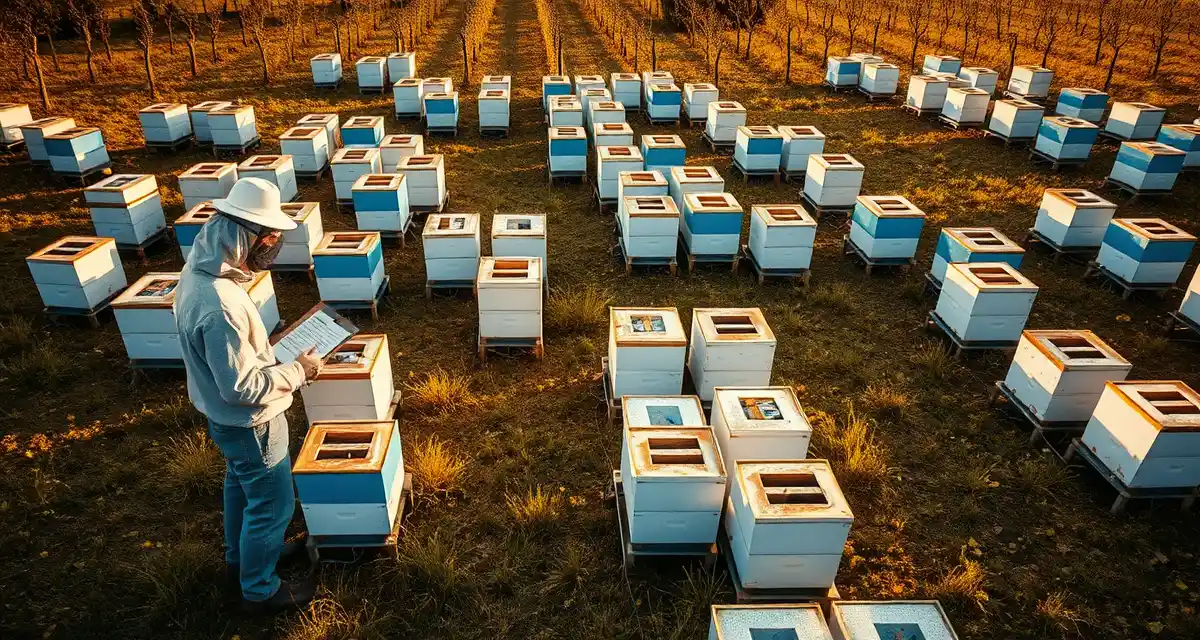
How to Calculate Your Pollination Capacity by Hive Count
500 hives × $200 almond rate = $100,000 per almond season. That's the entry point for full-time income from pollination alone. Capacity planning prevents over-commitment that leads to contract breach and damaged relationships.
Your pollination capacity is not simply your total hive count. It's the number of contract-ready colonies you can deploy for each crop and timing window in your season. Understanding the difference is what separates operators who consistently meet their contracts from those who scramble at delivery.
TL;DR
- The California Almond Board's research supports 6 frames of bees as the minimum effective colony strength for almond pollination.
- Many growers now specify 8 frames for premium contracts, with rates at $200-215/hive versus $185-195 for 6-frame minimums.
- Hive strength assessment should be documented by yard, date, and assessor to create a defensible record for contract compliance.
- A colony assessed at the required strength in January can fall below minimum by February delivery if varroa loads are high or weather stress is severe.
- Third-party inspection at delivery is the cleanest resolution for strength disputes and protects operators as well as growers.
The Capacity Planning Framework
Step 1: Start with total hive count.
How many colonies do you currently manage? Be honest about winter losses and what you expect to recover before each season's first delivery.
Step 2: Apply a readiness factor.
Not all colonies reach contract-ready strength at the same time. A realistic readiness factor for a well-managed operation:
- 85-90% of colonies ready for almond season (February delivery)
- 90-95% ready for spring fruit season (May delivery, after build-up)
- 80-85% ready after a full California almond placement (some colonies weaken during almond deployment)
Step 3: Apply the per-acre placement rate for your target crop.
- Almonds: 2 hives/acre
- Cherry: 1-2 hives/acre (varies by grower)
- Apple: 1-2 hives/acre
- Blueberry: 1-2 hives/acre
- Cucurbit: 1-2 hives/acre
This tells you how many acres you can service.
Step 4: Apply a buffer for non-contract colonies.
Maintain 10-15% of your hive count as non-contracted reserve. These colonies fill shortfalls when a contracted colony fails, cover emergency replacements, and serve as your split source for colony expansion.
Capacity Calculation by Hive Count
200 Hives
Contract-ready colonies: ~170 (85% readiness)
Reserve: 20 colonies (10%)
Deployable: ~150 colonies per season leg
Almond capacity: 75 acres (at 2/acre)
Spring fruit capacity: 75 acres per crop
Revenue at $200 almond rate: $34,000 per almond leg
Revenue at $100 spring fruit rate: $15,000 per spring leg
Total circuit revenue: $49,000-$70,000 depending on crops
At 200 hives, you're building toward full-time income but not yet there on pollination alone unless you combine with strong honey production.
500 Hives
Contract-ready colonies: ~425 (85%)
Reserve: 50
Deployable: ~375 colonies per season leg
Almond capacity: 187 acres (at 2/acre)
Spring fruit capacity: 187 acres per crop
Revenue at $200 almond rate: $85,000-$90,000
Revenue at $100 spring fruit rate: $37,500-$40,000
Total circuit revenue: $130,000-$175,000
500 hives is the established threshold for full-time income from multi-crop pollination. 500 hives × $200 in almonds plus a spring fruit circuit generates a viable full-time business.
1,000 Hives
Contract-ready colonies: ~850 (85%)
Reserve: 100
Deployable: ~750 per season leg
Almond capacity: 375 acres
Spring fruit: 375 acres per crop
Revenue at $200 almond rate: $170,000-$180,000
Revenue at $100 spring fruit rate: $75,000-$80,000
Total circuit revenue: $280,000-$360,000
At 1,000 hives, you're managing a multi-employee operation with significant annual revenue. Operating at this scale requires professional contract management. The administrative overhead of a paper system at 1,000 hives is prohibitive.
2,000 Hives
Contract-ready colonies: ~1,700 (85%)
Reserve: 200
Deployable: ~1,500 per season leg
Almond capacity: 750 acres
Spring fruit: 750 acres per crop
Revenue at $200 almond rate: $340,000-$360,000
Revenue at $100 spring fruit rate: $150,000-$160,000
Total circuit revenue: $560,000-$720,000
2,000 hives is a significant commercial operation requiring multiple trucks, multiple employees, and systematic management infrastructure. The per-hive rate calculation tools and capacity planning module in PollenOps support financial planning at this scale.
Maximum Almond Acreage by Hive Count
| Hive Count | Deployable (85%) | Almond Acres at 2/acre |
|-----------|-----------------|----------------------|
| 200 | 170 | 85 acres |
| 500 | 425 | 212 acres |
| 1,000 | 850 | 425 acres |
| 2,000 | 1,700 | 850 acres |
| 5,000 | 4,250 | 2,125 acres |
Avoiding Over-Commitment
Capacity planning prevents the most common reason for contract failures: over-committing hive counts that don't exist.
Before signing a contract, compare the contracted hive count against your current capacity calculation. If your contracted commitment would require deploying more than 90% of your ready colonies without reserve, you're at risk.
The over-commitment failure pattern:
- Operator signs contracts for 110% of realistic capacity
- Pre-move assessment shows 10-15% of colonies below minimum
- Available colonies don't cover all commitments
- Operator breaches one contract to fulfill another
- Damaged grower relationship + dispute
The solution is a 10-15% reserve in every season's capacity plan. If your commitments fit within 85-90% of your ready hive count, you have enough buffer to absorb normal pre-season losses.
For commercial beekeeping profitability analysis and capacity modeling at different scales, PollenOps revenue tools connect your capacity plan to specific contract revenue projections.
Frequently Asked Questions
How many pollination contracts can a 1000-hive operation fulfill?
A 1,000-hive operation can typically fulfill 6-10 pollination contracts per season, depending on contract size and circuit design. At 85% readiness, you have approximately 850 deployable colonies. If your average contract is 150 hives, that's 5-6 contracts per circuit leg. Operations running 2 circuit legs (almond + spring fruit) fill 10-12 contracts annually. Capacity for simultaneous contracts is different from total annual contracts: you can fulfill more contracts by sequencing them through the season rather than placing all hives simultaneously. PollenOps contract timeline view shows your simultaneous and sequential capacity against your available hive count.
What is the maximum almond acreage a 2000-hive operation can service?
A 2,000-hive operation with 85% readiness has approximately 1,700 deployable colonies for almond season. At the standard 2 hives per acre, that covers approximately 850 acres. At 1.5 hives per acre (some growers accept lower density), you could service up to 1,133 acres. With a 10% reserve (200 hives), your committed almond capacity is 1,500 colonies for 750 acres at standard density. Most 2,000-hive operations don't place all their hives with a single grower; they distribute across multiple contracts totaling 700-900 acres across the Central Valley.
How do you calculate your pollination capacity for multiple simultaneous contracts?
Calculate your capacity for simultaneous contracts by determining your total deployable colonies (total hive count × readiness factor, typically 85%), then allocate that pool across your simultaneous contracts. If you have 1,000 hives with 850 deployable and two simultaneous contracts requiring 400 hives each, that's 800 hives committed with a 50-colony reserve, which is workable. If three simultaneous contracts require 350 hives each (1,050 total), you're over capacity and need to either increase your hive count or decline one contract. PollenOps capacity planning shows your contracted hive count against your available inventory so you can see exactly where you stand before signing.
How is hive strength measured for commercial contract compliance?
Hive strength is typically measured by counting frames of bees: the number of frames in the brood box that are covered (both faces) by worker bees. A frame covered on both faces counts as one frame of bees. Some assessors use a modified approach counting only the top face of each frame. The contract should specify the measurement method, since a hive assessed at 6 frames by one method might be 5 frames by another. Third-party inspection using a consistent, documented method is the cleanest standard for compliance.
What causes hives to fall below strength requirements between assessment and delivery?
Several factors can reduce colony strength between pre-season assessment and delivery: high varroa loads with insufficient treatment response, poor winter weather in northern states during transport south, queen failure or queen loss in the weeks before delivery, and nutritional stress from limited forage. Commercial operators typically re-assess colonies 1-2 weeks before departure to confirm strength has been maintained, replacing any colonies that have declined with stronger hives from their reserve inventory.
Can strength requirements be met with a recently split colony?
No. A recently split colony (within 4-6 weeks) will not have a full brood cycle's worth of adult workers emerging to maintain population. A split colony may appear to have adequate frames at the time of split but will decline in population over the following weeks as older workers die without emerging brood to replace them. Colonies going to almond pollination should have had their most recent split at least 8-10 weeks before delivery to allow full population recovery.
Try These Free Tools
Sources
- USDA Agricultural Research Service
- Bee Informed Partnership
- American Beekeeping Federation (ABF)
- Almond Board of California
- Project Apis m.
Get Started with PollenOps
Hive strength documentation is the foundation of contract compliance and dispute prevention. PollenOps structures strength assessment records, delivery confirmations, and inspection data so you have the evidence you need when questions arise about contract performance.