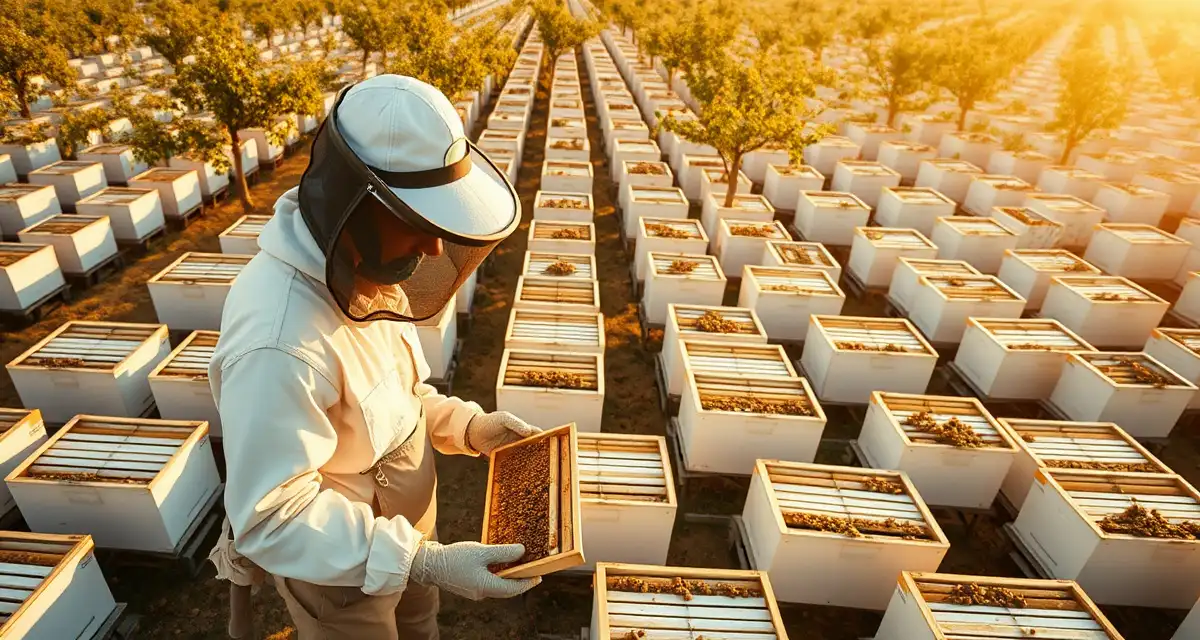
Commercial Beekeeping Profitability at 1000 Hives: Full Income Analysis
Running 1,000 hives is often described as the inflection point where commercial beekeeping becomes a real business rather than a very large hobby. At that scale, gross revenue potential approaches $275,000 per year, combining approximately $200,000 from almond pollination and $75,000 from honey production, and net profit margins can reach 20 to 40% for well-run operations. Below that range means your costs are too high or your contracts are underpriced. Above it means you're running exceptionally efficiently.
Net profit margins in commercial beekeeping range from 20 to 40% depending on efficiency. That spread between 20% and 40% represents everything: labor management, mite treatment timing, winter loss rates, contract pricing, and how well you actually execute the season versus how you planned it.
TL;DR
- Commercial beekeeping operations face two primary management challenges: operational logistics (hive health, transport, placement) and administrative coordination (contracts, payments, documentation).
- Most disputes and revenue losses in commercial beekeeping are preventable with better documentation and clearer contract terms.
- The operations that run most profitably are those with disciplined systems for tracking hive health, contract status, and fleet logistics in one place.
- PollenOps is built specifically for the operational complexity of commercial-scale pollination services, not adapted from a hobbyist tool.
- The most important management decisions (treatment timing, contract renewal, hive allocation) require accurate current data to make well.
Revenue Breakdown
A 1,000-hive operation generating pollination income from California almonds at $180 per hive places most or all of its colonies in February. At $180 per hive across 900 deliverable hives (allowing for winter attrition), that's $162,000 from almonds alone.
Add secondary pollination contracts, such as blueberries, cherries, or specialty crops at $70 to $100 per hive, and 300 hives placed for a 3-week spring secondary contract adds another $21,000 to $30,000.
Honey production from a 1,000-hive operation varies significantly by location and forage quality, but 50 lbs per hive is a reasonable national average across migratory operations. At 50 lbs per hive across 700 honey-producing hives (accounting for hives in active pollination contracts), that's 35,000 lbs of honey. At $2.00 per pound wholesale, that's $70,000 in honey revenue.
Total: $162,000 + $25,000 (secondary pollination) + $70,000 (honey) = $257,000 gross.
Major Cost Categories
Labor is typically the largest operating expense. A 1,000-hive migratory operation usually requires 2 to 4 full-time equivalent workers including the owner-operator, plus seasonal help during peak periods. At $18 to $25 per hour for experienced beekeeping labor, annual labor costs run $80,000 to $140,000 for a fully staffed operation.
Mite treatment and medications at commercial scale run $15 to $30 per hive per year depending on the treatment program. For 1,000 hives, budget $15,000 to $30,000 annually.
Winter losses and replacement packages or splits cost $30 to $60 per lost colony to replace. At a 20 to 30% winter loss rate, 200 to 300 replacement colonies at $40 each is $8,000 to $12,000.
Fuel and vehicle costs for migratory operations are substantial. A full California-to-Northern States circuit with multiple moves can consume $15,000 to $30,000 in fuel annually plus truck maintenance.
Equipment depreciation on hive bodies, frames, extractors, and trucks represents a real cost even if it's not a cash expense in every year.
Net Profit Analysis
At $257,000 gross revenue and $170,000 in operating costs (labor, treatments, fuel, equipment, fees), the net margin is roughly $87,000, or about 34%. This is achievable for a well-run operation.
Operators who struggle with high winter losses, poor mite management, or underpriced contracts may find net margins closer to 10 to 15%, which isn't sustainable long-term.
Frequently Asked Questions
What is the gross revenue potential of a 1000-hive commercial operation?
A 1,000-hive operation combining California almond pollination at $180 per hive with secondary pollination contracts and honey production can generate $200,000 to $275,000 in gross annual revenue. The exact figure depends on how many hives you successfully deliver to almond season (winter loss rates matter), what secondary contracts you've built, and what honey prices you're achieving. Operators who add premium secondary contracts like organic orchard pollination or cranberries, and who sell honey through higher-margin channels than wholesale bulk, can push toward the top of this range.
What are the major cost categories for a 1000-hive beekeeping business?
The five largest cost categories are labor, mite treatment and medications, winter loss replacement, fuel and vehicle costs, and equipment depreciation. Labor typically dominates, running $80,000 to $140,000 annually for a fully staffed migratory operation. Mite treatments add $15,000 to $30,000. Fuel for a full migratory circuit adds $15,000 to $30,000. Winter loss replacement varies but budget $8,000 to $15,000. These variable costs are where operational efficiency creates the most margin differentiation between operators at similar scale.
What profit margin should a 1000-hive commercial operation target?
A well-run 1,000-hive operation should target a 25 to 35% net profit margin. Operations consistently below 20% net are either underpricing their contracts, carrying too many winter losses, or have labor or fuel costs that need management attention. Operations achieving 35 to 40% net margins are typically combining excellent colony health management with above-average contract rates and multiple revenue streams. If your current margin is below 20%, the first analysis should be winter loss rate and treatment program cost-effectiveness, as colony replacement expense is the most common margin killer at this scale.
What is the difference between commercial and hobby beekeeping?
Commercial beekeeping is distinguished by scale (typically 100+ hives, often 500-5,000+), revenue source (pollination contracts and bulk honey sales rather than local honey retail), and management approach (systematic protocols applied across yards rather than individual colony attention). Commercial operators manage bees as an agricultural enterprise, with the administrative, regulatory, and logistical complexity that entails. Most commercial operators derive the majority of their income from pollination services; honey production is a supplementary revenue stream.
How many hives are needed to make commercial beekeeping a full-time income?
Most beekeeping economists put the full-time commercial threshold at 500-800 hives, assuming efficient operations management and a combination of pollination and honey revenue. At 500 hives and $200/hive for almond pollination, almond season alone generates $100,000 in gross revenue before expenses. Net margins depend on operational efficiency, but well-run operations can achieve 30-50% net margins on pollination revenue. Additional crops and honey production improve per-hive economics but require additional management capacity.
What is the annual revenue potential for a 1,000-hive commercial operation?
A 1,000-hive operation running an almond season ($200/hive) plus blueberry or apple contracts ($80-100/hive) plus summer honey production ($25-40/hive after extraction costs) can generate $300,000-360,000 in annual gross revenue. Net margins after transport, crew, equipment, and hive replacement costs typically run 25-40% for well-managed operations, putting net income at $75,000-145,000 annually. The specific number depends heavily on circuit efficiency, loss rates, and contract quality.
Try These Free Tools
Sources
- USDA Agricultural Research Service
- Bee Informed Partnership
- American Beekeeping Federation (ABF)
- American Honey Producers Association
- Project Apis m.
Get Started with PollenOps
Managing a commercial beekeeping operation involves more data, more deadlines, and more moving parts than any general-purpose tool was designed to handle. PollenOps brings contracts, yard records, health documentation, and fleet logistics together in one platform built for the realities of commercial-scale beekeeping.