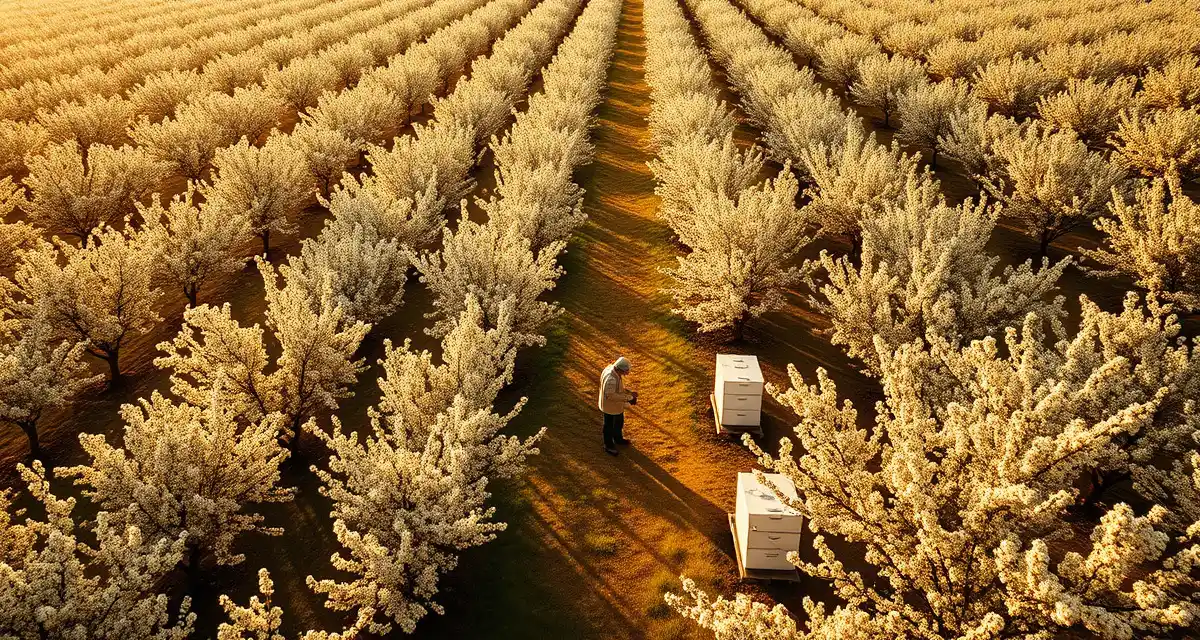
Almond Variety Bloom Windows: Nonpareil, Carmel, Monterey Guide
Operators who align delivery timing with variety bloom earn the highest per-hive payment rates. Nonpareil blooms first, with pollinators like Carmel and Price following 7-10 days later. Understanding variety timing lets you deliver at the right moment for maximum pollination value and demonstrate knowledge that earns grower confidence.
California almonds are planted in interplanted variety combinations, because almonds are self-incompatible: Nonpareil pollen won't fertilize Nonpareil flowers. Growers plant a primary variety (usually Nonpareil, which commands the highest nut price) with two or more pollinizer varieties that bloom at overlapping times and provide compatible pollen.
The staggered variety bloom is both a challenge and an opportunity for commercial beekeepers.
TL;DR
- California's primary commercial beekeeping role is shaped by its crop mix, climate, and position on the national pollination circuit.
- Pollination rates in California range $65-220/hive depending on crop depending on crop and colony strength requirements.
- Out-of-state operators entering California for pollination contracts must register with the state agricultural authority and obtain a Certificate of Health.
- California functions as either a primary pollination destination, a seasonal honey production location, or a transitional stop depending on the circuit.
- Tracking permit status, registration documents, and yard records for California operations requires organized record-keeping before the season opens.
Major Almond Varieties and Their Bloom Windows
Nonpareil
bloom timing: Earliest variety; sets the reference point for all others
Typical peak: In Fresno County, approximately February 7-14 in average years
Market role: Primary variety; the most planted almond in California; premium kernel price
Pollinizer requirements: Needs pollinizers (usually Carmel, Price, or Monterey) for nut set
Nonpareil is what most people mean when they say "almond bloom." When the industry discusses bloom timing, the reference point is almost always Nonpareil. Bees placed before Nonpareil peak ensure maximum pollen transfer during Nonpareil's highest-receptivity window.
Carmel
Bloom timing: 5-8 days after Nonpareil
Notes: One of the primary pollinizers for Nonpareil. Widely planted because of its reliable overlap with Nonpareil bloom. In an average year, Carmel reaches peak bloom around February 12-20 in the Fresno/Madera corridor.
Price
Bloom timing: Overlaps with Carmel and Nonpareil; approximately 3-7 days after Nonpareil
Notes: Another common pollinizer. Price blooms slightly earlier than Carmel in some years, providing a longer overlap window with Nonpareil.
Monterey
Bloom timing: 7-12 days after Nonpareil
Notes: Later-blooming pollinizer. Popular because it extends the total bloom window and provides pollen availability later in the Nonpareil receptivity period. An operation with Nonpareil plus Monterey has a wider bloom window than one with Nonpareil plus Carmel alone.
Butte
Bloom timing: 5-9 days after Nonpareil
Notes: Early to mid pollinizer. Often paired with Padre in orchard design.
Padre
Bloom timing: 7-12 days after Nonpareil
Notes: Later pollinizer, often planted with Butte to cover the full Nonpareil bloom window.
Independence
Bloom timing: Approximately 3-5 days after Nonpareil
Notes: Semi-self-fertile variety; can produce without cross-pollination, but still benefits from bee placement. Growing acreage in recent years.
Wood Colony
Bloom timing: 5-9 days after Nonpareil
Notes: Mid-season pollinizer; less common than Carmel or Monterey.
How Variety Timing Affects Your Delivery Strategy
The critical insight for commercial beekeepers: the optimal delivery time is before Nonpareil peak, not at Nonpareil peak.
Bees placed at 5-10% Nonpareil bloom are oriented to the orchard and in full foraging activity before Nonpareil reaches its peak receptivity window. They're working at maximum efficiency during the days of highest pollen value.
Bees placed at 30-40% Nonpareil bloom are starting from scratch during the most valuable window. They're orienting to the orchard while the prime pollination days are passing.
For orchards with Nonpareil as the primary variety, this means your delivery trigger should be when Nonpareil is just beginning to show open blooms, not when the orchard looks white.
Knowing Your Grower's Variety Mix
Before you deliver, know which varieties are planted in your grower's blocks:
- Ask which varieties are planted and in what ratio
- Ask which variety the grower considers their primary commercial variety
- Ask whether the grower has Independence or other semi-self-fertile varieties in specific blocks
This information lets you calibrate your delivery timing precisely. An orchard that's 60% Nonpareil/20% Carmel/20% Monterey needs bees before Nonpareil opens. An orchard that's heavy on Monterey may benefit from slightly later delivery to cover the full Monterey bloom period.
For almond pollination contracts guidance and delivery timing best practices, PollenOps bloom alerts fire variety-specific notifications for Nonpareil timing as the primary trigger, with Carmel and Monterey alerts available as secondary notifications.
Highest Per-Hive Payment and Variety Knowledge
Growers who know their variety mix are the most discerning clients. An operator who arrives and asks "which varieties are where?" at delivery demonstrates expertise. An operator who arrives at the right bloom stage, having already discussed timing based on the grower's specific variety combination, demonstrates the expertise that justifies premium rates.
Knowledge of variety timing is one of the concrete signals that differentiates professional operators from informal ones.
Frequently Asked Questions
When does Nonpareil almond bloom vs Carmel?
Nonpareil is the earliest major California almond variety to bloom, typically reaching peak bloom 5-8 days before Carmel in most growing regions. In Fresno County in an average year, Nonpareil peaks around February 7-14; Carmel follows from approximately February 12-20. The exact gap varies by year based on temperature accumulation: in warm years, Carmel may follow Nonpareil by only 4-5 days; in cool years, the gap can extend to 9-10 days. Understanding this gap is important because cross-pollination between Nonpareil and Carmel is most effective when their bloom windows overlap. Bees need to be present and active during both windows to maximize transfer.
How do almond variety bloom windows affect delivery timing?
Delivery timing should be calibrated to the beginning of the primary variety's bloom, not its peak. For Nonpareil-dominant orchards, deliver bees when Nonpareil is at 5-10% bloom, just opening with most flowers still closed. Bees orient to the orchard during early bloom and reach peak foraging activity when Nonpareil is at peak receptivity (typically days 5-10 of the bloom period). For orchards with significant Monterey plantings, slightly earlier delivery ensures bees are active for both the Nonpareil window and the later Monterey window. PollenOps bloom alerts allow you to set variety-specific timing targets for each contract so you're responding to the actual variety mix.
Which almond varieties pay the highest pollination rates?
Pollination contracts don't typically differentiate rates by almond variety. Rates reflect colony strength, grower relationship, and regional market conditions rather than which variety is planted. Nonpareil blocks don't pay more than Monterey blocks. However, Nonpareil-dominant orchards are the highest-value almond production, which means the growers with the largest Nonpareil acreage are often the most professional and best-paying clients. Newer semi-self-fertile varieties like Independence, while less dependent on bee cross-pollination, are increasingly planted at premium acreage and their growers often maintain professional pollination contracts.
What is the process for registering an out-of-state apiary in a new state?
Most states require out-of-state operators to register with the state department of agriculture apiary program before placing colonies. The process typically involves submitting a registration application (online or paper), paying a fee (usually $10-50 per location), and providing contact information for the operation. Some states also require the registration to be renewed annually. Contact the destination state's department of agriculture apiary program at least 60 days before your planned arrival to confirm current requirements.
What documentation do state apiary inspectors typically review?
State apiary inspectors review health certificates for out-of-state colonies, registration documentation, and colony inspection records during apiary visits. Inspectors check for signs of American foulbrood, European foulbrood, and other regulated pests and diseases. Operations with organized digital records that include treatment history and mite counts typically have faster, less complicated inspections than operations without documentation. Some state inspectors also verify that varroa mite loads are below state entry thresholds.
What triggers a state apiary inspection?
State apiary inspections can be triggered by routine inspection schedules (most states inspect a percentage of registered apiaries annually), neighbor or landowner complaints, disease reports from nearby operations, or inspection requirements tied to state entry permits. California, in particular, has the right to inspect incoming loads at port of entry for commercial beekeeping operations. Maintaining current registration and organized records makes required inspections faster and less disruptive.
Try These Free Tools
Sources
- USDA Agricultural Research Service
- Bee Informed Partnership
- American Beekeeping Federation (ABF)
- California Department of Agriculture
- Project Apis m.
Get Started with PollenOps
Commercial operations working in California face the same registration, permit, and documentation requirements as any state on the national circuit -- plus California's specific regulatory requirements. PollenOps tracks your California yard records, contract assignments, and permit documentation alongside your full operation, so entering a new state doesn't add a separate administrative burden. See how the platform fits operations working across multiple states.