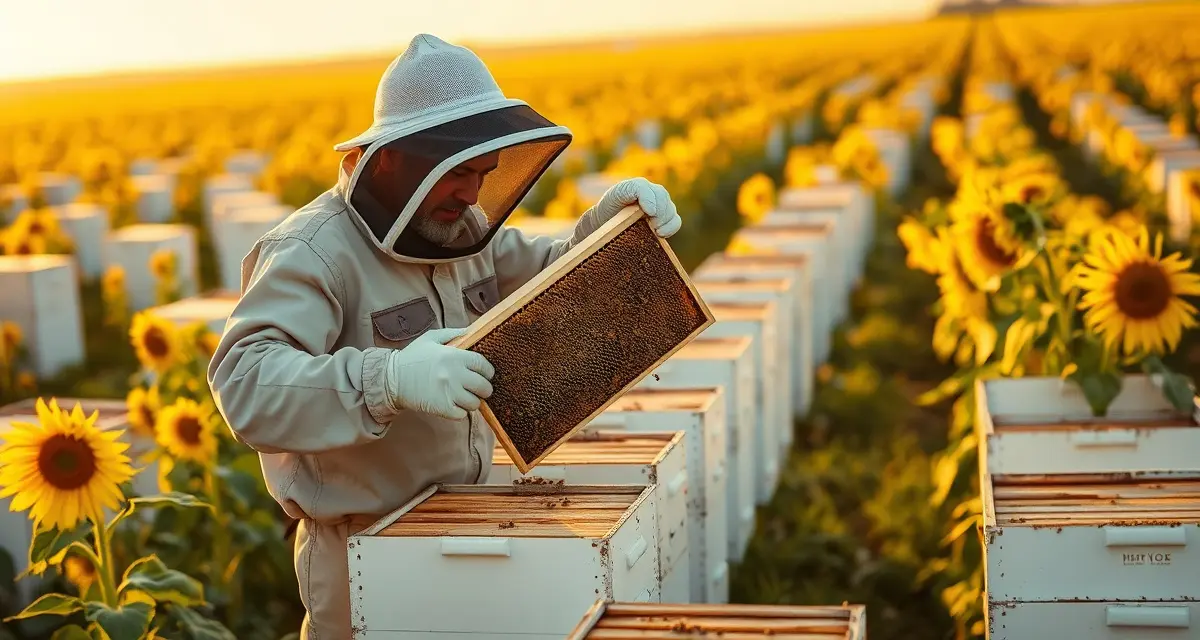
Commercial Beekeeping in South Dakota: Honey and Sunflower Pollination
South Dakota consistently ranks in the top 5 honey producing states with diverse forage. South Dakota sunflower and clover offer major summer income opportunities for migratory operators. The state's position adjacent to North Dakota means the two states together define the Northern Plains summer circuit that drives a significant share of US commercial honey production.
South Dakota produces slightly different honey character than North Dakota because of more varied terrain: the Black Hills in the west, the Missouri River breaks in the center, and the eastern agricultural plains. That diversity creates a range of honey types, from western sweet clover to Black Hills wildflower to eastern canola and clover.
TL;DR
- South Dakota's primary commercial beekeeping role is shaped by its crop mix, climate, and position on the national pollination circuit.
- Pollination rates in South Dakota range $35-65/hive depending on crop and colony strength requirements.
- Out-of-state operators entering South Dakota for pollination contracts must register with the state agricultural authority and obtain a Certificate of Health.
- South Dakota functions as either a primary pollination destination, a seasonal honey production location, or a transitional stop depending on the circuit.
- Tracking permit status, registration documents, and yard records for South Dakota operations requires organized record-keeping before the season opens.
South Dakota Honey Production
Sweet clover: The primary commercial honey crop statewide. The eastern plains counties (Brookings, Moody, Lake, Miner, Kingsbury, Hamlin, Codington) have extensive sweet clover on roadsides and CRP land, similar to North Dakota's pattern. Flow timing: mid-July to mid-August. Average yields in good years: 70-120 lbs/colony.
Canola: South Dakota has growing canola acreage in the eastern counties, overlapping with sweet clover timing. Canola provides a June flow that leads into the main clover peak. Eastern South Dakota canola operations create a sequential flow: canola in June, then sweet clover in July-August.
Black Hills wildflower: The Black Hills region (Lawrence, Pennington, Meade, Custer, Fall River counties) has diverse mountain wildflower forage including sweet clover, wildflowers, and tree nectars. Black Hills wildflower honey has distinctive character and a regional premium market in the Black Hills tourism economy.
Sunflower: South Dakota is a major sunflower seed state. The James River Valley and southeastern plains have significant oil and confectionery sunflower acreage. Sunflower bloom: mid-July to mid-August. This overlap with sweet clover means colonies on sunflower contracts also benefit from surrounding clover forage.
Sunflower Pollination in South Dakota
South Dakota's sunflower acreage creates commercial pollination contracts for operators positioned in the state:
Contract rates: $35-65/hive for confectionery sunflower; $30-50/hive for oil sunflower. Lower than North Dakota rates by a slight margin in some areas.
Placement density: 1-2 hives per acre for sunflower. At 500 acres, that's 500-1,000 colony placements, manageable for a mid-size commercial operation.
The dual-income play: As in North Dakota, the best South Dakota sunflower yards sit near sweet clover and native wildflower forage. Colonies on sunflower contracts also produce honey from surrounding vegetation. Combined value per hive for a 3-4 week South Dakota sunflower placement: $50-100 (contract) + 20-50 lbs honey (yield) = $85-175 equivalent per hive.
South Dakota vs. North Dakota for Summer Operations
Both states offer similar honey production and sunflower pollination opportunities. The practical differences:
Distance from California: South Dakota is 200-400 miles closer to central California than North Dakota, reducing truck transit time for operations that want to move from almonds to the Northern Plains directly.
Production consistency: North Dakota generally has higher average yields per colony for sweet clover. The Red River Valley and central North Dakota have more extensive CRP and clover coverage. South Dakota has more terrain diversity (Black Hills) but slightly less homogeneous clover country in the east.
Sunflower volume: Both states have comparable sunflower acreage and similar contract availability.
Regulatory environment: Both states have registration requirements and entry permits. South Dakota's program is somewhat lighter-touch than some states.
Many operations run both states simultaneously, with some yards in South Dakota and some in North Dakota, distributing weather risk and forage diversity across a broader area.
South Dakota Apiary Regulations
Administering agency: South Dakota Department of Agriculture, Division of Agricultural Services
Registration: Annual apiary registration required for all South Dakota beekeepers. Out-of-state commercial operators maintaining colonies in South Dakota must register.
CVI requirement: South Dakota requires a health certificate for colonies entering from out of state. Contact the SD Department of Agriculture before your first season to confirm current entry documentation.
State inspection program: South Dakota has an active state apiarist program. Commercial operations are subject to periodic inspection.
Fees: Registration fees are modest, typically $10-30 depending on colony count.
Operating Logistics in South Dakota
Eastern plains access: Most commercial honey production yards in South Dakota are in the eastern plains counties, accessible via paved and gravel county roads. The terrain is flat and roads are generally truck-accessible through the summer. Spring wet conditions can create access issues on gravel roads in May-June.
Black Hills access: Remote Black Hills yards require more careful access road scouting. The terrain is rougher and some forest access roads have weight restrictions.
Extraction infrastructure: South Dakota, like North Dakota, requires that operations either own extraction equipment or arrange co-pack access. Some large operations trailer portable extractories to the state. Others co-pack at established South Dakota honey operations.
Interstate logistics: South Dakota sits at the crossroads of I-90 (east-west) and I-29 (north-south), making it one of the more accessible states in the Northern Plains for large truck operations. The route from central California to eastern South Dakota via I-80/I-90 is well-traveled and straightforward for bee truck drivers.
South Dakota's Honey Market
South Dakota honey sold locally commands a premium over generic bulk in the state's tourist economy. The Black Hills and Mount Rushmore region attracts 3-4 million visitors annually, creating a retail honey market that values regional identity. "Black Hills Wildflower Honey" and "South Dakota Prairie Honey" have authentic regional identity that sells at premium retail prices in tourist shops, farmers markets, and regional specialty food stores.
Operations willing to invest in regional branding around their South Dakota honey can capture $6-12/lb retail through these channels. At even 5,000 lbs sold retail at $8/lb versus bulk at $2.20/lb, the revenue difference is $29,000, which is worth the retail infrastructure investment for operations with the marketing bandwidth.
FAQ
What honey production opportunities exist in South Dakota?
South Dakota's primary honey production comes from sweet clover (July-August, eastern plains, 70-120 lbs/colony in good years), canola (June, eastern counties), Black Hills wildflower (summer, Black Hills region with premium regional positioning), and sunflower-adjacent wildflower in the James River Valley. The eastern plains sweet clover zone is comparable to North Dakota's in quality, slightly lower in average yield but more accessible from California due to shorter driving distance.
Does South Dakota have sunflower pollination opportunities?
Yes. South Dakota is a significant sunflower seed producing state with confectionery and oil sunflower acreage in the James River Valley and southeastern plains. Contract rates run $30-65/hive depending on sunflower type and grower. The placement timing (mid-July to mid-August) overlaps with the peak sweet clover honey flow, creating dual-income potential from a single South Dakota placement. Contact local grain elevators and the National Sunflower Association's South Dakota member network for contract leads.
What are South Dakota's apiary registration requirements?
South Dakota requires annual apiary registration with the SD Department of Agriculture Division of Agricultural Services for all beekeepers including out-of-state commercial operators. A health certificate (CVI) is required for colonies entering the state. Registration fees are modest ($10-30 based on colony count). The state maintains an active apiary inspection program. Contact the South Dakota Department of Agriculture directly before your first season to confirm current entry documentation requirements and registration fees.
What is the process for registering an out-of-state apiary in a new state?
Most states require out-of-state operators to register with the state department of agriculture apiary program before placing colonies. The process typically involves submitting a registration application (online or paper), paying a fee (usually $10-50 per location), and providing contact information for the operation. Some states also require the registration to be renewed annually. Contact the destination state's department of agriculture apiary program at least 60 days before your planned arrival to confirm current requirements.
What documentation do state apiary inspectors typically review?
State apiary inspectors review health certificates for out-of-state colonies, registration documentation, and colony inspection records during apiary visits. Inspectors check for signs of American foulbrood, European foulbrood, and other regulated pests and diseases. Operations with organized digital records that include treatment history and mite counts typically have faster, less complicated inspections than operations without documentation. Some state inspectors also verify that varroa mite loads are below state entry thresholds.
What triggers a state apiary inspection?
State apiary inspections can be triggered by routine inspection schedules (most states inspect a percentage of registered apiaries annually), neighbor or landowner complaints, disease reports from nearby operations, or inspection requirements tied to state entry permits. California, in particular, has the right to inspect incoming loads at port of entry for commercial beekeeping operations. Maintaining current registration and organized records makes required inspections faster and less disruptive.
Try These Free Tools
Sources
- USDA Agricultural Research Service
- Bee Informed Partnership
- American Beekeeping Federation (ABF)
- South Dakota Department of Agriculture
- Project Apis m.
Get Started with PollenOps
Commercial operations working in South Dakota face the same registration, permit, and documentation requirements as any state on the national circuit -- plus South Dakota's specific regulatory requirements. PollenOps tracks your South Dakota yard records, contract assignments, and permit documentation alongside your full operation, so entering a new state doesn't add a separate administrative burden. See how the platform fits operations working across multiple states.