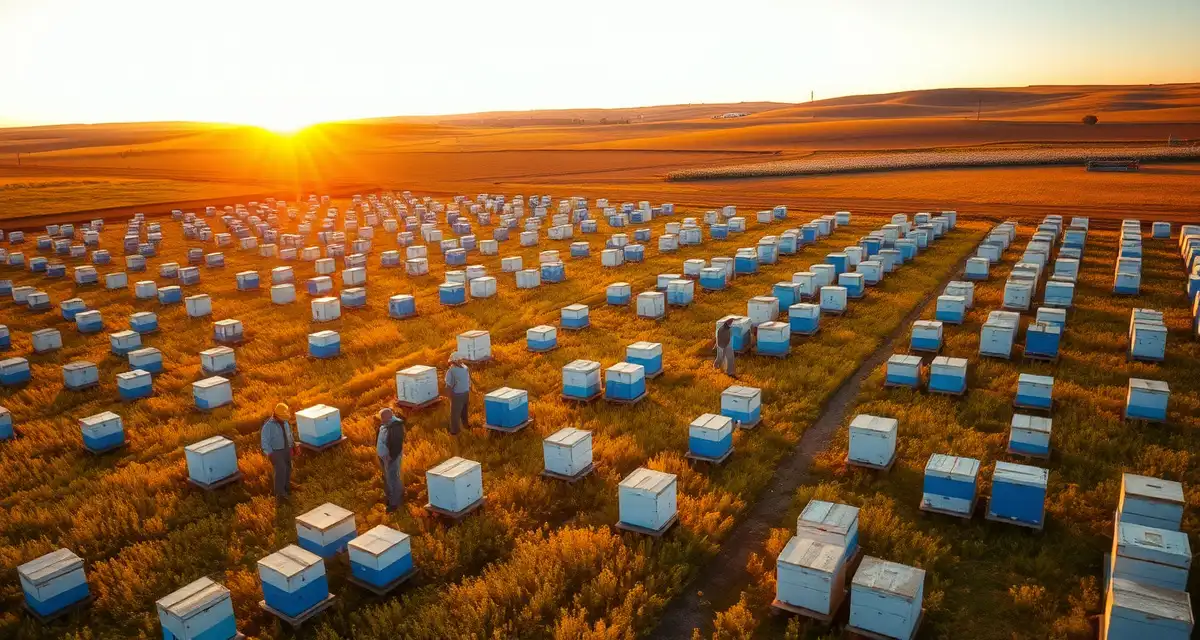
South Dakota Commercial Honey Production: Volume Operations and Markets
South Dakota ranks in the top 3 honey producing states in the US, and for good reason. Its clover and wildflower forage supports exceptional honey production for colonies positioned well across the state. South Dakota honey operations often run 2,000 to 5,000 hives for summer honey production, and the state consistently produces over 30 million pounds annually.
For migratory beekeepers who complete spring pollination circuits in California and the Pacific Northwest, South Dakota represents the summer income anchor. The timing works: almonds finish in March, spring fruit circuits wrap in May, and South Dakota's honey flows peak in July and August.
TL;DR
- South Dakota's primary commercial beekeeping role is shaped by its crop mix, climate, and position on the national pollination circuit.
- Pollination rates in South Dakota range $65-220/hive depending on crop depending on crop and colony strength requirements.
- Out-of-state operators entering South Dakota for pollination contracts must register with the state agricultural authority and obtain a Certificate of Health.
- South Dakota functions as either a primary pollination destination, a seasonal honey production location, or a transitional stop depending on the circuit.
- Tracking permit status, registration documents, and yard records for South Dakota operations requires organized record-keeping before the season opens.
Why South Dakota Produces So Much Honey
South Dakota's honey production capacity comes from a combination of factors that align unusually well.
Vast clover acreage. South Dakota's agricultural landscape includes massive acreages of alfalfa grown for hay and seed, sweet clover in roadside and pasture settings, and white clover in mixed pastures. Alfalfa honey and sweet clover honey are South Dakota's dominant types.
Low pesticide pressure on forage. Compared to states where row crop production dominates, South Dakota's clover forage is relatively lightly treated with insecticides. Pasture-based clover particularly is often untreated.
Low competition. South Dakota has fewer resident beekeepers relative to its forage capacity than many other states. The total pollinator demand is low (South Dakota doesn't have the intensive pollination-dependent crop production of California or Michigan), meaning more of the forage goes to honey production.
Reliable summer weather. While drought can reduce flows, South Dakota's summer weather patterns support predictable nectar flows in most years.
How Do You Build a Commercial Honey Operation in South Dakota?
Building a South Dakota honey operation requires advance planning, good yard locations, and the logistical capacity to move hives into and out of the state as the season demands.
Timing the South Dakota Season
For migratory operators:
- Arrive late May to early June: Colonies positioned early catch the beginning of the clover flow and the later alfalfa bloom
- Peak production: July is typically the most productive month, with sweet clover and alfalfa in full production
- Harvest: Many operators harvest once in late July and again in late August
- Exit: Most operators move hives out of South Dakota in September as nectar flows end and fall approaches
Yard Location Selection
South Dakota honey yard selection should prioritize:
Proximity to alfalfa hay fields: Alfalfa in bloom is a primary South Dakota honey source. Positioning yards within easy foraging range of large hay fields (particularly fields managed for seed, which are left to bloom fully rather than cut before bloom) maximizes production.
Distance from competitors. With the vast South Dakota landscape, spacing yards to avoid forage competition with other beekeepers is achievable. Talk to local landowners and other beekeepers about yard concentration before committing to locations.
Road access. South Dakota's rural roads range from paved state highways to two-track gravel paths. Your loaded trucks need to be able to reach your yards. Scout road conditions in late spring before your delivery runs.
Landowner relationship. The best South Dakota honey yards come through landowner relationships. Honey payment is a common arrangement, where landowners receive some of the honey produced on their property in lieu of cash rent. This works well for all parties and creates stable, long-term yard relationships.
Apiary Registration in South Dakota
South Dakota requires registration of apiaries with the South Dakota Department of Agriculture and Natural Resources. Out-of-state operators bringing hives into South Dakota must comply with entry requirements including a current health inspection certificate.
Contact the South Dakota DANR for current registration requirements, entry certificate formats, and any specific disease concerns that may affect entry requirements in a given year.
What Honey Markets Can South Dakota Producers Access?
South Dakota's geographic position (far from major population centers) creates marketing challenges for direct-to-consumer channels. Most South Dakota honey production moves through:
Bulk Buyers and Packers
The path of least resistance for high-volume South Dakota honey is bulk sale to regional or national honey packers. Western South Dakota and Minnesota-based buyers have historically purchased South Dakota clover honey in volume.
Bulk clover honey from South Dakota typically trades at benchmark domestic prices, tracking USDA Honey Market News published prices for the region. Given South Dakota's reputation as a high-quality domestic producer, well-established operations with quality documentation can often achieve prices at or above regional benchmarks.
Honey Co-ops
Honey co-ops allow individual producers to pool volume and marketing, typically achieving better prices than individual bulk sales. Several beekeeping co-ops and marketing groups operate in the Great Plains region that can provide market access for South Dakota producers.
Natural and Specialty Food Markets
South Dakota honey's "Great Plains" origin story has appeal in natural food markets, particularly for consumers interested in domestic, traceable honey. Premium positioning around South Dakota's clover varieties or limited wildflower types can support higher prices through specialty food distribution channels.
Access channels for premium markets:
- Natural food distributors (UNFI, KeHE) who supply specialty grocery chains
- Direct relationships with regional specialty grocery retailers
- Online direct-to-consumer sales to markets that value Great Plains provenance
Direct Sales in Neighboring Markets
Operators with South Dakota honey production who are based in or near Midwest cities (Sioux Falls, Minneapolis, Rapid City) have direct market access for farmers market and local retail sales. Sioux Falls in particular has a growing local food market.
South Dakota Honey Production Economics
Per-Hive Yield Expectations
In a good South Dakota honey year:
- Average yield: 80 to 120 pounds per hive
- Exceptional year: 150+ pounds per hive in optimal forage conditions
- Poor year (drought): 30 to 50 pounds per hive
The variability is real. South Dakota's honey production is more weather-dependent than pollination income. A drought year cuts yields dramatically.
Revenue Per Hive
At $2.00 to $2.50 per pound bulk and 100-pound average yield, revenue per hive runs $200 to $250 per hive. At 2,000 hives, that's $400,000 to $500,000 in gross honey revenue in a good year.
But subtract the cost of getting 2,000 hives to South Dakota and back (fuel, driver time, permits), summer labor, extraction costs, and winter hive preparation, and the net margins require solid production years to be attractive.
Most South Dakota honey operators combine this production with spring pollination income that provides a more predictable revenue floor.
FAQ
How do you build a commercial honey operation in South Dakota?
Start by securing yard locations through landowner relationships in clover-rich agricultural areas. Registration with South Dakota DANR is required. Position hives in late May to early June to catch the primary clover and alfalfa flows. Plan for two harvests (late July and late August) to maximize production. Exit the state in September before cold weather arrives. Build marketing relationships in advance of your first full production year so you have buyers ready when honey is ready to sell.
What honey markets can South Dakota producers access?
The primary market for high-volume South Dakota honey is bulk sale to domestic honey packers and co-ops. Regional premium markets through specialty food distributors and direct retail channels (farmers markets, specialty grocers) provide higher per-pound value but require marketing investment and lower volume capacity. South Dakota's reputation as a quality domestic honey source supports competitive pricing in bulk channels, and premium positioning around the state's forage diversity can access specialty food premiums through appropriate distribution channels.
What are South Dakota's apiary registration requirements?
South Dakota requires registration of all apiaries with the Department of Agriculture and Natural Resources. Out-of-state operators bringing hives into South Dakota must carry a current health inspection certificate from their state of origin. Contact South Dakota DANR for current registration forms, fees, and entry certificate requirements. Requirements including certificate timing and specific disease certifications should be verified each season, as they can be updated in response to current disease conditions.
What is the process for registering an out-of-state apiary in a new state?
Most states require out-of-state operators to register with the state department of agriculture apiary program before placing colonies. The process typically involves submitting a registration application (online or paper), paying a fee (usually $10-50 per location), and providing contact information for the operation. Some states also require the registration to be renewed annually. Contact the destination state's department of agriculture apiary program at least 60 days before your planned arrival to confirm current requirements.
What documentation do state apiary inspectors typically review?
State apiary inspectors review health certificates for out-of-state colonies, registration documentation, and colony inspection records during apiary visits. Inspectors check for signs of American foulbrood, European foulbrood, and other regulated pests and diseases. Operations with organized digital records that include treatment history and mite counts typically have faster, less complicated inspections than operations without documentation. Some state inspectors also verify that varroa mite loads are below state entry thresholds.
What triggers a state apiary inspection?
State apiary inspections can be triggered by routine inspection schedules (most states inspect a percentage of registered apiaries annually), neighbor or landowner complaints, disease reports from nearby operations, or inspection requirements tied to state entry permits. California, in particular, has the right to inspect incoming loads at port of entry for commercial beekeeping operations. Maintaining current registration and organized records makes required inspections faster and less disruptive.
Try These Free Tools
Sources
- USDA Agricultural Research Service
- Bee Informed Partnership
- American Beekeeping Federation (ABF)
- South Dakota Department of Agriculture
- Project Apis m.
Get Started with PollenOps
Commercial operations working in South Dakota face the same registration, permit, and documentation requirements as any state on the national circuit -- plus South Dakota's specific regulatory requirements. PollenOps tracks your South Dakota yard records, contract assignments, and permit documentation alongside your full operation, so entering a new state doesn't add a separate administrative burden. See how the platform fits operations working across multiple states.