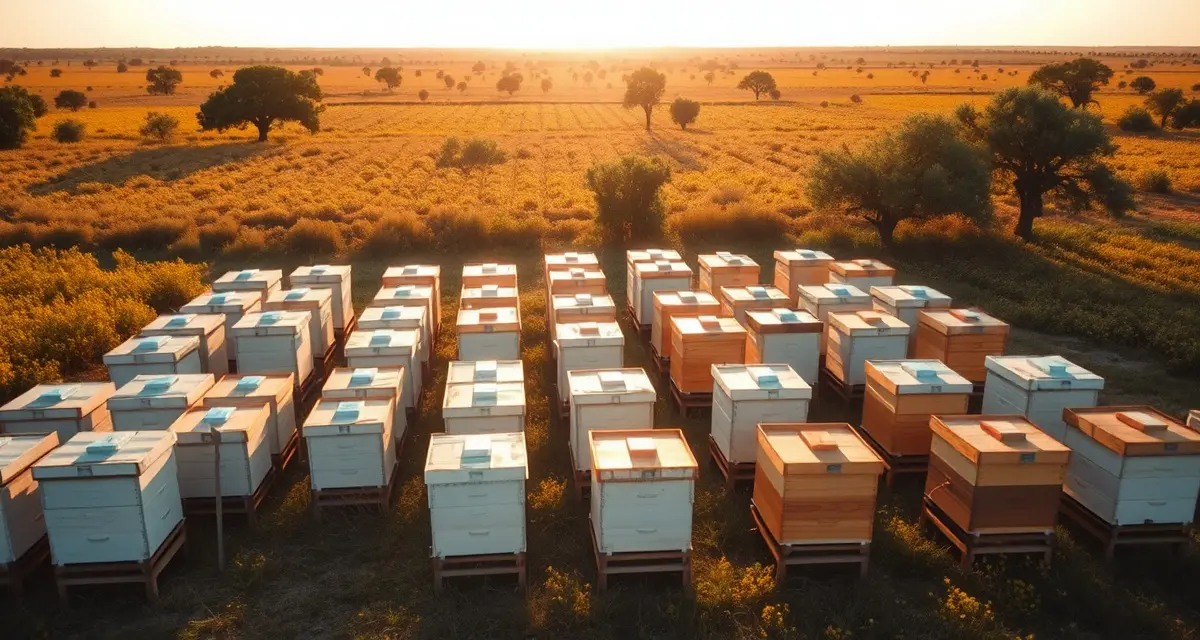
Commercial Beekeeping in Texas: Scale Operations and Opportunities
Texas is among the top honey-producing states with diverse forage from clover to mesquite, and with 170 million acres, it has more land area than any state except Alaska. For a commercial operation, that scale creates both opportunity and logistics challenges. The state is big enough to support a full migratory circuit within its own borders, and diverse enough to provide spring, summer, and fall honey flows in different regions.
Texas has no state apiary inspection program but counties may have local requirements. That lighter regulatory touch compared to California or Oregon comes with a trade-off: less systematic disease monitoring means some Texas apiaries carry higher disease loads than well-inspected states.
TL;DR
- Texas's primary commercial beekeeping role is shaped by its crop mix, climate, and position on the national pollination circuit.
- Pollination rates in Texas range $55-75/hive depending on crop and colony strength requirements.
- Out-of-state operators entering Texas for pollination contracts must register with the state agricultural authority and obtain a Certificate of Health.
- Texas functions as either a primary pollination destination, a seasonal honey production location, or a transitional stop depending on the circuit.
- Tracking permit status, registration documents, and yard records for Texas operations requires organized record-keeping before the season opens.
Texas Honey Production: What's Worth Knowing
Texas produces 3-7 million pounds of honey in average years, with significant variation depending on rainfall. The state's geography supports several distinct honey flow types:
Huajillo/Guajillo and other South Texas brush: The South Texas Plains (Webb, Zapata, and surrounding counties near Laredo) produce brush-country honey from huajillo (Acacia berlandieri), catclaw, black brush, and related species. South Texas brush honey is light, mild, and has a distinct local character. The flow occurs in spring, typically March-April, triggered by rains. In wet years, South Texas produces exceptional honey yields; in drought years, almost nothing. Volatile but high-upside.
Texas clover: Central Texas grasslands and roadsides have white clover and other clovers that contribute to spring flows. Not as productive per acre as North Dakota sweet clover, but the earlier timing (April-May) makes it useful for spring buildup.
Wildflower and sumac: East Texas piney woods and transition zones have late-summer wildflower and sumac flows. Sumac honey is dark and strong-flavored, with a specialty market.
Mesquite: Western Texas has significant mesquite tree density. Mesquite honey is light to medium amber with a mild, distinctive flavor. The mesquite flow peaks in May-June in most areas.
Turpentine weed and fall flows: South-central Texas has late-summer and fall flows from turpentine weed (Gutierrezia spp.) and other native plants. These provide fall colony buildup support.
Pollination Opportunities in Texas
Texas's agricultural diversity creates pollination demand across more crop types than most states, though the scale of any single crop is generally smaller than California or the Pacific Northwest:
Watermelon and cantaloupe: South Texas and the Rio Grande Valley are major melon producers. Watermelon pollination runs March-May. Contract rates: $55-75/hive. The Rio Grande Valley cantaloupes are among the earliest in the US, creating contracts as early as February in some years.
Citrus in the Rio Grande Valley: Texas citrus (primarily grapefruit and oranges) is concentrated in the Rio Grande Valley counties: Hidalgo, Cameron, and Starr. Citrus bloom runs February-March. Contract rates: $60-85/hive. Texas citrus production is smaller than Florida's but creates local demand. AHB is present in the Valley, which adds regulatory complexity for operations in this area.
Cotton: Texas produces significant cotton acreage. Cotton does not require bee pollination but bees forage heavily on cotton nectar and pollen. This isn't a pollination contract opportunity but creates honey production potential in cotton-growing areas.
Sunflower: The Texas Panhandle and High Plains have sunflower production, primarily for oil seed. Pollination contract rates are lower than the Dakotas ($30-50/hive) but can be combined with honey production in the region.
Garden seeds and specialty crops: Texas has scattered seed crop production in the Hill Country and other areas that creates small-scale pollination contract opportunities.
Africanized Honey Bee Considerations
Texas is an AHB-positive state. Africanized honey bees established in Texas in the late 1980s through the south and have spread to cover the southern two-thirds of the state. As of 2026, AHB genetics are present in feral bee populations throughout South Texas, the Hill Country, and the Gulf Coast region.
For commercial operations:
- Operations wintering or working in AHB-affected Texas counties risk genetic contamination through drone flight with feral AHB populations
- Colonies showing any defensive behavioral changes should be requeened from non-AHB stock
- Some destination states (California, Oregon) can require additional inspection documentation for colonies originating from AHB-positive counties
The practical reality for most commercial operations: colonies maintained in the northern third of Texas (Panhandle, North Texas plains) have substantially lower AHB exposure than those in South Texas. Operations wintering in Texas tend to concentrate in North Texas for this reason.
Texas Regulations
Texas has one of the lighter regulatory environments for beekeeping of any major agricultural state:
No state apiary inspection program: Unlike California, Oregon, Florida, and most other states, Texas does not operate a routine state apiary inspection program. There is no state apiarist conducting annual colony inspections or disease surveillance at the state level.
County requirements: Some Texas counties have local apiary ordinances, but they are not uniform and enforcement is inconsistent. Check with the county agricultural extension office before placing in a new county.
Registration: Texas beekeepers are encouraged but not required to register with the Texas A&M AgriLife Extension apiary program. Registration provides access to state disease consultation resources but is not mandatory for commercial operations.
AHB response: Texas A&M coordinates the state's Africanized bee response. Commercial operations should be aware of any county-specific AHB restrictions or notification requirements.
Moving out of Texas: Other states' entry requirements apply when colonies leave Texas. California will treat Texas as an AHB-positive origin state for inspection purposes, particularly for colonies coming from southern counties. Have your CVI ready and be prepared for additional inspection.
Texas as a Component of the Southern Circuit
Texas doesn't fit naturally into the California-Northwest-Dakota circuit the way Florida, Georgia, and Louisiana do. But for operations based in Texas or serving Texas and southern markets, the state offers:
Year-round operation: South Texas climate allows colonies to maintain population year-round without wintering strategy. Operations based in the Rio Grande Valley can run continuous production.
Early season advantage: Texas pollination contracts begin in February for some crops, earlier than any northern state pollination work. For an operation that doesn't run California almonds, Texas citrus and melon contracts provide early-season revenue.
Gateway to the Southwest: Texas-based operations can access New Mexico, Arizona, and Oklahoma pollination markets with relatively short moves.
FAQ
What honey production opportunities exist in Texas?
Texas offers diverse but variable honey production. South Texas brush country (huajillo, catclaw) flows in wet springs are the highest-yield single events. Mesquite in western Texas produces a distinctive varietal honey in May-June. Texas wildflower flows in spring and fall contribute to year-round production potential in some regions. North Dakota-style large clover flows don't exist in Texas, but the diversity of species and longer active season support multi-flow production for operations based in the state.
Is Texas a good state to build a large commercial operation?
Texas has real advantages: large land area, diverse forage, relatively light regulation, and AHB-free northern regions for those who position carefully. Its disadvantages include variable rainfall making honey yields unpredictable, AHB presence in the southern half creating management and compliance complexity, and the lack of a single massive crop (almonds, blueberries) that drives high-density pollination income per hive. Operations that use Texas as a year-round base and run focused pollination circuits (South Texas citrus and melons, Texas sunflower, supplemented by out-of-state contracts in California or the Pacific Northwest) can build a viable commercial model.
What registration is required for commercial beekeeping in Texas?
Texas does not have a mandatory statewide apiary registration program. The Texas A&M AgriLife Extension apiary program accepts voluntary registrations that provide access to state disease consultation services. Some counties may have local ordinances. Check with the county agricultural extension before placing colonies in a new county. AHB-positive status in southern Texas means that operations moving colonies to other states need to be prepared for additional inspection scrutiny at destination state border crossings.
What is the process for registering an out-of-state apiary in a new state?
Most states require out-of-state operators to register with the state department of agriculture apiary program before placing colonies. The process typically involves submitting a registration application (online or paper), paying a fee (usually $10-50 per location), and providing contact information for the operation. Some states also require the registration to be renewed annually. Contact the destination state's department of agriculture apiary program at least 60 days before your planned arrival to confirm current requirements.
What documentation do state apiary inspectors typically review?
State apiary inspectors review health certificates for out-of-state colonies, registration documentation, and colony inspection records during apiary visits. Inspectors check for signs of American foulbrood, European foulbrood, and other regulated pests and diseases. Operations with organized digital records that include treatment history and mite counts typically have faster, less complicated inspections than operations without documentation. Some state inspectors also verify that varroa mite loads are below state entry thresholds.
What triggers a state apiary inspection?
State apiary inspections can be triggered by routine inspection schedules (most states inspect a percentage of registered apiaries annually), neighbor or landowner complaints, disease reports from nearby operations, or inspection requirements tied to state entry permits. California, in particular, has the right to inspect incoming loads at port of entry for commercial beekeeping operations. Maintaining current registration and organized records makes required inspections faster and less disruptive.
Try These Free Tools
Sources
- USDA Agricultural Research Service
- Bee Informed Partnership
- American Beekeeping Federation (ABF)
- Texas Department of Agriculture
- Project Apis m.
Get Started with PollenOps
Commercial operations working in Texas face the same registration, permit, and documentation requirements as any state on the national circuit -- plus Texas's specific regulatory requirements. PollenOps tracks your Texas yard records, contract assignments, and permit documentation alongside your full operation, so entering a new state doesn't add a separate administrative burden. See how the platform fits operations working across multiple states.