PollenOps Colony Health Module: Acoustic AI and Manual Assessment Tools
ApisProtect charges $3/hive/month for monitoring only. PollenOps includes acoustic monitoring in flat-rate plans. The difference isn't just price: ApisProtect is health monitoring without any connection to your contracts, fleet, or grower records. PollenOps health module connects colony data to contract risk alerts. That connection is not available in any competitor.
Acoustic AI detects health issues 2-3 weeks earlier than monthly visual inspection schedules. At that lead time, you're managing problems proactively rather than discovering them at the worst possible moment: the truck-loading day before an almond delivery.
This guide covers every component of the PollenOps health module.
TL;DR
- Commercial beekeeping operations that manage contracts on spreadsheets and phone calls spend 5-10 hours per week on administrative tasks that software handles automatically.
- Purpose-built beekeeping software centralizes contract lifecycle management, yard records, health documentation, and fleet logistics in one platform.
- The primary ROI drivers for operations software are fewer contract disputes, faster invoicing, and reduced time spent on administrative coordination.
- PollenOps is built specifically for commercial-scale pollination operations; it is not a hobbyist platform adapted for commercial use.
- Moving from spreadsheets to dedicated software typically pays for itself within one season in time savings and dispute prevention.
Manual Assessment Tools
Manual inspection remains the foundation of commercial colony health management. The PollenOps assessment interface makes manual inspections faster, more consistent, and automatically documented.
The inspection screen:
When you open a colony for inspection in PollenOps, the interface presents standardized fields:
- Bee population: Frame count on a numeric scale
- Brood pattern: Tight, moderate, or spotty (with prompt for brood stage details)
- Queen status: Confirmed, evidence, flag
- Food stores: Full, adequate, low (with frame count option)
- Varroa status: Last wash result and date, current estimated level
- Disease signs: AFB, EFB, Nosema, chalkbrood, sacbrood (checkboxes with notes)
- Treatment applied: Type, dosage, date
- Notes: Free text for anything outside the standard fields
Composite quality score:
From your standardized inputs, PollenOps calculates a 1-10 quality score using the weighted four-factor formula (population 40%, brood 30%, food 20%, queen 10%). The score is calculated in real time as you enter data.
Yard-level assessment workflow:
For a 50-colony yard, an experienced beekeeper using the PollenOps app can complete inspections in 90 minutes. The standardized interface eliminates writing time and ensures consistent data quality across crew members.
Acoustic Sensor AI Integration
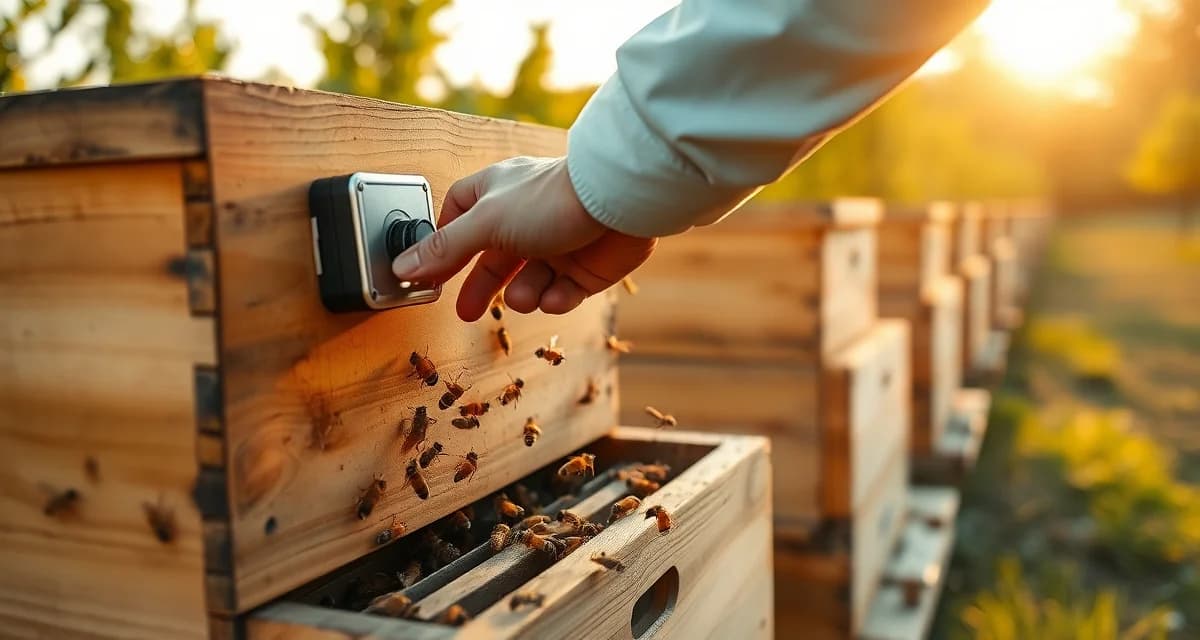
For operations that want monitoring between manual inspections, PollenOps integrates with acoustic sensor hardware that monitors colony sound profiles continuously.
How acoustic monitoring works:
Honeybee colonies produce distinctive sounds at different frequencies that correlate with colony state. A healthy colony in normal forager activity sounds different from a colony preparing to swarm, a queenless colony, or a colony under high varroa stress.
PollenOps acoustic sensor integration uses machine learning models trained on thousands of colony audio recordings to detect anomalous sound patterns. When a colony's acoustic profile deviates from a healthy baseline, the system flags it.
What the AI detects:
- Pre-swarm behavior (detected 3-5 days before swarm departure)
- Queen failure or queenlessness (detected by absence of queen pheromone sound patterns)
- High varroa infestation signals (associated with brood stress sounds)
- Abnormal winter cluster behavior
- Hive intrusion (unusual vibration patterns from wildlife or theft)
Alert structure:
When an acoustic anomaly is detected, you receive an alert with:
- Which colony triggered the alert
- What type of anomaly was detected
- Confidence level of the detection
- Link to the colony's contract risk status (see below)
Detection timing advantage:
Acoustic detection identifies problems 2-3 weeks before they would become visible in a monthly manual inspection schedule. A varroa problem that would show up as a collapsing colony in your February pre-move inspection is flagged in January when there's still time to treat.
Treatment Record Tracking
Treatment records in PollenOps cover every registered varroa treatment, antibiotic application, and other colony intervention.
For each treatment:
- Product name and active ingredient
- Dosage and application method
- Date applied and projected removal date (for strip treatments)
- Colonies treated (by yard or individual colony)
- Applicator (user ID of who applied)
- Pre- and post-treatment varroa wash results
Why this matters beyond management:
Treatment records are required for organic certification compliance. If you're serving organic almond growers who require documentation that no prohibited treatments were applied within a specified window, PollenOps provides the treatment history record that demonstrates compliance.
The records are also valuable for your own varroa resistance monitoring. Tracking treatment efficacy over seasons helps you identify whether your mite pressure is building resistance to specific treatments and when rotation is needed.
The Contract Risk Connection
The feature that sets PollenOps health monitoring apart from standalone health tools is the contract risk connection.
When a health alert fires for a colony or a yard, PollenOps checks whether that yard has an active or upcoming contract. If it does, the contract is flagged as at-risk in your contract pipeline dashboard.
What you see:
In your contract dashboard, a contract with a health risk shows a warning indicator. Opening the contract shows:
- Which health alert triggered the risk flag
- How many colonies in the yard are flagged
- Days until contract delivery
- Recommended actions (treat, combine, replace, or reassess)
This connection is what makes health monitoring operationally valuable for commercial operations. A health alert that's just a notification is information. A health alert linked to a contract delivery in 3 weeks is an action item that drives specific management decisions.
For hive health management in commercial beekeeping, the health module provides both the data and the operational context to act on it effectively.
Varroa Monitoring Protocol
PollenOps supports a formal varroa monitoring protocol that integrates with your management calendar:
Monitoring frequency: Configurable quarterly, monthly, or event-triggered
Alcohol wash or sugar roll results: Entered as mites per 100 bees
Threshold alerts: Set your treatment threshold (commonly 2-3% infestation rate for pre-contract colonies) and receive alerts when any yard exceeds it
Treatment timing calendar: After entering a treatment, PollenOps projects the expected efficacy window and sets a follow-up monitoring reminder
For pre-almond varroa management, the monitoring protocol ensures that every yard gets assessed and treated on schedule before your February delivery window.
Acoustic AI for acoustic-sensor-ai colony health monitoring
The acoustic AI integration requires compatible sensors. PollenOps provides a sensor compatibility list and integration documentation for supported hardware. Sensor data is transmitted to the PollenOps cloud, where the AI model processes it and generates alerts.
Sensor placement guidelines, installation instructions, and support for initial calibration are available in the PollenOps help center.
Frequently Asked Questions
How does the PollenOps acoustic AI colony health monitoring work?
PollenOps acoustic monitoring works by analyzing the sound profile of a colony using microphones placed inside or near the hive. The system records audio at regular intervals and runs the recording through a machine learning model trained on thousands of colony audio samples. The model identifies patterns associated with specific colony states: normal activity, pre-swarm preparation, queenlessness, high varroa stress, and others. When a colony's acoustic profile matches an anomalous pattern with sufficient confidence, an alert fires in your PollenOps dashboard. The alert includes the colony location, anomaly type, confidence level, and a link to the associated contract's risk status if the colony is contracted.
Can I track varroa treatment history in PollenOps?
Yes. PollenOps maintains a complete varroa treatment record for each yard and individual colony, including product name, active ingredient, application date, dosage, applicator, and projected strip removal date for oxalic acid or Apivar treatments. Pre- and post-treatment alcohol wash results can be entered to track efficacy. The treatment history is automatically included in organic compliance reports for growers who require clean-treatment documentation. PollenOps also sets follow-up monitoring reminders after treatment applications so your post-treatment assessment doesn't fall through the cracks during busy season.
How does the health module connect to pollination contracts risk?
When a health alert fires for a colony or yard, PollenOps automatically checks whether that yard has an active or upcoming pollination contract. If it does, the contract is flagged with a risk indicator in your contract pipeline. Opening the flagged contract shows the specific health alert, how many colonies are affected, the days until delivery, and recommended actions. This connection transforms health monitoring from passive information into active contract management. A varroa alert in a January contracted yard with a February delivery triggers a specific management response (treat now, reassess, and adjust your delivery plan if needed) rather than just appearing as a health note that you might not connect to the upcoming contract.
What does purpose-built commercial beekeeping software do that a spreadsheet cannot?
Dedicated software connects data across your operation in ways spreadsheets cannot: a contract record links to the specific hives assigned to it, which links to the yard location, which links to health inspection records and treatment logs. When a grower calls to dispute a hive count, you can pull the delivery record, timestamped photos, and GPS-confirmed location in 30 seconds rather than searching three spreadsheets and an email thread. This integration is where the time savings and dispute-prevention value comes from.
How long does it take to migrate from spreadsheets to beekeeping software?
Most commercial operators complete the core migration in 2-4 weeks, starting with current contract records and active yard locations. Historical data (past seasons' inspection records, old contracts) can be migrated over time rather than all at once. The practical recommendation is to start with the current season's live data and add historical records as time allows. The operational improvement from having current data in the system is immediate; the historical data adds analytical depth over subsequent seasons.
Is there a free trial available for PollenOps?
Contact PollenOps directly to confirm current trial and demo options. Most commercial operators benefit from a walkthrough of the contract management and yard tracking modules against their own operation's data before committing, since the fit between the platform and your specific circuit and crop mix is the most important evaluation factor.
Try These Free Tools
Sources
- USDA Agricultural Research Service
- Bee Informed Partnership
- American Beekeeping Federation (ABF)
- American Honey Producers Association
- Project Apis m.
Get Started with PollenOps
Commercial beekeeping operations that move from spreadsheets to purpose-built software consistently report fewer disputes, faster invoicing, and less time on administrative work during peak season. PollenOps is built specifically for commercial-scale pollination operations. See how the platform fits your operation.