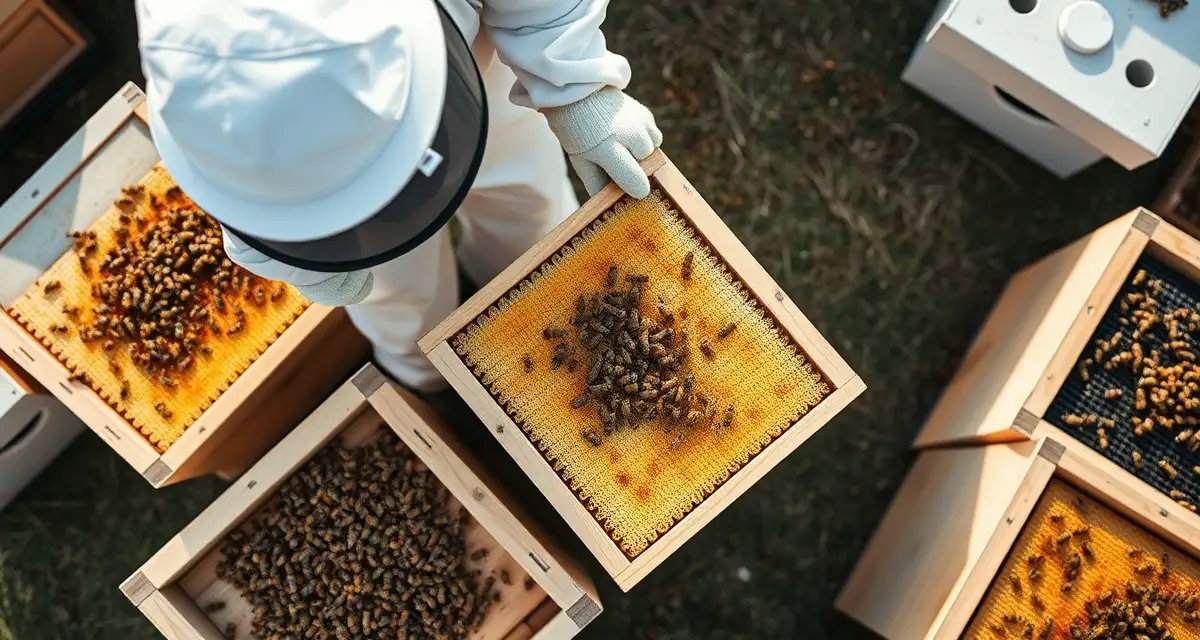
Managing Splits and Increases for Commercial Beekeeping Growth
Well-managed splits can replace 30 to 40% of annual colony losses while simultaneously growing your fleet size. A 1,000-hive operation can produce 300 or more splits annually to maintain or grow colony count, using the spring buildup period when colonies are strongest and queens are most available.
Splits are how commercial beekeeping operations grow without paying market price for replacement packages every spring. The math is simple: if you lose 25% of your colonies in winter, you need 250 replacement units for a 1,000-hive operation. At $130 to $200 per replacement package, that's $32,500 to $50,000 just to stay even. A well-managed split program produces those same replacements at a fraction of that cost.
TL;DR
- Commercial beekeeping operations face two primary management challenges: operational logistics (hive health, transport, placement) and administrative coordination (contracts, payments, documentation).
- Most disputes and revenue losses in commercial beekeeping are preventable with better documentation and clearer contract terms.
- The operations that run most profitably are those with disciplined systems for tracking hive health, contract status, and fleet logistics in one place.
- PollenOps is built specifically for the operational complexity of commercial-scale pollination services, not adapted from a hobbyist tool.
- The most important management decisions (treatment timing, contract renewal, hive allocation) require accurate current data to make well.
When to Make Splits
Spring buildup is the primary split window. Colonies that survived winter are expanding their populations from March through May as brood-rearing ramps up and forage improves. The right time to split is when a colony has enough population to sustain both halves, typically 8 to 10 frames of bees in a two-body setup.
Too early, and the resulting splits don't have enough population to survive until a mated queen is laying. Too late, and the natural swarming impulse has already cost you the colony's best period of growth.
For a 1,000-hive operation making 300+ splits, timing the split program relative to your spring buildup management schedule and your contract commitment calendar is essential.
How Splits Affect Pollination Contract Capacity
This is the critical planning question that most split management guides ignore: when you make splits from colonies that are committed to pollination contracts, you affect your delivered colony count.
If you plan to deliver 900 colonies to California almonds in February, and you make 200 splits in April from your best colonies, you're making splits from colonies that just completed a 6-week pollination contract. The post-split colonies need 4 to 6 weeks to recover and rebuild before they're ready for the next contract commitment.
Map your split program against your spring pollination contract schedule to ensure the splits you create don't leave gaps in contract fulfillment. The best practice is to make splits from the strongest colonies after their contract commitment is fulfilled, then use the resulting splits for contract positions that come 6 to 8 weeks later in the season.
Split Production Methods at Scale
Two-way splits: Divide a strong colony in half, with each half containing drawn comb, a frame of eggs for a queenright half, and a closed queen cell for a queenless half. Simple and effective, but doubles the management time for the split period.
Walk-away splits: Remove the old queen and half the bees to a new location. The queenless half raises a new queen from the existing eggs. Requires no purchased queens but adds 4 to 6 weeks for queen emergence and mating. Only works in spring when mating conditions are good.
Purchased queen splits: Create the queenless half of the split and introduce a purchased mated queen immediately. Faster colony establishment (usually laying within 1 week) and allows genetics control. Queen cost is the trade-off.
Nucleus colony production: Make 5-frame splits into nucleus boxes, build them up for 4 to 6 weeks, then upgrade to full-size equipment when the population justifies it. Nuclei require more tracking and management but can be sold as a revenue source if you produce more than you need for your own replacement program.
Managing 300+ Splits Across a Large Operation
When you're making 300 splits in a 6-week window across 20 or more yard locations, documentation and crew coordination determine whether the program succeeds.
Track each split with:
- Parent colony identifier
- Split date
- Queen status (queen introduced, queen cell present, or walk-away)
- Queen introduction or cell completion date
- Follow-up check date
- Outcome (queen mated and laying, or failure requiring re-do)
For colony loss and increase management at commercial scale, having all this data in a manageable system means you can identify which yards or crew members are having higher split failure rates and address training or technique issues quickly.
Equipment Needs for a Split Program
300 splits require 300 additional hive setups: bottom boards, hive bodies, frames, foundations, and covers. If you're using nucleus boxes as temporary homes, you need 300+ nucleus boxes. The capital investment is significant but typically lower than purchasing 300 replacement packages.
Build split equipment into your annual equipment budget and procurement timeline. Running out of nucleus boxes during a split window, when every day matters for spring buildup timing, creates avoidable operational problems.
Frequently Asked Questions
How do you manage splits efficiently in a 1000-hive operation?
Efficient split management at 1,000-hive scale requires pre-staged equipment at each yard location, trained crew who can execute splits consistently without requiring supervision for every colony, and a documentation system that tracks each split's queen status and follow-up schedule. Stage nucleus boxes or new hive bodies at yard locations before split day, not the day of the split. Train crew on the specific split method you're using (two-way, walk-away, or introduced queen) so the technique is consistent across the operation. The follow-up check schedule, 5 to 7 days for introduced queens and 3 to 4 weeks for walk-aways, is non-negotiable for catching failures early.
What is the best timing for splits to replace winter losses?
For replacing winter losses, the ideal split timing is when replacement colonies have enough time to build to contract-deliverable strength before your next contract commitment. In a California-centric migratory operation, this means mid-to-late April is often the window, allowing 6 to 8 weeks of buildup before June blueberry or cherry placements. For operations where the primary concern is having hives ready for the following February California almond season, any split made before June gives adequate time to build full colony strength by winter. Don't rush splits into the February-March window when colonies are still in early buildup mode.
How do splits affect pollination contract capacity planning?
Splits temporarily reduce the pollination contract capacity of the parent colonies by reducing their population. Budget 4 to 6 weeks of reduced capacity for a colony that has been split before it's back at full contract-deliverable strength. Plan your split program to avoid making splits from colonies committed to a contract within 6 weeks of their delivery date. The resulting split colonies add to your future capacity but not immediately. For a 1,000-hive operation making 300 splits in April, the net effect is 300 temporarily weaker parent colonies and 300 new colonies that will reach deliverable strength by July or August.
What is the difference between commercial and hobby beekeeping?
Commercial beekeeping is distinguished by scale (typically 100+ hives, often 500-5,000+), revenue source (pollination contracts and bulk honey sales rather than local honey retail), and management approach (systematic protocols applied across yards rather than individual colony attention). Commercial operators manage bees as an agricultural enterprise, with the administrative, regulatory, and logistical complexity that entails. Most commercial operators derive the majority of their income from pollination services; honey production is a supplementary revenue stream.
How many hives are needed to make commercial beekeeping a full-time income?
Most beekeeping economists put the full-time commercial threshold at 500-800 hives, assuming efficient operations management and a combination of pollination and honey revenue. At 500 hives and $200/hive for almond pollination, almond season alone generates $100,000 in gross revenue before expenses. Net margins depend on operational efficiency, but well-run operations can achieve 30-50% net margins on pollination revenue. Additional crops and honey production improve per-hive economics but require additional management capacity.
What is the annual revenue potential for a 1,000-hive commercial operation?
A 1,000-hive operation running an almond season ($200/hive) plus blueberry or apple contracts ($80-100/hive) plus summer honey production ($25-40/hive after extraction costs) can generate $300,000-360,000 in annual gross revenue. Net margins after transport, crew, equipment, and hive replacement costs typically run 25-40% for well-managed operations, putting net income at $75,000-145,000 annually. The specific number depends heavily on circuit efficiency, loss rates, and contract quality.
Try These Free Tools
Sources
- USDA Agricultural Research Service
- Bee Informed Partnership
- American Beekeeping Federation (ABF)
- American Honey Producers Association
- Project Apis m.
Get Started with PollenOps
Managing a commercial beekeeping operation involves more data, more deadlines, and more moving parts than any general-purpose tool was designed to handle. PollenOps brings contracts, yard records, health documentation, and fleet logistics together in one platform built for the realities of commercial-scale beekeeping.