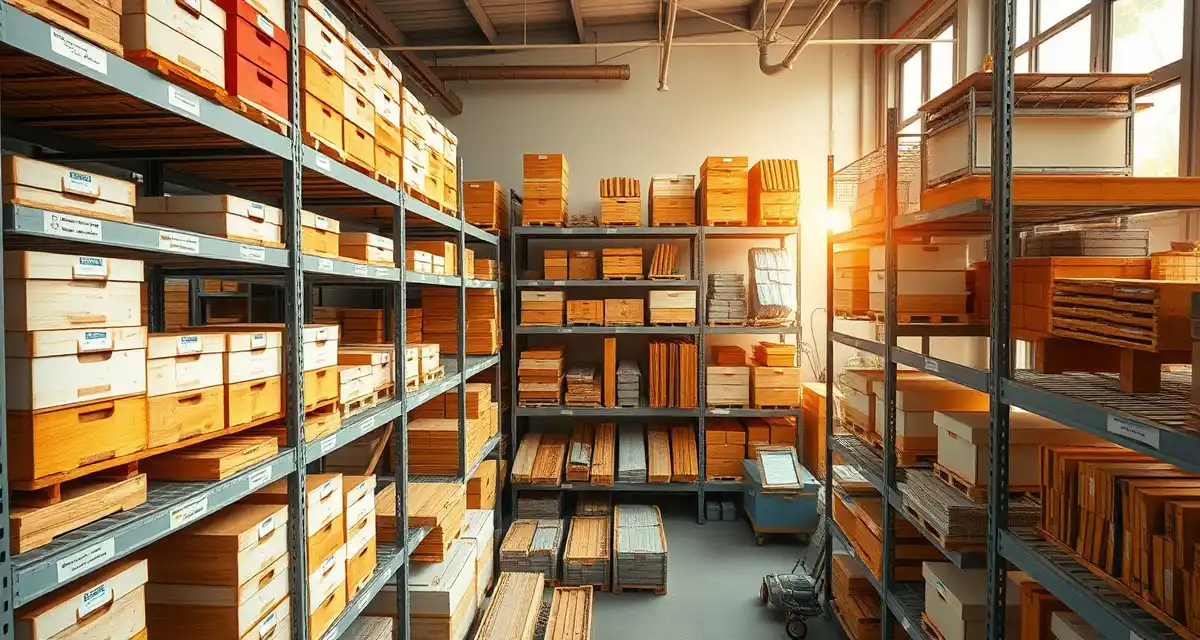
Equipment Inventory Management for Commercial Beekeeping Operations
A 1,000-hive operation manages $200,000 or more in equipment across 20 or more yard locations. Equipment shrinkage and misplacement costs commercial operations 5 to 10% of their asset value annually. That's $10,000 to $20,000 per year in lost or unaccounted-for gear.
Most of that loss isn't theft. It's organizational failure. Equipment gets left at the wrong yard, loaded on the wrong truck, borrowed and never returned, or simply lost in the shuffle of a busy season without a system to track it.
This guide covers how to build an equipment inventory management system that actually works at commercial scale.
TL;DR
- Core equipment for a 500+ hive commercial operation includes flatbed trailer or 18-wheeler capacity, a forklift or telehandler, commercial OAV vaporizers, and a honey extraction setup.
- Equipment needs scale with hive count; operations above 1,000 hives typically need multiple vehicles and a dedicated extraction facility.
- USDA Farm Service Agency operating loans and equipment financing from agricultural lenders are the primary financing options for commercial equipment purchases.
- Detailed equipment inventory with depreciation schedules supports loan applications and insurance coverage documentation.
- Equipment maintenance records and scheduling prevent breakdowns at peak-demand times when truck or forklift failures have maximum operational impact.
Why Equipment Tracking Breaks Down at Scale
At 50 hives, equipment inventory is easy. You know what you have because you use it every time you open a hive. At 500 hives across 10 yards, it's a different situation.
Supers used in Montana don't automatically appear in your California inventory. Equipment left at a yard in December may not be discovered missing until you need it in February. When multiple employees are loading and unloading equipment across multiple locations without a system, things drift.
The natural response is to just buy more. And operations that don't track equipment do buy more: more supers, more hive bodies, more frames. Not because they don't have enough, but because they don't know where what they have is located. That's pure waste.
Step 1: Inventory Your Equipment
Before you can track equipment, you need to know what you have. This sounds obvious but most operations haven't done a full inventory since they started.
What to Inventory
- Hive bodies (deeps, mediums, shallows) by size
- Frames (empty, drawn comb, foundationless)
- Honey supers by size
- Bottom boards (screened and solid)
- Lids and inner covers
- Queen excluders
- Feeders (frame feeders, top feeders, entrance feeders)
- Extraction equipment (uncapping tools, extractors, tanks, filters)
- Transport equipment (pallets, straps, loading equipment)
- Small tools (hive tools, smokers, brushes, marking pens)
- Protective equipment (suits, gloves, veils)
Categorize by condition too: equipment that's usable vs. equipment that needs repair.
How to Inventory at Scale
At 500+ hives spread across multiple locations, you can't do a single-day inventory sweep. The practical approach:
- Inventory each yard as you visit it over 2 to 3 weeks
- Document current location of all equipment at each yard
- Tally everything into a master inventory sheet when each yard is done
- Note equipment in transit between locations as its own category
Assign one person as inventory lead if you have employees. Don't try to do this as a group task with no clear owner. It won't get done consistently.
Step 2: Create an Equipment Numbering System
Individual item tracking at scale requires that items be identifiable. Without identification numbers, you can track categories ("we have 500 supers") but not specific items ("where are the 50 supers that were in the Montana yard in August?").
Practical Marking Approaches
Paint marking: Bright paint on the outside of boxes and supers is the most durable marking method. Choose a color code for your operation that distinguishes your equipment from anyone else's. At minimum, mark each box with your name or initials.
Number stamps: Number each box sequentially (hive body 001, hive body 002, etc.) using a permanent marker or paint. This allows you to track individual item movement. Labor-intensive at 5,000 boxes but valuable for high-value or frequently misplaced equipment.
Color code by yard: Some operators use different colored paint marks on supers assigned to different yards. When supers end up at the wrong location, they're immediately identifiable.
Branded end labels: A stamp with your operation name on the end of each box is quick to apply and makes equipment ownership immediately clear.
What Level of Tracking You Need
For large, fungible items (standard deeps in identical condition), yard-level tracking is usually sufficient. Know how many deeps are at each location and whether that matches your plan.
For expensive equipment (quality frames with drawn comb, specialized supers, extraction equipment), item-level tracking is worth the investment.
Step 3: Build Your Tracking System
Once you know what you have and can identify items, you need a system for tracking where things go.
Minimum Viable Tracking
A yard-level spreadsheet updated at each visit covers the basics:
- Yard name and location
- Date of last inventory
- Equipment counts by category
- Equipment flagged as damaged or missing
This doesn't catch item-level movement, but it catches yard-level imbalances. If you planned to have 100 supers at Yard B and your count shows 60, you know to look for the missing 40.
Integrated Equipment and Yard Management
The more sophisticated approach connects equipment inventory to yard management and fleet logistics. When hives move from Yard A to Yard B, the equipment moves with them. A system that tracks hive movements should automatically update equipment location.
This integration matters most for migratory operators with frequent moves. A move record that includes hive count should also include equipment count. Fleet logistics management that tracks equipment alongside hive movements prevents the equipment drift that accumulates into thousands of dollars in unaccounted-for gear.
Connecting this to yard site management records gives you a complete picture of what's where at any given moment.
Step 4: Establish Equipment Movement Protocols
Having an inventory is only useful if you update it when equipment moves. This requires operational protocols that your employees follow consistently.
Movement Documentation
Every time equipment moves between yards, document:
- What moved (item counts by category)
- From where
- To where
- Date
For loading operations, the truck manifest should include equipment counts as well as hive counts. A driver loading 80 hives and 40 supers should document both, not just the hives.
Return Protocol
Equipment left at a grower's location after hive removal is a common loss point. Establish a clear protocol: at hive pickup, everything that arrived with the hives leaves with the hives. No exceptions. Run a yard checklist before the last truck leaves any location.
Step 5: Loss Prevention
Some equipment loss is inevitable. You can minimize it with the right protocols.
Common Loss Points
Equipment left at grower yards: Happens during rushed pickups. Protocol fix: yard checklist before departure.
Misloaded equipment: Supers from one yard accidentally loaded on a truck going to a different yard. Fix: consistent loading manifests and driver communication.
Employee borrowing: Workers who take equipment home "temporarily." Fix: clear policy and periodic equipment checks.
Weather damage: Equipment left in the field longer than planned gets damaged or blown around. Fix: consistent yard schedules.
Insurance for Equipment Losses
For notable equipment concentrations at specific locations, inland marine insurance covers losses not covered by standard farm policies. At $200,000 in equipment value, the insurance cost is worth the coverage.
Document your equipment inventory value with photographs and purchase records. Insurance claims for equipment require demonstrated value, not just an assertion.
How Do You Prevent Equipment Loss in a Large Migratory Operation?
The honest answer is that you don't prevent all of it. You minimize it through:
- Consistent identification marking on all equipment
- Inventory counts at every yard visit
- Movement documentation for every truck run
- Departure checklists before leaving any location
- Assigned inventory responsibility to a specific person or role
Even with good systems, you'll have discrepancies. The goal is to find and investigate discrepancies quickly, before 10 supers missing from one yard turns into 100 supers unaccounted for across the whole operation.
FAQ
How do you track equipment across multiple yard locations?
Start with a yard-level inventory spreadsheet updated at each visit. Assign equipment counts by category to each yard and flag discrepancies when counts don't match expectations. For more sophisticated tracking, integrate equipment counts into your yard visit records and truck movement logs, so that every hive move also records equipment movement. Color coding and numbering equipment by yard of origin makes visual identification straightforward.
What is the best system for managing beekeeping equipment inventory?
At 100 to 300 hives, a well-maintained spreadsheet with yard-level counts updated at each visit works adequately. Above 500 hives across 10+ locations, the update burden of manual spreadsheets becomes notable. Operations at this scale benefit from equipment tracking integrated into their broader yard and fleet management system, so that when hive movements are recorded, equipment movements are captured simultaneously without duplicate data entry.
How do you prevent equipment loss in a large migratory operation?
Mark every piece of equipment clearly with your operation's name and ideally a color code or numbering system. Require drivers to complete loading manifests that include equipment counts, not just hive counts. Run a departure checklist before the last truck leaves any yard location. Conduct complete yard inventories at least twice per year, comparing actual counts to expected counts by yard. Investigate discrepancies immediately rather than assuming they'll resolve themselves.
What is the difference between commercial and hobby beekeeping?
Commercial beekeeping is distinguished by scale (typically 100+ hives, often 500-5,000+), revenue source (pollination contracts and bulk honey sales rather than local honey retail), and management approach (systematic protocols applied across yards rather than individual colony attention). Commercial operators manage bees as an agricultural enterprise, with the administrative, regulatory, and logistical complexity that entails. Most commercial operators derive the majority of their income from pollination services; honey production is a supplementary revenue stream.
How many hives are needed to make commercial beekeeping a full-time income?
Most beekeeping economists put the full-time commercial threshold at 500-800 hives, assuming efficient operations management and a combination of pollination and honey revenue. At 500 hives and $200/hive for almond pollination, almond season alone generates $100,000 in gross revenue before expenses. Net margins depend on operational efficiency, but well-run operations can achieve 30-50% net margins on pollination revenue. Additional crops and honey production improve per-hive economics but require additional management capacity.
What is the annual revenue potential for a 1,000-hive commercial operation?
A 1,000-hive operation running an almond season ($200/hive) plus blueberry or apple contracts ($80-100/hive) plus summer honey production ($25-40/hive after extraction costs) can generate $300,000-360,000 in annual gross revenue. Net margins after transport, crew, equipment, and hive replacement costs typically run 25-40% for well-managed operations, putting net income at $75,000-145,000 annually. The specific number depends heavily on circuit efficiency, loss rates, and contract quality.
Try These Free Tools
Sources
- USDA Agricultural Research Service
- Bee Informed Partnership
- American Beekeeping Federation (ABF)
- USDA Farm Service Agency
- American Honey Producers Association
Get Started with PollenOps
Commercial equipment investments represent significant capital that needs to be tracked, maintained, and financed alongside day-to-day operations. PollenOps helps you manage the full picture of your operation, from hive inventory to equipment records to contract revenue.