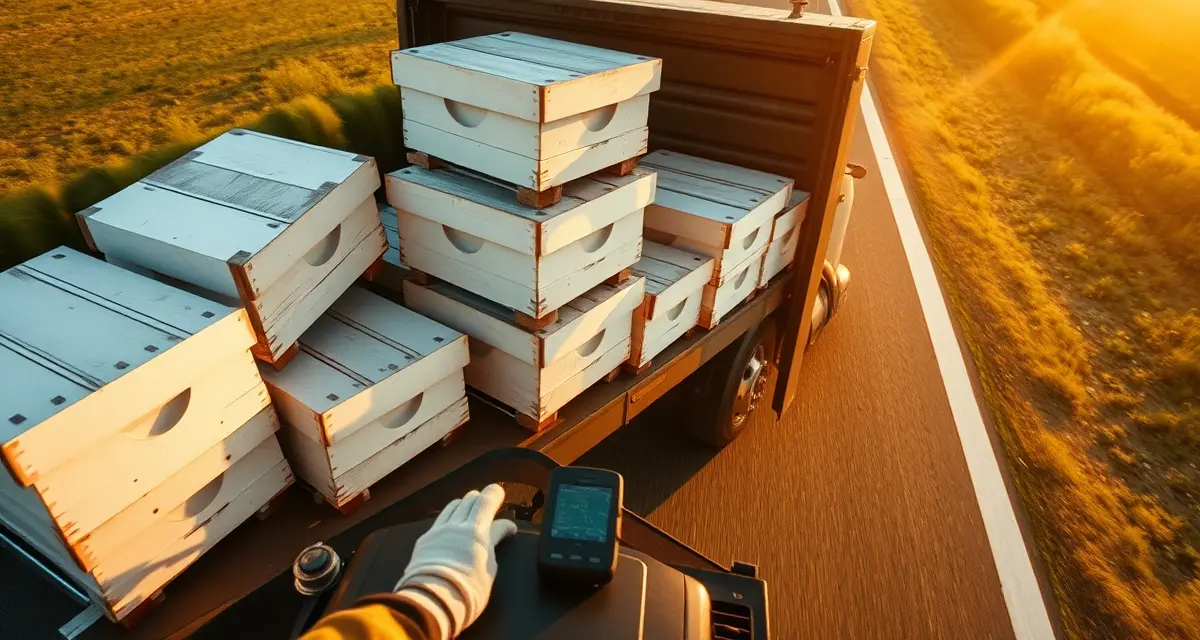
Hive Movement Tracking for Migratory Beekeepers
US beekeepers make an estimated 4 million individual hive moves per year for pollination. Each one is a chain of events that needs to be tracked: hive count at origin, loading timestamp, route, arrival at destination, count at destination. When something goes wrong (a count discrepancy, a compliance question, a state inspection), the movement record is what you rely on.
Most beekeepers can tell you generally where their hives have been. Very few can pull a searchable, GPS-verified movement record showing every hive moved from yard A to yard B on a specific date with origin and destination counts. That gap is where disputes win and compliance fails.
Hive movement tracking is the operational backbone of a professional migratory operation. This hub explains how to do it right.
TL;DR
- Most states require a Certificate of Health or Certificate of Veterinary Inspection issued by the origin state before out-of-state colonies can enter.
- A California-to-Florida-to-Pacific-Northwest-to-Northern-Plains circuit is the most common full-year migratory route for large commercial operations.
- Interstate permit coordination requires lead time; certificates typically need to be obtained 7-30 days before entry depending on the destination state.
- Moving 1,000 hives requires 2-3 truck loads per move, with fuel, driver wages, and DOT compliance as the primary variable costs.
- Operations that plan their annual circuit 6-8 months in advance can sequence pollination contracts and honey production to maximize annual revenue per hive.
The Problem with Tracking Moves Manually
No competitor maintains a searchable GPS move history across multiple seasons the way PollenOps does. Most hive movement records, where they exist at all, are handwritten log sheets, photos, or notes in a personal spreadsheet. These work until you need to find a specific move from 14 months ago, or until a state inspector asks for documentation of hive origin and transit route.
The other problem with manual tracking is the delay. A beekeeper loads 80 hives at 11 PM, drives three hours, unloads at 2 AM, and enters the record three days later when they have time. That entry is a reconstruction, not a record. Its evidentiary value is much weaker than a GPS-timestamped check-out and check-in event captured in real time.
Move history logs in PollenOps include truck route, load count, arrival GPS, and hive count at destination, all captured at the time of the move through the mobile app.
What a Complete Hive Movement Record Looks Like
A movement record isn't just "80 hives went from yard 12 to yard 7 on March 4th." A complete record includes:
Origin yard GPS coordinates. Confirmed from the check-out event in the mobile app. This establishes where the hives came from with spatial precision.
Check-out timestamp. The exact date and time hives were loaded and departed. This is important for state regulations that require advance notification or permits tied to move dates.
Load count. Number of hives loaded, recorded at the time of loading, not estimated from inventory records.
Truck and driver information. Which truck, which driver. Important for multi-truck operations and for state inspection records.
Planned route. The intended states or regions the move crosses. This triggers the state compliance checklist for the appropriate jurisdictions.
Arrival GPS coordinates. Confirmed from the check-in event at the destination yard.
Check-in timestamp. Date and time of arrival.
Count at destination. Hives confirmed at the receiving yard. Discrepancies between load count and arrival count are flagged immediately.
Condition notes. Any hives damaged in transit, any unusual conditions at pickup or delivery.
This record is captured automatically by PollenOps through the check-out and check-in workflow in the mobile app. Your crew doesn't write anything beyond the hive count and any notes.
How GPS Hive Tracking Helps with Contract Compliance
Many pollination contracts specify delivery windows tied to bloom timing. "Hives must be in place by February 10 or before first almond bloom, whichever is earlier." Your move record is your proof of compliance.
A GPS arrival timestamp from February 8 satisfies a February 10 requirement conclusively. No argument possible. A vague note in a spreadsheet saying "delivered first week of February" is contestable.
GPS tracking also helps when a grower claims hives were removed early or weren't at the site during peak bloom. If your records show check-in on February 8 and check-out on March 14, you can demonstrate the hive placement duration exactly.
For commercial bee yard management, the movement tracking data integrates directly with yard records. Every move event updates both the sending yard (hives departed) and the receiving yard (hives arrived). Yard hive counts are always current based on the most recent movement records.
Documenting Hive Moves for State Inspection Records
State apiary inspection requirements vary. Some states require inspection before hives are moved in. Others require registration of apiary locations after arrival. All states require health certificates for interstate moves.
Your movement log supports these requirements in two ways. First, it demonstrates the date hives entered a state, which supports compliance with arrival registration requirements. Second, it shows origin state, which is relevant to the health certificate documentation.
PollenOps GPS yard tracking records the GPS locations of both origin and destination yards, which a state inspector can verify against physical locations. When an inspector asks "where did these hives come from?", you pull up the movement record on your phone.
For multi-state moves (a common scenario for migratory operations running from Florida to California to Washington), the movement log shows the full route history. You can generate a report showing every state the hives transited and the dates of entry and exit.
Step-by-Step: Recording a Hive Move in PollenOps
Step 1: Initiate the Move Event at the Origin Yard
Before loading a single hive, open the origin yard record in PollenOps and start a move event. Select the destination yard (or create a new yard if this is the first visit to that location). Enter the planned load count and the driver and truck assigned.
The system captures your GPS location at this point, confirming you're at the origin yard at the time of the move.
Step 2: Confirm Load Count
As hives are loaded onto the truck, count and record the actual load count. This is your verified origin count, the number confirmed at the time of loading.
If you have multiple truck runs for a single yard, record each run separately. The system aggregates them into the full move event.
Step 3: Close Out the Origin Yard
After loading, close the move event at the origin yard. The system records the check-out timestamp and updates the origin yard's hive count to reflect hives removed.
Step 4: Check In at the Destination Yard
On arrival at the destination, open the destination yard in PollenOps and complete the arrival check-in. The system captures your arrival GPS and timestamp.
Enter the hive count at arrival. If this differs from the load count, add a note explaining the discrepancy (transit mortality, damaged hive, etc.).
Step 5: Review the Move Record
After check-in, the complete move record is saved: origin yard, check-out time and GPS, load count, destination yard, check-in time and GPS, arrival count. Both yard records are updated with current hive counts.
You can view the full move record in the movement log, sorted by date, yard, or hive count. The record is searchable and exportable for state reporting or contract compliance documentation.
Managing Hive Move Records Across Multiple Seasons
The most valuable aspect of searchable movement history is its longevity. A dispute about a move from three seasons ago is resolvable if you have the records. It's not resolvable if your three-year-old records are on a spreadsheet you can't find.
PollenOps stores movement history indefinitely. Every move is searchable by date range, origin yard, destination yard, contract, or crew member. You can pull the full movement history for a specific yard or for all hives in a specific contract.
This multi-season record is particularly useful for:
State inspection audits. An inspector asking about movement history over the past 24 months can be answered with a printed report.
Grower audits. A grower disputing whether hives were on their site during a specific window: resolved by pulling the check-in and check-out timestamps for that yard.
Operational planning. Reviewing past season movement patterns to identify opportunities for route efficiency or better timing.
FAQ
How do I track when and where my hives have been moved?
Use PollenOps to record a move event every time hives change yards. The check-out event at the origin captures GPS, timestamp, and load count. The check-in event at the destination captures arrival GPS, timestamp, and count. Both events are stored in the searchable movement log. For historical tracking, every move is linked to the relevant yard records and contract records, so you can reconstruct the full movement history for any hive group across multiple seasons.
Does GPS hive tracking help with contract compliance?
Yes, significantly. GPS movement records provide timestamped, spatially verified evidence of delivery and pickup dates. When a contract specifies delivery by a certain date, your GPS check-in timestamp proves compliance conclusively. For inspection compliance, GPS records show origin and destination yards that can be verified against physical locations. For insurance or dispute purposes, GPS movement records are far more credible than manual notes or spreadsheet entries created after the fact.
How do I document hive moves for state inspection records?
Record a move event in PollenOps for every inter-yard move, capturing origin yard GPS, check-out timestamp, load count, destination yard GPS, and check-in timestamp. When a state inspector asks for movement records, export the movement log for the requested date range and jurisdiction. PollenOps exports are formatted for readability and include all the data fields state inspectors typically request. For interstate moves, your movement records combined with health certificates and movement permits create a complete compliance package.
What is the most common full-year circuit for US migratory beekeepers?
The classic commercial circuit runs: winter buildup in Florida or southern Texas, California almonds in February, Pacific Northwest tree fruit (cherry, apple, pear) in April-May, Pacific Northwest or northern Midwest berry and clover crops in June-July, summer honey production in North Dakota, Montana, or Minnesota in July-August, and fall honey extraction and requeening before the cycle restarts. The exact circuit depends on contracted commitments, hive capacity, and the operator's regional relationships.
How do you coordinate state entry permits for a multi-state circuit?
State entry permits and health certificates require lead time: most states want certificates issued 7-30 days before entry. For a circuit that crosses 5-6 states, this means overlapping certificate applications where a certificate for the next state must be initiated before the current state's placement ends. Some operators use a permit tracking calendar that accounts for the lead time required for each destination state. PollenOps includes a permit tracking feature that alerts operators when certificates need to be initiated based on planned move dates.
What are the most common mistakes new migratory operators make?
The most common errors are underestimating transport costs, failing to secure contracts before building hive capacity, not accounting for state entry permit lead times, and neglecting varroa management during the compressed pre-almond preparation period. New operators often also underestimate the administrative load of managing 10-20 contracts across multiple states -- tracking payment status, compliance documentation, and crew scheduling simultaneously requires systems, not just a spreadsheet.
Try These Free Tools
Sources
- USDA Agricultural Research Service
- Bee Informed Partnership
- American Beekeeping Federation (ABF)
- American Honey Producers Association
- USDA Animal and Plant Health Inspection Service (APHIS)
Movement Tracking Is Your Paper Trail
Every hive you move leaves a trail of questions: where did they come from, when did they arrive, how many were there, what condition were they in? If you can answer those questions with documented records, you're protected. If you can't, you're at risk.
Get Started with PollenOps
Migratory operations face the most complex coordination challenges in commercial beekeeping: permits across multiple states, staggered delivery windows, and fleet logistics that have to work precisely across hundreds of miles. PollenOps was built to handle multi-state, multi-grower, multi-crop operations at this level of complexity.