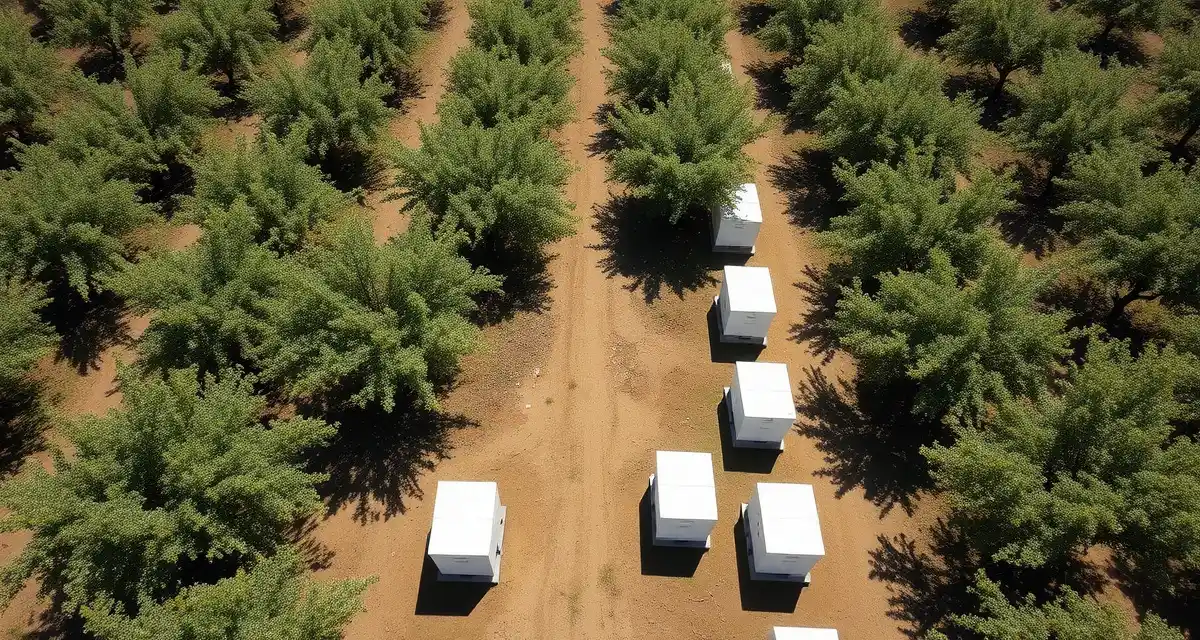
Hive Placement Mapping for Pollination Sites
Incorrect hive placement density reduces pollination effectiveness by up to 30% according to research. That's not a marginal effect. Misplace your hives within an orchard, and a technically compliant contract can underdeliver on the pollination outcome your grower expects.
Hive placement mapping is how you document where hives are placed within a specific field or orchard block, not just which yard they're associated with. The distinction matters for both performance and compliance.
TL;DR
- Commercial beekeeping operations face two primary management challenges: operational logistics (hive health, transport, placement) and administrative coordination (contracts, payments, documentation).
- Most disputes and revenue losses in commercial beekeeping are preventable with better documentation and clearer contract terms.
- The operations that run most profitably are those with disciplined systems for tracking hive health, contract status, and fleet logistics in one place.
- PollenOps is built specifically for the operational complexity of commercial-scale pollination services, not adapted from a hobbyist tool.
- The most important management decisions (treatment timing, contract renewal, hive allocation) require accurate current data to make well.
Why Placement Within an Orchard Matters
Dropping all your hives in one corner of a 200-acre almond orchard is different from distributing them in clusters across the planting. Honeybees forage most intensively within the first half-mile of the hive, and they preferentially work the areas closest to their entrance. An orchard block where all hives are concentrated at the south end will have uneven pollinator coverage: dense activity near the hive clusters, declining activity toward the far end of the block.
Most growers with commercial pollination experience understand this and specify placement requirements in their contracts. Common specifications include:
- Maximum cluster size (e.g., no more than 50 hives per cluster)
- Minimum spacing between clusters (e.g., at least 800 feet between cluster centers)
- Placement within a designated zone of the orchard
- Prohibition on placing all hives on a single side of the block
Meeting these requirements starts with knowing what they are, but proving you met them requires documentation.
How to Determine Optimal Hive Placement in an Almond Orchard
The key variables for almond orchard placement:
Orchard block size and shape: Larger, more square blocks need more distributed placement than smaller or narrow blocks. A linear 40-acre block along a canal might need hive clusters at each end plus the center. A square 40-acre block might be served by two or three clusters positioned for maximum coverage.
Variety layout: Some almond orchards have distinct variety blocks that require cross-pollination. The grower's variety layout may influence where hive clusters should be positioned to maximize pollen transfer between compatible varieties.
Prevailing wind: Bees fly less directly into prevailing winds. Placing hives so foragers fly with the wind toward the center of the orchard improves distribution in wind-exposed locations.
Water and shade: Bees need water, and they'll orient toward available sources. If you're providing a supplemental water source, its position influences early foraging patterns during colony establishment.
Access road locations: Practical placement reality includes your ability to position hives at specific spots. Wet fields, irrigation equipment, and narrow roads all constrain where you can actually put the truck.
What Is Ideal Spacing Between Hive Clusters in a Large Orchard?
Industry guidance suggests cluster spacing of 500-800 feet (roughly 100-200 meters) for most orchard pollination applications. This ensures that foragers from adjacent clusters share foraging territory in the middle zones rather than leaving dead zones between widely spaced clusters.
For a 200-acre almond block, three to four clusters positioned at roughly 800-foot intervals would provide reasonable coverage. For a smaller 40-acre block, two clusters positioned near opposite ends often works well.
These are guidelines, not formulas. The actual optimal configuration depends on orchard shape, variety layout, and hive count. For large contracts where placement configuration significantly affects performance, a pre-season site visit with the grower to discuss cluster positioning is worth the time.
Documenting Hive Placement for Grower Compliance Reports
This is where placement mapping becomes a compliance tool rather than just an operational one.
A placement map in your grower report shows:
- The orchard boundary (usually from satellite imagery)
- Each cluster's position within the orchard
- The number of hives in each cluster
- GPS coordinates for each cluster location
- Date of placement
This documentation answers the grower's core question: "Did you actually distribute the hives the way the contract requires?" A placement map is a far more satisfying answer than "yes, trust me."
PollenOps hive placement mapping generates placement maps from GPS cluster coordinates recorded during your yard setup. You log each cluster's GPS location when you place it, and the placement map is generated automatically for inclusion in your grower arrival report.
For growers who receive a placement map showing four well-distributed clusters across their 200-acre block, the arrival report is a professional document that builds confidence in your operation. For growers who get a text message saying "bees are there," you've given them much less.
Placement Maps as Dispute Evidence
When a grower claims that pollination coverage was uneven or that hives weren't placed as contracted, a GPS placement map is your evidence.
Without a map, the dispute comes down to your memory vs. the grower's perception. With a map showing exactly where each cluster was placed on a specific date, the conversation is grounded in verifiable facts.
For contracts with specific placement requirements, document your compliance at placement time, not after a dispute arises. The GPS record from your field check-in is timestamped and objective. A map created after the fact carries less weight.
Placement Density Calculator
How do you check that your planned hive placement meets the contract density requirement for a specific orchard?
The basic calculation: if the contract specifies 2 hives per acre for a 150-acre block, you need 300 hives. If you're placing those 300 hives in 5 clusters of 60 hives each, and the orchard is roughly rectangular, space your clusters so that every part of the orchard is within half a mile of the nearest cluster.
PollenOps includes a placement density calculator that takes your contracted hive count, the orchard acreage, and your planned cluster configuration and checks whether the distribution meets a minimum coverage threshold based on foraging range data.
This is most useful for complex or irregularly shaped orchard blocks where the obvious cluster placement might leave gaps in coverage that aren't apparent without mapping.
Frequently Asked Questions
How do I determine optimal hive placement in an almond orchard?
Consider the orchard block size and shape, variety layout (for cross-pollination positioning), prevailing wind, water source locations, and access road constraints. For most commercial almond blocks, distribute hive clusters at 500-800 foot intervals across the orchard to maximize foraging coverage. Avoid concentrating all hives on one side of the block. Review your contract for any specific placement requirements from the grower before finalizing cluster positions.
What is the ideal spacing between hive clusters in a large orchard?
Industry guidance suggests 500-800 feet between cluster centers for most orchard pollination applications. This spacing ensures foragers from adjacent clusters share the middle zones rather than leaving uncovered areas. For a 200-acre block, three to four clusters at 800-foot intervals provides reasonable coverage. Actual ideal spacing depends on orchard shape, hive count, and the foraging density you need to achieve.
How do I document hive placement for grower compliance reports?
Record GPS coordinates for each cluster location during your yard setup. Include the number of hives in each cluster, the placement date, and the orchard boundary in your grower report. PollenOps generates a placement map from your GPS cluster coordinates that shows hive distribution across the orchard on a satellite imagery background. This map, included in your arrival report, documents your placement compliance in a format growers can verify and reference if questions arise later.
What is the difference between commercial and hobby beekeeping?
Commercial beekeeping is distinguished by scale (typically 100+ hives, often 500-5,000+), revenue source (pollination contracts and bulk honey sales rather than local honey retail), and management approach (systematic protocols applied across yards rather than individual colony attention). Commercial operators manage bees as an agricultural enterprise, with the administrative, regulatory, and logistical complexity that entails. Most commercial operators derive the majority of their income from pollination services; honey production is a supplementary revenue stream.
How many hives are needed to make commercial beekeeping a full-time income?
Most beekeeping economists put the full-time commercial threshold at 500-800 hives, assuming efficient operations management and a combination of pollination and honey revenue. At 500 hives and $200/hive for almond pollination, almond season alone generates $100,000 in gross revenue before expenses. Net margins depend on operational efficiency, but well-run operations can achieve 30-50% net margins on pollination revenue. Additional crops and honey production improve per-hive economics but require additional management capacity.
What is the annual revenue potential for a 1,000-hive commercial operation?
A 1,000-hive operation running an almond season ($200/hive) plus blueberry or apple contracts ($80-100/hive) plus summer honey production ($25-40/hive after extraction costs) can generate $300,000-360,000 in annual gross revenue. Net margins after transport, crew, equipment, and hive replacement costs typically run 25-40% for well-managed operations, putting net income at $75,000-145,000 annually. The specific number depends heavily on circuit efficiency, loss rates, and contract quality.
Try These Free Tools
Sources
- USDA Agricultural Research Service
- Bee Informed Partnership
- American Beekeeping Federation (ABF)
- American Honey Producers Association
- Project Apis m.
Get Started with PollenOps
Managing a commercial beekeeping operation involves more data, more deadlines, and more moving parts than any general-purpose tool was designed to handle. PollenOps brings contracts, yard records, health documentation, and fleet logistics together in one platform built for the realities of commercial-scale beekeeping.