How Many Hives Per Acre for Pollination?
The answer depends heavily on the crop, and getting it wrong in either direction costs you money or grower goodwill. Too few hives and you underperform on pollination outcomes. Too many and you're spending truck time and leaving capacity unavailable for other contracts.
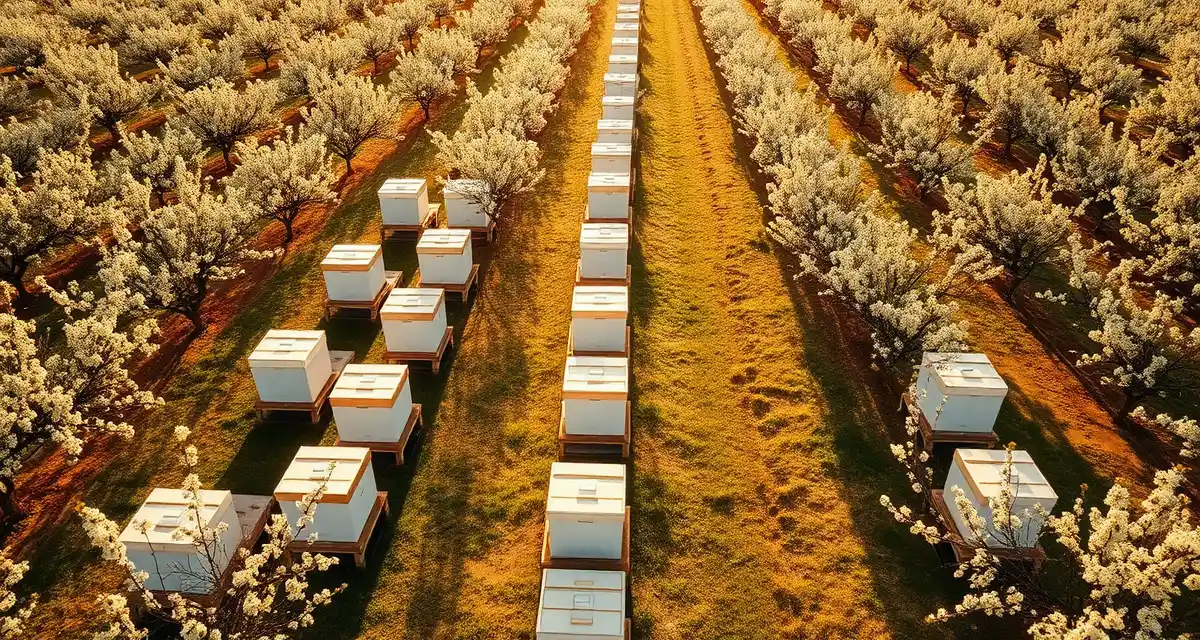
The almond industry standard is 2-3 hives per acre, while blueberries require up to 4-6 hives per acre in high-value production. These aren't arbitrary numbers; they're based on decades of field research and grower experience calibrated to real-world crop set outcomes.
TL;DR
- Commercial beekeeping operations face two primary management challenges: operational logistics (hive health, transport, placement) and administrative coordination (contracts, payments, documentation).
- Most disputes and revenue losses in commercial beekeeping are preventable with better documentation and clearer contract terms.
- The operations that run most profitably are those with disciplined systems for tracking hive health, contract status, and fleet logistics in one place.
- PollenOps is built specifically for the operational complexity of commercial-scale pollination services, not adapted from a hobbyist tool.
- The most important management decisions (treatment timing, contract renewal, hive allocation) require accurate current data to make well.
Hive Density by Crop
Here are the working standards for the major commercial pollination crops in the US:
Almonds
Standard: 2-3 hives per acre
This is the most-cited figure in commercial pollination. The California Almond Board's research baseline is around 2 hives per acre for adequate pollination in most production scenarios, with some growers preferring 2.5-3 to account for variable colony performance.
High-demand, high-premium orchards (particularly self-incompatible varieties that require thorough cross-pollination) sometimes request 3+ hives per acre. New plantings with young trees and limited flower density may manage adequately at 2.
Cherries (Sweet)
Standard: 1-2 hives per acre
Sweet cherry is more efficiently pollinated than almond because of the flower structure and the concentrated bloom pattern. One to two strong hives per acre is the typical commercial requirement. Some growers with isolated orchards or historically low fruit set request up to 3 per acre.
Cherry bloom windows are short (5-10 days), so the density of active foragers at peak bloom matters more than the total number of hives over a longer period.
Blueberries (Highbush)
Standard: 2-4 hives per acre, up to 6 for intensive production
Highbush blueberry flowers are bell-shaped (urceolate), which makes them less accessible to honeybees than open-face flowers. Honeybees compensate through volume, requiring more hives per acre than crops with more accessible flowers.
Michigan growers typically request 3 hives per acre as a standard. High-density plantings targeting maximum berry size may request 4-5. In operations where bumblebee colonies supplement honeybee placements, the honeybee requirement drops somewhat.
Apples
Standard: 1-2 hives per acre
Apple orchards with standard tree spacing typically need 1-2 hives per acre. High-density plantings (more trees per acre) may need 2-3. The key variable is the variety mix: apple is self-incompatible and requires pollen from a compatible variety, so orchard configuration influences how effectively foragers transfer pollen between rows.
Avocados
Standard: 1-3 hives per acre
The range is wide because the relevant factor is the Type A/B flower mix and the availability of natural pollinators. Orchards with a good variety mix and some natural pollinator population can work with 1 hive per acre. Isolated monovariety blocks may need 2-3.
Cranberries
Standard: 2-3 hives per acre
Cranberry blooms are bell-shaped like blueberry, and honeybees work them less efficiently than bumblebees. Commercial cranberry production still relies heavily on honeybees because of availability, but the density requirement is higher per acre than for open-face flowers.
Citrus
Standard: 0.5-1 hive per acre
Many citrus varieties are self-fertile and don't strictly require cross-pollination, but commercial growers often use bees to improve fruit set and fruit size. Requirements are lower than for other crops. Some specialty citrus varieties require active cross-pollination and may need higher density.
Watermelon and Squash
Standard: 1-2 hives per acre
Cucurbit crops (melon, squash, cucumber) require active bee pollination for fruit set. One to two hives per acre covers most commercial production scenarios.
Sunflowers (Seed)
Standard: 1-2 hives per acre
Sunflower seed production contracts typically call for 1-2 hives per acre. Confection sunflower varieties that produce large seeds may benefit from denser placement.
Alfalfa Seed
Standard: 3-5 hives per acre
Alfalfa flowers require tripping, which honeybees do somewhat reluctantly. Commercial alfalfa seed growers compensate by using high hive density. Leafcutter bees are more efficient per visit but honeybees remain the dominant commercial option because of availability.
Do Hive Strength and Density Both Affect Pollination Contract Rates?
Yes. Both matter, and they interact.
A contract for 3 hives per acre at 6 frames of bees minimum is significantly different from a contract for 3 hives per acre with no strength specification. Weaker colonies have fewer foragers, and fewer foragers mean lower pollination intensity even at the correct hive density.
When you price a pollination contracts, you're effectively pricing forager-hours per acre. Strong colonies at lower density may provide equivalent or better pollination than weak colonies at higher density. This is the argument for charging premium rates for strong hives, and it's a legitimate one if you can document your colony condition.
PollenOps per-hive rate calculation takes your hive strength scores and the crop-specific benchmark to generate a rate that reflects both the hive count and the colony quality you're delivering.
How Do I Calculate Total Hives Needed for a 500-Acre Almond Contract?
Basic calculation: Orchard acres x hives per acre = total hive requirement.
For 500 acres at 2.5 hives per acre: 500 x 2.5 = 1,250 hives.
But the full calculation also considers:
- Useful vs. gross acres: Large orchards often include headlands, access roads, and windbreaks that don't have almond trees. Confirm whether the grower's acreage figure refers to planted acres or total property.
- Variety mix: If the orchard is all one variety (unusual but possible), cross-pollination requires that your bees fly further, which sometimes justifies slightly higher density.
- Contracted minimums vs. your delivery plan: If you're delivering 1,250 hives to meet a 2.5/acre requirement, build in a buffer for any colony losses during transit.
For a 500-acre contract at 2.5 hives per acre, most beekeepers plan to deliver 1,300-1,350 hives to have a comfortable margin above the contracted minimum.
Frequently Asked Questions
What is the recommended hive density for almond pollination?
The industry standard for almond pollination is 2-3 hives per acre. The California Almond Board's research baseline is approximately 2 hives per acre for typical production conditions. Premium or high-yield target orchards may request 2.5-3 hives per acre. The contracted minimum typically specifies both hive count per acre and minimum hive strength (commonly 6-8 frames of bees).
Do hive strength and density both affect pollination contract rates?
Yes. Both factors determine the total forager-hours per acre that your hives provide. Strong colonies at lower density can out-pollinate weak colonies at higher density. Per-hive contracts often specify both a hive count requirement and a minimum strength standard because density alone doesn't guarantee adequate pollination intensity. PollenOps rate calculator accounts for both hive count and strength scores when generating a justified per-hive price.
How do I calculate total hives needed for a 500-acre almond contract?
Multiply planted acres by the contracted hives-per-acre requirement. For 500 acres at 2.5 hives per acre, the baseline is 1,250 hives. Add a buffer of 5-10% above the contracted minimum to account for transit losses and any colonies that don't meet strength minimums at delivery. Confirm whether the grower's acreage refers to planted acres or total property acreage, as the difference can be significant on large properties.
What is the difference between commercial and hobby beekeeping?
Commercial beekeeping is distinguished by scale (typically 100+ hives, often 500-5,000+), revenue source (pollination contracts and bulk honey sales rather than local honey retail), and management approach (systematic protocols applied across yards rather than individual colony attention). Commercial operators manage bees as an agricultural enterprise, with the administrative, regulatory, and logistical complexity that entails. Most commercial operators derive the majority of their income from pollination services; honey production is a supplementary revenue stream.
How many hives are needed to make commercial beekeeping a full-time income?
Most beekeeping economists put the full-time commercial threshold at 500-800 hives, assuming efficient operations management and a combination of pollination and honey revenue. At 500 hives and $200/hive for almond pollination, almond season alone generates $100,000 in gross revenue before expenses. Net margins depend on operational efficiency, but well-run operations can achieve 30-50% net margins on pollination revenue. Additional crops and honey production improve per-hive economics but require additional management capacity.
What is the annual revenue potential for a 1,000-hive commercial operation?
A 1,000-hive operation running an almond season ($200/hive) plus blueberry or apple contracts ($80-100/hive) plus summer honey production ($25-40/hive after extraction costs) can generate $300,000-360,000 in annual gross revenue. Net margins after transport, crew, equipment, and hive replacement costs typically run 25-40% for well-managed operations, putting net income at $75,000-145,000 annually. The specific number depends heavily on circuit efficiency, loss rates, and contract quality.
Try These Free Tools
Sources
- USDA Agricultural Research Service
- Bee Informed Partnership
- American Beekeeping Federation (ABF)
- American Honey Producers Association
- Project Apis m.
Get Started with PollenOps
Managing a commercial beekeeping operation involves more data, more deadlines, and more moving parts than any general-purpose tool was designed to handle. PollenOps brings contracts, yard records, health documentation, and fleet logistics together in one platform built for the realities of commercial-scale beekeeping.