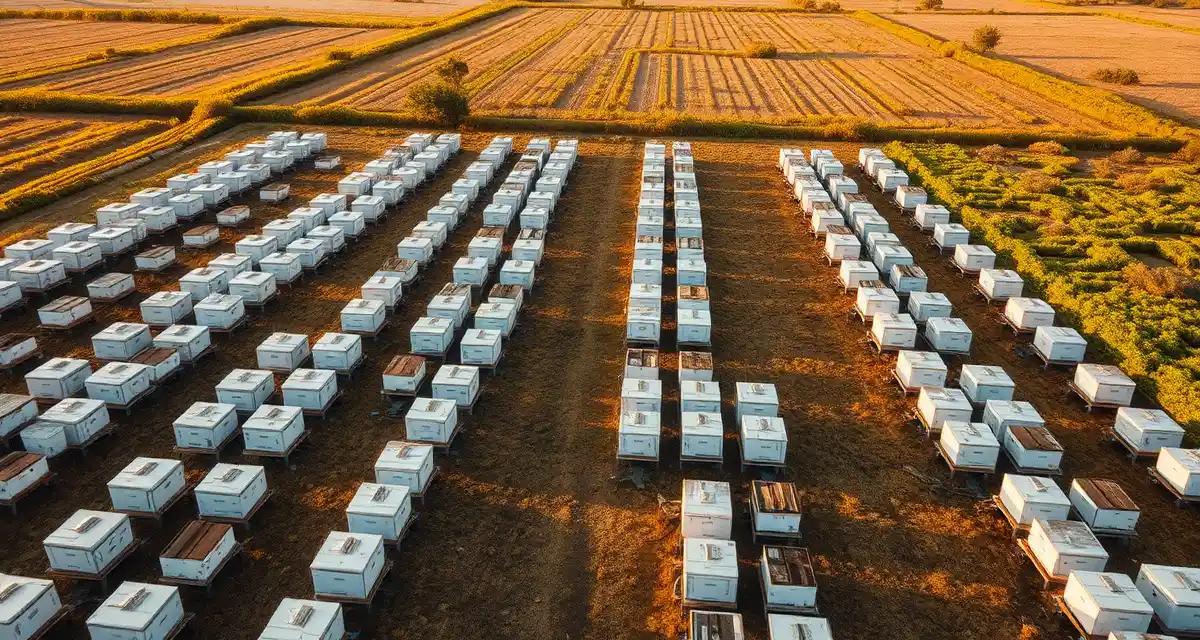
How a 200-Hive Operation Scaled to 2000 with PollenOps
Operations scaling from 200 to 2,000 hives see a 4x increase in administrative overhead without software to manage it. Every contract, every yard location, every grower relationship, every invoice becomes more complex as the fleet grows, and the manual systems that work at 200 hives become bottlenecks that limit growth at 600, 800, and especially at 1,000-plus. This case study follows a Central Valley-based commercial beekeeper who scaled from 200 to 2,000 hives over four seasons, identifying which PollenOps features were most important at each stage of the growth.
Every major growth milestone in this case study was enabled by a specific PollenOps feature. The pattern isn't coincidental: scaling beekeeping operations has consistent chokepoints, and purpose-built software addresses them in ways that spreadsheets and phone management cannot.
TL;DR
- Real commercial beekeeping operations consistently identify the same pain points: contract tracking, hive count disputes, and administrative overhead.
- Operations that have moved from paper-and-phone management to digital platforms report 5-10 hours per week saved on administrative tasks.
- Case study operations typically see ROI on management software within the first season through dispute prevention and faster invoicing.
- Documenting operations systematically is the common thread among operations that scale from 200 to 1,000+ hives without proportionally scaling administrative staff.
- The specific numbers in these case studies reflect real operational outcomes, not theoretical projections.
Season One: 200 to 500 Hives
The operator started PollenOps at 200 hives when they decided to scale to 500 for the following almond season. At 200 hives with 6 to 8 contracts, manual management was workable but starting to show cracks: invoices were late, one grower had disputed a count, and tracking which yards held which contracts was creating mental overhead.
The first PollenOps benefit at this stage was contract standardization. The operator used PollenOps contract templates to formalize all their agreements with consistent terminology, strength requirements, and payment terms. Several existing informal arrangements were converted to signed contracts, which immediately reduced the ambiguity that led to disputes.
The GPS yard tracking resolved the hive location confusion that manual spreadsheets created. By the time the operation reached 500 hives and 14 contracts for almond season, the GPS map gave the operator a real-time view of their fleet location that no spreadsheet had ever provided.
At 500 hives, the grower portal feature became important. The operator started giving growers portal access at contract signing, which meant growers could see their delivery status without calling the office. This reduced inbound phone calls from growers by roughly half during almond season.
Season Two: 500 to 1,000 Hives
The jump from 500 to 1,000 hives was where the operator said they would not have scaled successfully without PollenOps. The reason was team management.
At 500 hives, the operator could run most operations with one driver and their own field presence. At 1,000 hives, they needed three drivers, and coordinating three independent drivers across multiple states and dozens of yard locations without a centralized coordination tool was impossible to manage by phone and text messages alone.
The PollenOps commercial yard management team features (driver assignment, mobile check-in, real-time location visibility) made it possible to run three drivers simultaneously without the operator being physically present at every delivery. Each driver received yard assignments through the app, checked in at each location with GPS verification, and the operator saw delivery status in real time from wherever they were.
The second critical feature at the 1,000-hive stage was bloom timing alerts. At 200 hives, the operator had been manually tracking bloom timing through grower calls and extension service updates. At 1,000 hives across multiple states, this manual approach couldn't keep up. Bloom timing alerts from PollenOps synchronized across all active contracts, flagging when conditions indicated bloom was approaching and when delivery windows were opening.
One specific incident illustrates the value: a bloom alert fired 36 hours before contracted delivery for a Fresno County almond grower, indicating early bloom based on temperature data. The operator was able to advance placement for that contract by 12 hours, delivering ahead of the bloom rather than during it. The grower noticed the attentiveness and referenced it in his contract renewal conversation.
Season Three: 1,000 to 1,500 Hives
At 1,000 hives, hive inventory management became the constraint. The operator was buying packages, making splits, and losing colonies to normal mortality, and tracking the accurate available fleet count at any given time was difficult. Contracting 1,200 hives when you only have 1,050 available after winter losses is a contract compliance failure waiting to happen.
PollenOps hive inventory tracking updated in real time as drivers completed check-ins and as splits and new package arrivals were logged. The operator could see their exact available fleet count before signing new contracts, which meant they stopped over-committing. One overcommit in season two had resulted in scrambling to source 60 hives from another operator at the last minute at $50 per hive rental fee, a $3,000 expense that was entirely avoidable with accurate inventory tracking.
The multi-state compliance documentation feature also became important at this scale. Running operations in California, Oregon, and Washington required keeping health certificates, apiary registrations, and import permits current for all three states. PollenOps compliance tracking flagged expiration dates and upcoming renewal requirements so nothing slipped.
The operator hired an office manager for the first time at 1,500 hives, and PollenOps made it possible to onboard that person quickly. The platform's audit trail meant the office manager could review the full contract and payment history for every grower without requiring the operator to brief them on every relationship's history from memory.
Season Four: 1,500 to 2,000 Hives
The final scaling phase to 2,000 hives introduced a challenge the operator hadn't anticipated: grower retention complexity. At 200 hives, the operator knew every grower personally and managed relationships through direct communication. At 2,000 hives with 40-plus active grower relationships, personally tracking which accounts were at risk before renewal season wasn't feasible.
The beekeeper-grower relationship management features in PollenOps gave the operator a grower performance history view that flagged accounts with documented friction from prior seasons. Growers who had disputed invoices, who had complained about delivery timing, or who had received below-average delivery documentation were flagged for priority pre-renewal outreach.
This proactive retention approach, driven by PollenOps data, maintained grower renewal rates above 85 percent through the scaling period. The operator's estimate was that retaining each large almond grower relationship at 2,000 hives was worth $15,000 to $50,000 per season depending on the account's acreage.
At 2,000 hives, the operator moved to PollenOps Enterprise for the API integration with their accounting software, which eliminated double data entry between their contract system and their financial records. The enterprise-tier pricing at $499 per month represented under 0.3 percent of their annual revenue, a cost that barely registered against the operational value delivered.
Frequently Asked Questions
Which PollenOps features were most important during the scaling process?
Different features mattered most at different scales. At 200 to 500 hives, contract templates and GPS yard tracking were the foundations. At 500 to 1,000 hives, team management and bloom timing alerts became critical. At 1,000 to 1,500 hives, hive inventory management and multi-state compliance documentation. At 1,500 to 2,000 hives, grower retention analytics and API integration with accounting software. The consistent thread is that PollenOps addressed each scaling chokepoint before it became a crisis.
What challenges did this beekeeper face at 500, 1000, and 2000 hives?
At 500 hives: contract formalization and managing multiple simultaneous deliveries without GPS verification. At 1,000 hives: coordinating three drivers across multiple states without real-time visibility, and accurate bloom timing across more contracts than manual monitoring could track. At 2,000 hives: grower retention across 40-plus relationships, inventory accuracy that prevented over-commitment, and accounting integration to manage the financial complexity of a large multi-state operation.
What advice does this beekeeper give to others considering PollenOps during growth?
Start earlier than you think you need to. The operator wishes they'd started PollenOps at 100 hives rather than 200 because the transition is less disruptive when you have fewer records to migrate and fewer growers to onboard to the portal. The platform grows with you rather than requiring a replacement at each scale level. The investment at 200 hives is the same as at 2,000 hives on the Pro plan, so the ROI per dollar spent is better early in the growth curve.
What is the difference between commercial and hobby beekeeping?
Commercial beekeeping is distinguished by scale (typically 100+ hives, often 500-5,000+), revenue source (pollination contracts and bulk honey sales rather than local honey retail), and management approach (systematic protocols applied across yards rather than individual colony attention). Commercial operators manage bees as an agricultural enterprise, with the administrative, regulatory, and logistical complexity that entails. Most commercial operators derive the majority of their income from pollination services; honey production is a supplementary revenue stream.
How many hives are needed to make commercial beekeeping a full-time income?
Most beekeeping economists put the full-time commercial threshold at 500-800 hives, assuming efficient operations management and a combination of pollination and honey revenue. At 500 hives and $200/hive for almond pollination, almond season alone generates $100,000 in gross revenue before expenses. Net margins depend on operational efficiency, but well-run operations can achieve 30-50% net margins on pollination revenue. Additional crops and honey production improve per-hive economics but require additional management capacity.
What is the annual revenue potential for a 1,000-hive commercial operation?
A 1,000-hive operation running an almond season ($200/hive) plus blueberry or apple contracts ($80-100/hive) plus summer honey production ($25-40/hive after extraction costs) can generate $300,000-360,000 in annual gross revenue. Net margins after transport, crew, equipment, and hive replacement costs typically run 25-40% for well-managed operations, putting net income at $75,000-145,000 annually. The specific number depends heavily on circuit efficiency, loss rates, and contract quality.
Try These Free Tools
Sources
- USDA Agricultural Research Service
- Bee Informed Partnership
- American Beekeeping Federation (ABF)
- Project Apis m.
- American Honey Producers Association
Get Started with PollenOps
The operations that scale most successfully are those that build management systems before growth makes disorganization costly. PollenOps provides the infrastructure for disciplined, documented operations management at any hive count. See how it works for operations at your scale.