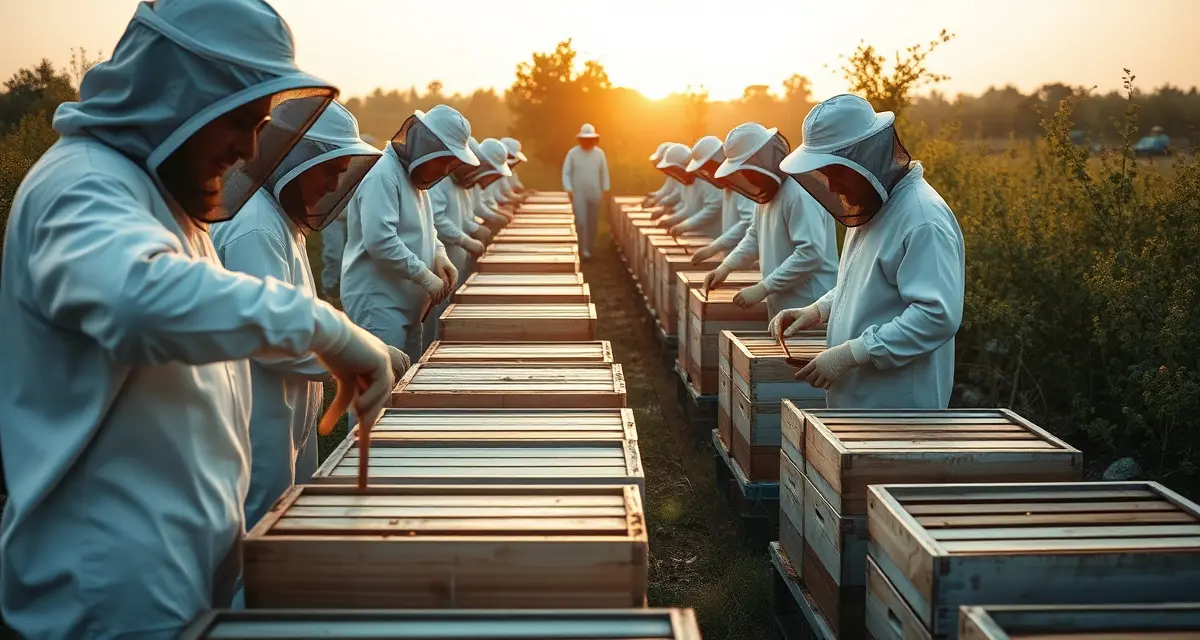
Seasonal Labor Management for Commercial Beekeeping Operations
Seasonal beekeeping workers are among the hardest agricultural employees to find and retain. The work is physically demanding, requires specific skills that take months to develop, involves unusual hours and locations, and competes for workers against every other agricultural employer in the region during the same peak weeks. Operators who solve their seasonal labor problem have a genuine operational advantage over those who're scrambling for crew every January.
H-2A visa workers are increasingly used by large commercial beekeeping operations to fill this gap. H-2A is a federal agricultural guest worker program that allows US employers to bring foreign nationals to the US for temporary agricultural work. The administrative burden is real, but for operations that can't reliably staff up from the domestic labor pool, it's often the most consistent solution.
TL;DR
- A 2-person crew can place 200-300 hives per day for almond delivery; a 1,000-hive operation requires 7-10 crew-days for a single crop placement.
- Seasonal beekeeping labor is in high demand during February-May pollination season; recruiting begins months in advance for well-run operations.
- Clear task assignment and documentation requirements for crew work reduce errors and create accountability for inspection and treatment records.
- OSHA requirements for outdoor agricultural work apply to commercial beekeeping crews, including sting response protocols and appropriate PPE.
- Payroll, workers' compensation, and H-2A visa compliance (for operations using seasonal agricultural workers) add administrative complexity that scales with crew size.
Understanding Your Seasonal Labor Cycle
Before you can manage seasonal labor well, you need to map your actual labor demand through the year. A migratory operation typically has:
Peak demand during almond season (January-March): Loading trucks, driving, placing hives, and doing mid-season yard checks requires maximum crew. This is also when competition for agricultural workers is highest, since almond harvest in the fall and other California crops run similar schedules.
Secondary peak during spring pollination moves (April-May): Moving colonies to blueberries, cherries, and other spring crops requires another intensive labor push.
Summer honey management (June-August): Regular yard visits, honey supers, and mite treatments require steady crew presence across multiple yard locations.
Fall prep and winter moves (September-November): Pulling honey, treating for mites, and moving to winter yards.
Employee management for beekeeping crews means having a plan for each of these periods rather than treating labor as a reactive problem.
Finding Seasonal Beekeeping Workers
The best seasonal beekeeping workers come from referrals. Workers who've done this work before know what they're getting into, can be trained faster, and are more likely to return the following year. Treat retention of experienced seasonal workers as a priority.
For finding new workers:
Agricultural labor contractors can supply crew for short-term peak needs but typically at higher cost and with less worker continuity than direct hires.
Beekeeping forums and industry networks are underused for labor recruitment. Other beekeepers sometimes have workers available between seasons, and posting in industry forums reaches people with relevant background.
Local community colleges with agricultural programs sometimes have students looking for practical experience. These workers need more training investment but can develop into excellent long-term crew members.
H-2A workers recruited through the program's established processes provide consistent, returning workers who know your operation's systems. The year-two H-2A worker is far more productive than the year-one H-2A worker.
Training Requirements
New seasonal workers need documented training before they work independently with colonies. Cover bee biology basics, sting response protocols (including emergency procedures for anaphylaxis), PPE use, hive inspection and manipulation, and operation-specific procedures.
Crew safety training is both a liability management requirement and a practical necessity. A crew member who gets stung through inadequate PPE or who doesn't know the correct way to screen a hive entrance before a night move creates problems that slow down your entire operation.
Document training completion. Workers should sign off on safety protocols and operational procedures. This documentation matters for workers compensation claims, OSHA inspections, and any accident investigations.
H-2A Workers for Commercial Beekeeping
H-2A allows you to bring workers from participating countries for temporary agricultural positions. The process involves filing with the Department of Labor, working with the State Workforce Agency, and handling visa processing. The typical lead time from application to worker arrival is 60 to 90 days.
H-2A housing and transportation requirements add overhead. You're responsible for providing or arranging housing that meets program standards and transportation from housing to work sites. For operators who are already managing remote operations, this is additional logistics but manageable.
The program's benefits are real for operations that commit to it: returning H-2A workers who know your operation, who have improved skills each season, and who provide a reliable labor base that doesn't disappear during peak weeks.
Retention Strategies
Keeping good seasonal workers returning year after year is worth real money. Operators who retain experienced crew have lower training costs, higher per-worker productivity, and fewer quality problems. Practical retention approaches include end-of-season bonuses tied to return commitments, off-season communication that keeps workers engaged, competitive wages relative to alternative agricultural employment, and safe, well-maintained equipment that signals you respect the work.
Frequently Asked Questions
How do you find seasonal beekeeping workers?
The most reliable source is referrals from current and past workers. Experienced beekeeping workers who liked working for you will refer their contacts. Beyond referrals, agricultural labor contractors can supply crew for short-term peaks, beekeeping industry forums reach experienced workers between seasons, and agricultural college programs produce motivated trainees. Large commercial operations increasingly use the H-2A visa program, which brings returning international agricultural workers who build familiarity with your operation over multiple seasons. No single approach solves the seasonal labor problem permanently; most operations use a combination of methods.
What training do seasonal beekeeping workers need?
New workers need training in bee biology and behavior, PPE selection and use, sting first aid and anaphylaxis emergency protocols, basic colony inspection and manipulation, hive transport and loading procedures, and your specific operational protocols. Training should be documented with worker sign-off. Workers should not work independently with colonies until they've demonstrated competency in the core skills, particularly safety-related ones. Plan for 2 to 5 days of supervised training before a new worker can handle yard work independently. Workers from agricultural backgrounds learn faster; workers with no agricultural experience need closer supervision initially.
How do you manage H-2A workers for commercial beekeeping operations?
H-2A management starts 90 days before you need workers with the Department of Labor application. You'll file a job order, get clearance from your State Workforce Agency, and then file visa petitions. Housing that meets program standards and transportation from housing to work sites must be arranged. Once workers arrive, management is similar to any seasonal employee, but with additional documentation requirements for the H-2A program. The return rate for H-2A workers in agriculture is high when workers are treated well and paid competitively. Building a core group of returning H-2A workers who come back season after season is the model that makes the program worthwhile for commercial beekeeping operations.
What is the difference between commercial and hobby beekeeping?
Commercial beekeeping is distinguished by scale (typically 100+ hives, often 500-5,000+), revenue source (pollination contracts and bulk honey sales rather than local honey retail), and management approach (systematic protocols applied across yards rather than individual colony attention). Commercial operators manage bees as an agricultural enterprise, with the administrative, regulatory, and logistical complexity that entails. Most commercial operators derive the majority of their income from pollination services; honey production is a supplementary revenue stream.
How many hives are needed to make commercial beekeeping a full-time income?
Most beekeeping economists put the full-time commercial threshold at 500-800 hives, assuming efficient operations management and a combination of pollination and honey revenue. At 500 hives and $200/hive for almond pollination, almond season alone generates $100,000 in gross revenue before expenses. Net margins depend on operational efficiency, but well-run operations can achieve 30-50% net margins on pollination revenue. Additional crops and honey production improve per-hive economics but require additional management capacity.
What is the annual revenue potential for a 1,000-hive commercial operation?
A 1,000-hive operation running an almond season ($200/hive) plus blueberry or apple contracts ($80-100/hive) plus summer honey production ($25-40/hive after extraction costs) can generate $300,000-360,000 in annual gross revenue. Net margins after transport, crew, equipment, and hive replacement costs typically run 25-40% for well-managed operations, putting net income at $75,000-145,000 annually. The specific number depends heavily on circuit efficiency, loss rates, and contract quality.
Try These Free Tools
Sources
- USDA Agricultural Research Service
- Bee Informed Partnership
- American Beekeeping Federation (ABF)
- USDA Farm Service Agency
Get Started with PollenOps
Crew management during peak season is one of the most operationally demanding aspects of commercial beekeeping. PollenOps coordinates crew scheduling with yard assignments and contract timelines so your team is always working on the right yards at the right time.