USDA Beekeeping Regulations for Interstate Hive Movement
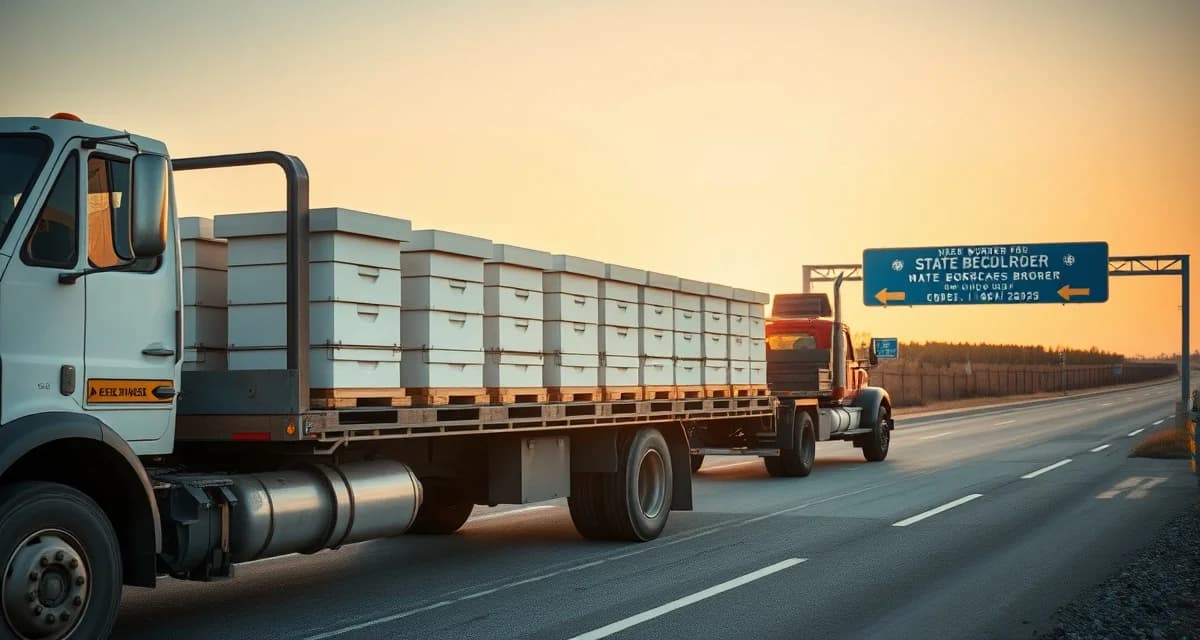
Missing a single state entry permit can strand a loaded truck at a state border. You've got 400 hives on a flatbed, fuel costs running $1,200 one-way from North Dakota to California, and a contract delivery date three days out. Getting turned back at the border because your health certificate lists the wrong county of origin isn't a paperwork headache, it's a $50,000 problem. Getting compliance right starts before the truck leaves the yard.
USDA APHIS regulates bee imports from other countries, but when it comes to moving colonies state-to-state, each state runs its own program independently. That means there's no single federal permit that covers interstate movement, you're dealing with a patchwork of 50 different systems, and the rules for a January run to California differ from what you'll face hauling to Maine in June for blueberries.
TL;DR
- Most states require annual apiary registration with a state agricultural agency before placing colonies for commercial purposes.
- Out-of-state operators entering for pollination contracts must register before hives land in most jurisdictions.
- California, Florida, and Texas have the most detailed entry requirements for commercial honey bees, including specific pest and disease certifications.
- State apiary inspectors focus on disease detection (AFB, EFB), pest management, and compliance with registration requirements.
- Permit and certificate requirements change periodically; verifying current requirements 30-60 days before planned entry prevents compliance failures.
What Federal Authority Actually Covers
USDA APHIS has jurisdiction over bee imports from other countries under the Honeybee Act. For domestic interstate movement, APHIS's role is limited, it sets guidelines and funds programs like the National Honey Bee Disease Survey, but the actual entry requirements are state law.
The one federal layer that matters for most commercial operators is the interstate movement permit system that some states have integrated with USDA programs. California, for instance, coordinates its entry requirements through CDFA but references USDA standards for disease identification. If you're moving bees into states with active pest exclusion programs, USDA-certified inspectors may need to sign off on health certificates.
USDA APHIS also controls treatment protocols for American Foulbrood. If your operation has ever had AFB confirmed by a federal lab, movement restrictions may apply regardless of state-level permits.
State-Level Entry Permits: The Real Compliance Layer
Every state that receives significant commercial hive traffic has some form of entry requirement. The specifics vary enormously. Some states require advance notification 72 hours before entry. Others want permits pulled 30 days out. A few states have online systems; some still require fax.
California (CDFA): The gold standard for entry requirements. You need a Certificate of Veterinary Inspection (CVI) issued by a licensed accredited veterinarian in your home state within 30 days of movement. The CVI must confirm the colonies are free from American Foulbrood, European Foulbrood, and other regulated pests. You also need a CDFA entry permit pulled online before crossing into California. County agricultural commissioners may have additional requirements for placement.
Oregon and Washington: Both require CVIs for incoming colonies. Washington State Department of Agriculture (WSDA) requires registration in the state if you're placing colonies for 30+ days. Oregon requires an Oregon Department of Agriculture import permit.
Florida: Florida Department of Agriculture and Consumer Services (FDACS) requires a health certificate and a Florida apiary registration if your colonies will remain in state beyond the initial transit period. Africanized bee regulations add another layer, colonies coming from AHB-positive counties in other states face additional scrutiny.
North Dakota and South Dakota: Both require health certificates. North Dakota requires a permit from the ND Department of Agriculture before entry. Given how many operations winter in the south and summer in the Dakotas for clover and sunflower honey, this is a high-traffic compliance requirement.
Getting the Health Certificate Right
The Certificate of Veterinary Inspection is issued by an accredited veterinarian, not your county extension agent, not your state apiarist unless they're also an accredited vet. The vet physically inspects a representative sample of your colonies. For a load of 400 hives, that doesn't mean inspecting all 400, but it means enough to certify the load is disease-free.
What inspectors look for: brood pattern abnormalities, AFB scale or ropiness, chalkbrood mummies, signs of EFB, Varroa levels, and small hive beetle pressure. Some states require a quantified Varroa mite wash monitoring result, not just visual assessment.
Get the inspection done in the 30-day window before your move. Most receiving states won't accept certificates older than 30 days; California specifically enforces this. If you're moving in a weather window that opens up faster than expected, don't skip the inspection, call your vet and get it done in the new timeframe.
What the CVI Must Include
- Operator name and address
- Source state and county of origin
- Number of colonies being moved
- Colony identification (yard location, tag numbers if applicable)
- Statement of disease-free status covering AFB, EFB, and other regulated pests
- Varroa treatment history in some states
- Vet's accreditation number and signature
- Date of inspection
Any errors, wrong county, missing colony count, expired date, give border inspectors grounds to reject the load. Double-check every field before you leave the yard.
Varroa Treatment Requirements Before Movement
Several states now require documentation of varroa treatment as a condition of entry, not just inspection. California does not currently mandate specific pre-entry varroa treatment, but the CDFA inspection process flags heavily infested loads, and colonies with Varroa counts above threshold can be refused entry or required to treat before placement.
Oregon requires a varroa management plan as part of commercial apiary registration. Washington inspectors can require treatment if colonies test above state threshold levels.
The practical advice: treat before you move, document it, and carry the treatment records with your CVI. Oxalic acid vaporization or Apivar strips with documented application dates and removal dates show inspectors you're running a managed operation. Varroa management at large scale requires a documented system, inspection records, treatment logs, mite wash results by yard. That paper trail protects you at the border and during contract inspections.
Apiary Registration in Destination States
Moving into a state for a pollination contract or a honey flow isn't a one-permit transaction in many states. If your colonies will be located in the state beyond a short transit period, typically 30 days, you may be required to register as an out-of-state beekeeper.
This is separate from the entry permit. Registration gives the state apiarist the ability to inspect your colonies during the season and notify you of disease issues in your area. For a migratory operation, you might carry active registrations in 4-6 states simultaneously during peak season.
States that actively enforce this for commercial operators: California, Washington, Oregon, Florida, Minnesota, and the Dakotas. Registration fees are generally modest, $10 to $75 depending on colony count, but operating without registration exposes you to fines and can complicate your contract compliance documentation.
Moving Through States vs. Moving Into States
There's an important distinction between transiting through a state versus placing colonies there. If you're hauling from Florida to California and passing through Texas and Arizona, those transit states generally don't require entry permits for bees that remain on the truck and don't stop.
If you stop and unload, even temporarily for rest or mechanical issues, that can trigger entry requirements. Know the rules for every state on your route, not just origin and destination. This matters especially on the I-10 corridor running through Texas and New Mexico, and on I-80 through Nevada.
Keep the truck moving when possible during transit. If you must stop overnight with hives on the truck, choose your stopping point with the state line in mind.
Yard Permits and Local Requirements
State entry permits don't substitute for county-level yard permits in states that require them. California is the primary example, many counties in the San Joaquin Valley require beekeepers to obtain a yard permit from the county agricultural commissioner before placing hives on a parcel. Some almond growers arrange this as part of the placement contract. Others leave it to you.
Confirm who's responsible for county permits before your contract is signed. A misunderstanding here can cost you a placement and a relationship.
Building a Compliance Checklist for Each Move
For every interstate movement, work through this in sequence:
- Destination state entry permit, apply at least 2 weeks out
- All transit state requirements reviewed
- CVI scheduled with accredited vet, inspection 7-14 days before move date
- Varroa treatment completed and documented if required
- Destination state apiary registration active or applied for
- County yard permits confirmed (California, Oregon)
- CDFA online permit pulled (California moves)
- All documents printed and in cab, originals, not copies, for some states
Run this checklist for every move. A platform like PollenOps that tracks your apiary registration requirements by state and flags permit renewal dates means this doesn't live only in your head or on a whiteboard in the shop.
What Happens If You Get Stopped
State agricultural inspection stations, the "Ag stations" on major routes into California, Arizona, and Florida, are staffed to check compliance. Commercial bee trucks get pulled in. Inspectors check your CVI, your entry permit, and colony count. If something's wrong, the options are: turn back, treat on-site if that's feasible, or have loads held while you sort documentation.
In California, the inspection stations on I-80, I-10, I-15, and US-395 all see significant hive traffic in January and February. Don't count on getting waved through.
Keep your cell phone charged and your vet's number accessible. If there's a documentation issue, a phone call that results in an emailed correction sometimes resolves it on the spot. Often it doesn't. The cost of being right the first time is a few hours of prep. The cost of getting turned back is a blown delivery date and a grower who calls someone else next year.
FAQ
What federal permits are required to move bees across state lines?
There's no single federal permit for domestic interstate movement. USDA APHIS governs imports from other countries but each state independently controls what's required for colonies entering from another US state. Your federal compliance obligation is primarily ensuring your colonies meet USDA-recognized disease-free standards as documented in your Certificate of Veterinary Inspection.
Which states require health certificates for incoming colonies?
Most major receiving states for migratory beekeeping require CVIs, including California, Oregon, Washington, Florida, Minnesota, North Dakota, and South Dakota. California's requirements are the most stringent and well-enforced, requiring a CVI issued within 30 days of movement plus a CDFA online entry permit. Check with each destination state's department of agriculture 6-8 weeks before your planned move date, requirements can change.
How do you get an apiary inspection before interstate movement?
Contact an USDA-accredited veterinarian in your home state, not just any vet, specifically one holding accreditation. Some state apiarists also hold accreditation and can issue CVIs directly. Schedule at least 2-3 weeks before your move to allow time for the paperwork to be issued and mailed. The inspection itself typically takes a few hours for a large load and involves examination of representative colonies for disease signs, brood health, and varroa pressure.
What is the process for registering an out-of-state apiary in a new state?
Most states require out-of-state operators to register with the state department of agriculture apiary program before placing colonies. The process typically involves submitting a registration application (online or paper), paying a fee (usually $10-50 per location), and providing contact information for the operation. Some states also require the registration to be renewed annually. Contact the destination state's department of agriculture apiary program at least 60 days before your planned arrival to confirm current requirements.
What documentation do state apiary inspectors typically review?
State apiary inspectors review health certificates for out-of-state colonies, registration documentation, and colony inspection records during apiary visits. Inspectors check for signs of American foulbrood, European foulbrood, and other regulated pests and diseases. Operations with organized digital records that include treatment history and mite counts typically have faster, less complicated inspections than operations without documentation. Some state inspectors also verify that varroa mite loads are below state entry thresholds.
What triggers a state apiary inspection?
State apiary inspections can be triggered by routine inspection schedules (most states inspect a percentage of registered apiaries annually), neighbor or landowner complaints, disease reports from nearby operations, or inspection requirements tied to state entry permits. California, in particular, has the right to inspect incoming loads at port of entry for commercial beekeeping operations. Maintaining current registration and organized records makes required inspections faster and less disruptive.
Try These Free Tools
Sources
- USDA Agricultural Research Service
- Bee Informed Partnership
- American Beekeeping Federation (ABF)
- USDA Animal and Plant Health Inspection Service (APHIS)
- National Association of State Departments of Agriculture
Get Started with PollenOps
Navigating state apiary registration and permit requirements across a multi-state circuit adds administrative complexity to an already demanding operation. PollenOps tracks permit status and documentation requirements alongside your contract and yard records so compliance doesn't fall behind operational demands.