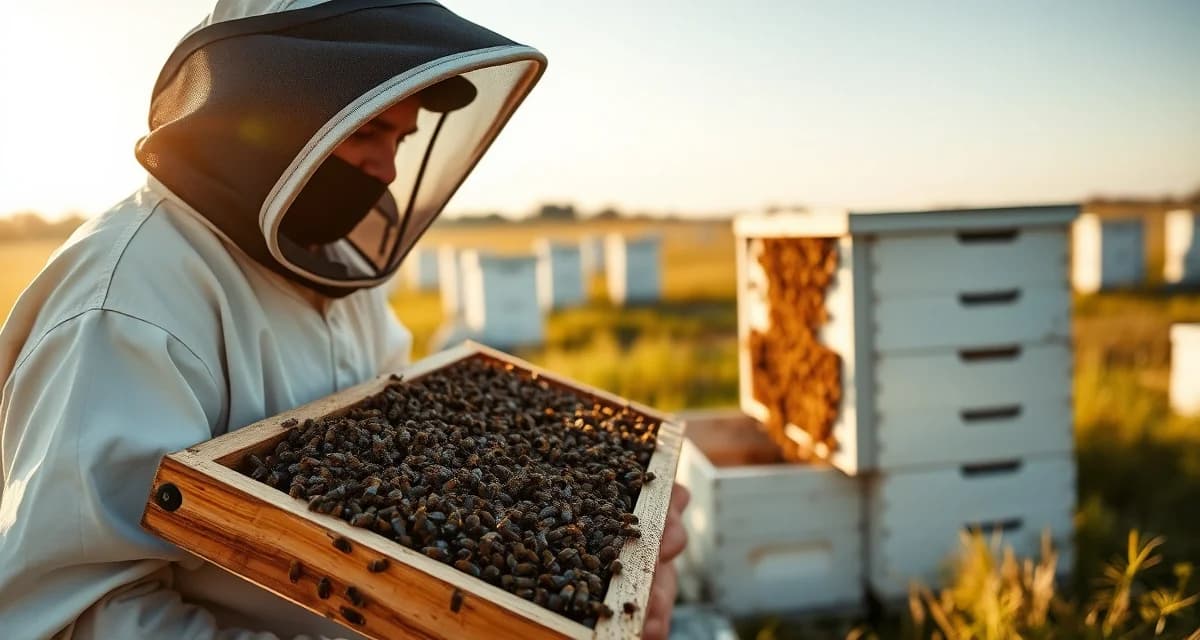
What Is Commercial Beekeeping?
There are approximately 2,800 commercial beekeeping operations in the US managing over 100 hives each. These are the operations that pollinate the country's crops, produce bulk honey for national brands, and form the backbone of American food production's pollination infrastructure.
Commercial beekeeping means managing bees as a business. It's different from hobby beekeeping in scale, intent, and management approach. A hobby beekeeper maintains a few hives for personal interest or small-scale honey production. A commercial beekeeper manages colonies as productive assets generating revenue through pollination services, honey production, or both.
TL;DR
- Commercial beekeeping operations face two primary management challenges: operational logistics (hive health, transport, placement) and administrative coordination (contracts, payments, documentation).
- Most disputes and revenue losses in commercial beekeeping are preventable with better documentation and clearer contract terms.
- The operations that run most profitably are those with disciplined systems for tracking hive health, contract status, and fleet logistics in one place.
- PollenOps is built specifically for the operational complexity of commercial-scale pollination services, not adapted from a hobbyist tool.
- The most important management decisions (treatment timing, contract renewal, hive allocation) require accurate current data to make well.
What Commercial Beekeepers Do
Pollination services: The primary revenue source for most large commercial operations. Growers hire beekeepers to place colonies in their fields and orchards during bloom. The bees pollinate the crop; the grower pays a per-hive rental fee. California almonds, which require over 1.5 million hive rentals annually, are the largest single pollination market.
Honey production: Many commercial operations produce bulk honey for sale to packers and brokers, or premium varietal honey for direct-to-consumer and specialty retail markets. Operations in North Dakota, Montana, and other Northern Plains states often run honey-focused models.
Package bee and queen production: Some commercial operations rear and sell queen bees or package bees to hobbyists and other beekeepers. This is a specialized market that requires different genetics and facilities.
Most large commercial operations combine pollination and honey production, with pollination typically generating the majority of revenue.
How Many Hives Does a Commercial Beekeeper Need?
There's no official threshold, but the commercial beekeeping community generally considers 100+ hives to be the minimum for commercial-scale operations. At that count, the operation is complex enough to require professional management systems and large enough to generate meaningful revenue.
Typical commercial operation sizes:
- 100-300 hives: Small commercial, typically single-person operation. Full-time income is possible but tight, usually requiring multiple revenue streams.
- 300-1,000 hives: Mid-size commercial. Typically requires 1-3 employees at peak season. This range covers most commercial operations in the US.
- 1,000-5,000 hives: Large commercial. Multi-employee operations with dedicated trucks and crew. Professional contract management is essential at this scale.
- 5,000+ hives: Industrial scale. The largest US operations run 30,000-80,000 hives and are major logistics and agricultural enterprises.
What Licenses Do You Need?
Requirements vary by state, but most commercial beekeepers need:
State apiary registration: Most states require annual registration of your hive count and location. This is typically free or low-cost and administered by the state department of agriculture.
Interstate movement permits: If you move hives across state lines (as most commercial operations do), each destination state typically requires an entry permit and a certificate of health from your home state's apiarist.
Business licenses: Like any business, you'll need a standard business license in your operating state. If you operate as an LLC or corporation, you'll need those entity registrations as well.
Sales tax permits: If you sell honey at retail, you'll need to collect and remit sales tax in the states where you sell.
Some states have additional requirements for commercial operations (pesticide applicator licenses, food facility registration for honey packers), but the core requirements above apply in most states.
The Business Model
Commercial pollination beekeeping runs on contracts. You negotiate with growers for the coming season, commit to delivering a specified number of strong colonies during bloom, deliver and manage the hives, and invoice after delivery.
Revenue is straightforward: hive count × per-hive rate × number of placements per season. A 500-hive operation earning $200/hive in almonds and $100/hive in spring blueberries grosses $100,000 + $50,000 = $150,000 per season before expenses.
Operating a professional commercial pollination business requires tools for contract management, compliance documentation, and colony health tracking. PollenOps is built specifically to support commercial beekeepers at every scale, from a getting started guide for how to use PollenOps through full enterprise contract management.
Frequently Asked Questions
How many hives do you need to be a commercial beekeeper?
Most commercial beekeepers manage at least 100 hives, though the threshold is somewhat arbitrary. At 100+ hives, the operation is complex enough to require professional systems and large enough to generate meaningful income. In practice, the commercial/hobby distinction is more about intent and approach than a strict hive count. An operation of 50 hives managed as a serious business with contracts, professional documentation, and a growth plan is more "commercial" than a 200-hive operation maintained casually. For practical purposes, operations above 100 hives that depend on beekeeping income and work with growers under contract are commercial operations.
What is the difference between hobby beekeeping and commercial beekeeping?
Hobby beekeeping involves maintaining a small number of hives (typically 1-20) for personal interest, local honey production, or small-scale sales. Commercial beekeeping manages colonies as productive business assets generating revenue through pollination contracts, bulk honey sales, or queen production. Commercial operations manage scale (100+ hives) and complexity (multiple yards, multiple states, employee management) that hobby beekeeping doesn't face. Commercial beekeepers use professional software systems for contract management, compliance documentation, and colony health tracking. Hobby beekeepers typically use basic inspection log apps or paper notebooks. The management requirements, business infrastructure, and regulatory obligations are fundamentally different at commercial scale.
What licenses do I need to start a commercial beekeeping operation?
You need state apiary registration (required in most states, typically free and annual), a standard business license for your operating state, and interstate movement permits and health certificates if you operate across state lines. If you sell honey at retail, you'll need sales tax collection permits. If you pack honey for sale (as opposed to selling in bulk), many states require food facility registration. Additional requirements vary by state and can include pesticide applicator licenses, county-level permits in some agricultural areas, and specific registration for operations above certain hive counts. The state department of agriculture in your home state is the starting point for understanding your specific requirements.
What is the difference between commercial and hobby beekeeping?
Commercial beekeeping is distinguished by scale (typically 100+ hives, often 500-5,000+), revenue source (pollination contracts and bulk honey sales rather than local honey retail), and management approach (systematic protocols applied across yards rather than individual colony attention). Commercial operators manage bees as an agricultural enterprise, with the administrative, regulatory, and logistical complexity that entails. Most commercial operators derive the majority of their income from pollination services; honey production is a supplementary revenue stream.
How many hives are needed to make commercial beekeeping a full-time income?
Most beekeeping economists put the full-time commercial threshold at 500-800 hives, assuming efficient operations management and a combination of pollination and honey revenue. At 500 hives and $200/hive for almond pollination, almond season alone generates $100,000 in gross revenue before expenses. Net margins depend on operational efficiency, but well-run operations can achieve 30-50% net margins on pollination revenue. Additional crops and honey production improve per-hive economics but require additional management capacity.
What is the annual revenue potential for a 1,000-hive commercial operation?
A 1,000-hive operation running an almond season ($200/hive) plus blueberry or apple contracts ($80-100/hive) plus summer honey production ($25-40/hive after extraction costs) can generate $300,000-360,000 in annual gross revenue. Net margins after transport, crew, equipment, and hive replacement costs typically run 25-40% for well-managed operations, putting net income at $75,000-145,000 annually. The specific number depends heavily on circuit efficiency, loss rates, and contract quality.
Try These Free Tools
Sources
- USDA Agricultural Research Service
- Bee Informed Partnership
- American Beekeeping Federation (ABF)
- American Honey Producers Association
- Project Apis m.
Get Started with PollenOps
Managing a commercial beekeeping operation involves more data, more deadlines, and more moving parts than any general-purpose tool was designed to handle. PollenOps brings contracts, yard records, health documentation, and fleet logistics together in one platform built for the realities of commercial-scale beekeeping.