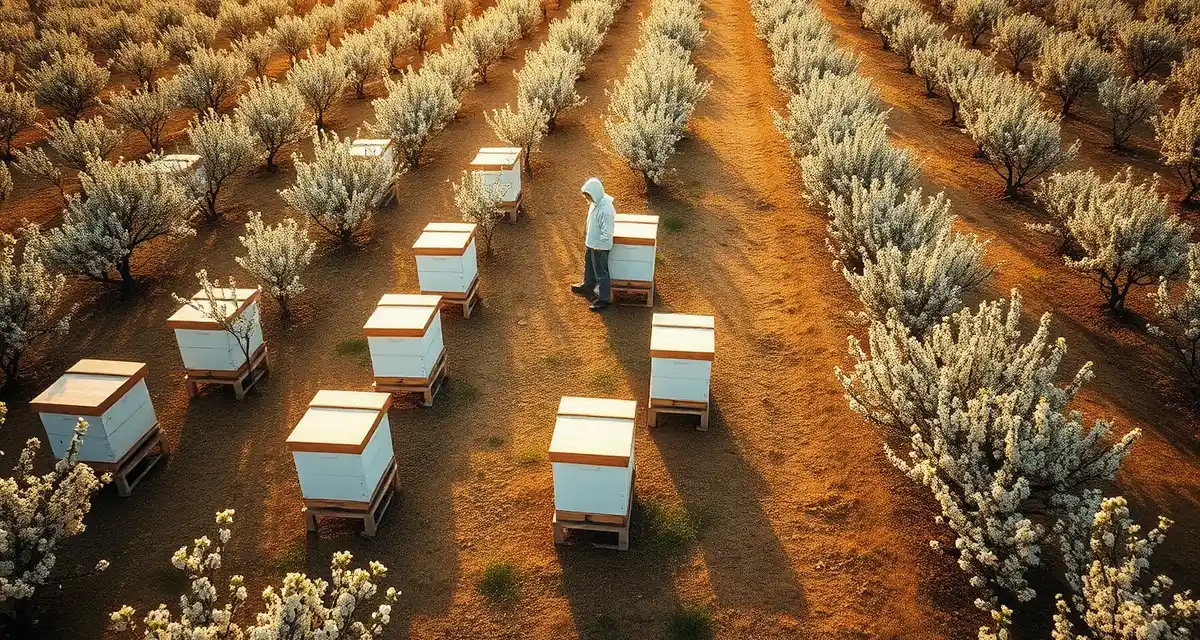
Almond Beekeeper Hive Placement Strategy
Incorrect hive spacing in almond orchards reduces effective pollination by up to 25 percent per acre. Placement isn't just about meeting the contracted hive count. It's about positioning hives so that forager distribution across the orchard maximizes the cross-pollination that drives fruit set. A beekeeper who delivers the right number of hives in the wrong configuration is leaving yield on the table and may be setting up a dispute if the grower notices patchy fruit set in improperly served blocks.
PollenOps placement map confirms per-acre density compliance before you leave the orchard, creating a GPS-documented record of where each cluster of hives was positioned. This documentation serves both as proof of service and as a planning tool for improving placement geometry across multiple contracts.
TL;DR
- California almond pollination consumes roughly 80% of the US commercial hive population every February, making it the most supply-constrained pollination market in the country.
- Per-hive rates have held between $185 and $220 for 6-8 frame colonies over recent seasons.
- Contracts are typically signed October through November for the following February season; operators without agreements by December are working from a weak position.
- Hive strength minimums range from 6 to 8 frames of bees depending on the grower, with premium-strength colonies commanding $200-215/hive.
- varroa management, documentation, and logistics coordination in the 6-8 weeks before delivery determine whether almond season is profitable or a breakeven event.
Almond Pollination Biology and Why Placement Geometry Matters
Almond is fully self-incompatible, meaning each variety requires pollen from a different variety to set fruit. Nonpareil (the dominant commercial variety) requires pollen from Butte, Padre, Carmel, or another pollenizer variety to produce a crop. Every bee that carries pollen from a pollenizer row to a Nonpareil flower is providing direct commercial value.
Forager range from a hive under commercial foraging conditions is typically 1 to 2 miles for pollen and nectar, but effective cross-pollination declines with distance from the hive. Practical pollination efficiency is highest within 300 to 500 meters of the hive and drops off progressively beyond that. Placing all your contracted hives in a single cluster at one corner of a 100-acre orchard gives the adjacent block excellent coverage and the far blocks inadequate coverage, regardless of how strong your colonies are.
Uniform distribution across the orchard maximizes the forager overlap that drives cross-pollination efficiency. This means not just per-acre compliance but geometric distribution that ensures no part of the orchard is more than 300 to 400 meters from a hive cluster.
Optimal Hive Arrangement Within an Almond Orchard
The standard industry practice is to distribute hives in clusters of 4 to 8 units at evenly spaced intervals throughout the orchard rather than in large concentrated groups. Cluster size and spacing depend on the contracted hive density and the orchard's geometry:
For a 100-acre rectangular orchard at 2 hives per acre (200 hives): Distribute clusters of 6 to 8 hives at approximately 4 to 6 locations spaced through the orchard, with the goal of no point in the orchard being more than 400 meters from a cluster.
For odd-shaped or fragmented orchards: Identify the orchard's "dead zones" (areas that would be underserved by a regular grid placement) and position clusters specifically to cover those areas.
Edge placement vs. interior placement: Some growers specify edge placement along access roads for logistical convenience. Edge placement serves adjacent blocks well but may underserve the orchard's interior. If edge placement is required by the grower's access constraints, negotiate for additional interior placements or acknowledge the coverage limitation in writing.
What the Correct Distance Between Clusters Should Be
For standard almond density of 2 hives per acre, clusters should be spaced roughly 400 to 600 meters apart to ensure adequate forager overlap across the entire orchard footprint. At higher densities (3 hives per acre), cluster spacing can be tighter because the denser population fills coverage gaps.
In practice, row spacing, access road availability, and grower preferences constrain your ideal geometric placement. Work with the constraints but document any placement that deviates from ideal geometry. If the grower's required placement configuration creates coverage gaps, document that in writing so a poor fruit set outcome doesn't become your liability.
The rule of thumb: no part of the orchard should be more than 400 meters from the nearest hive cluster. Walk or drive the orchard after placement to confirm this coverage standard before you leave.
Documenting Hive Placement for California Almond Contracts
The PollenOps hive placement mapping tool generates a GPS-verified placement record that shows the location of each cluster on the orchard map. This documentation serves multiple purposes:
Contract compliance proof: If a grower claims you delivered fewer hives than contracted or placed them incorrectly, the GPS placement map is your authoritative record.
Density compliance verification: The system calculates the per-acre density from your GPS placements and the contracted orchard acreage, confirming you met the contractual density requirement.
Delivery report generation: The placement map is included in the automated grower delivery report sent within an hour of placement completion, giving the grower a documented record of where their hives are and what density was achieved.
For large multi-orchard operations, the placement documentation also becomes your own route planning resource. Knowing exactly where each cluster was placed at every contract in your portfolio allows you to optimize cluster positioning for sequential placements in the same orchards across seasons.
Placement Access and Grower Coordination
Coordinate placement timing and access with the grower before delivery day. Know which access gates are open, who has the keys, where the approved parking is for your truck and forklift, and what the grower's preferences are for cluster positioning within the rows.
Many growers have strong preferences about row placement. Some want hives on the west side of rows for shade access in afternoon heat. Others want specific cluster positions based on their orchard irrigation infrastructure or spray program logistics. Honoring these preferences without being asked is noticed and appreciated.
Never place hives without grower notification, even in your contracted timing window. A driver who arrives at 3:00 AM and places 200 hives without calling the grower first creates an unnecessary anxiety event, even if the placement is perfect. Notify the grower's contact before or immediately upon placement completion.
Frequently Asked Questions
How should I arrange hives within an almond orchard for maximum coverage?
Distribute hives in clusters of 4 to 8 units at evenly spaced intervals throughout the orchard, aiming for no point in the orchard being more than 400 meters from a cluster. Large concentrated groups at one end of the orchard create excellent coverage nearby but inadequate coverage at the far end regardless of colony strength. PollenOps placement mapping tools show your cluster positions on the orchard GPS map and calculate per-acre density compliance, allowing you to verify your coverage geometry before leaving the site.
What is the correct distance between hive clusters in a large almond block?
For standard 2-hive-per-acre almond density, cluster spacing of 400 to 600 meters achieves reasonable forager overlap across the orchard. Higher density placements (3 hives per acre) allow somewhat tighter cluster spacing. Odd-shaped or fragmented orchards require custom cluster positioning to eliminate dead zones rather than applying a regular grid. Walk or drive the orchard after placement to confirm that no significant area is more than 400 meters from a cluster before you leave the site.
How do I document hive placement for a California almond contract?
Get Started with PollenOps
Almond season is the revenue event that defines the commercial beekeeping year, and the details -- contract terms, delivery timing, hive strength documentation, and invoicing -- determine whether the season is profitable. PollenOps manages the full almond contract lifecycle from quote to final payment, with yard tracking, crew scheduling, and grower communication built in. See how it works for operations from 200 to 5,000 hives.
How early should almond pollination contracts be negotiated?
Large almond growers and broker networks begin securing hive commitments in July and August for the following February season. Written contracts are typically signed October through November. Operators who do not have signed agreements by December are working from a weak position since most quality hive inventory is already committed. Start grower outreach in mid-summer and target signed agreements before Thanksgiving.
What documentation is required for hive delivery to California almonds?
California requires a Certificate of Health for out-of-state colonies, issued by the origin state's apiary inspection program within 30 days of entry. The certificate must certify freedom from American foulbrood, European foulbrood, and Varroa destructor below treatment threshold. Some states require small hive beetle freedom for California entry. In addition, many growers now expect documentation of pre-delivery mite counts confirming colonies are below threshold.
What happens to hives after almond season ends in late March?
Post-almond options include moving north for Pacific Northwest cherry or apple pollination in April-May, routing to Michigan or Maine blueberries in May-July, transitioning to summer honey yards in North Dakota or Montana, or staying in California for splits and rebuilding. The right choice depends on hive strength coming out of almonds and downstream contract commitments. Operators who plan their full-year circuit in advance can optimize both pollination revenue and honey production.
Try These Free Tools
Sources
- USDA Agricultural Research Service
- Bee Informed Partnership
- American Beekeeping Federation (ABF)
- Almond Board of California
- University of California Cooperative Extension